
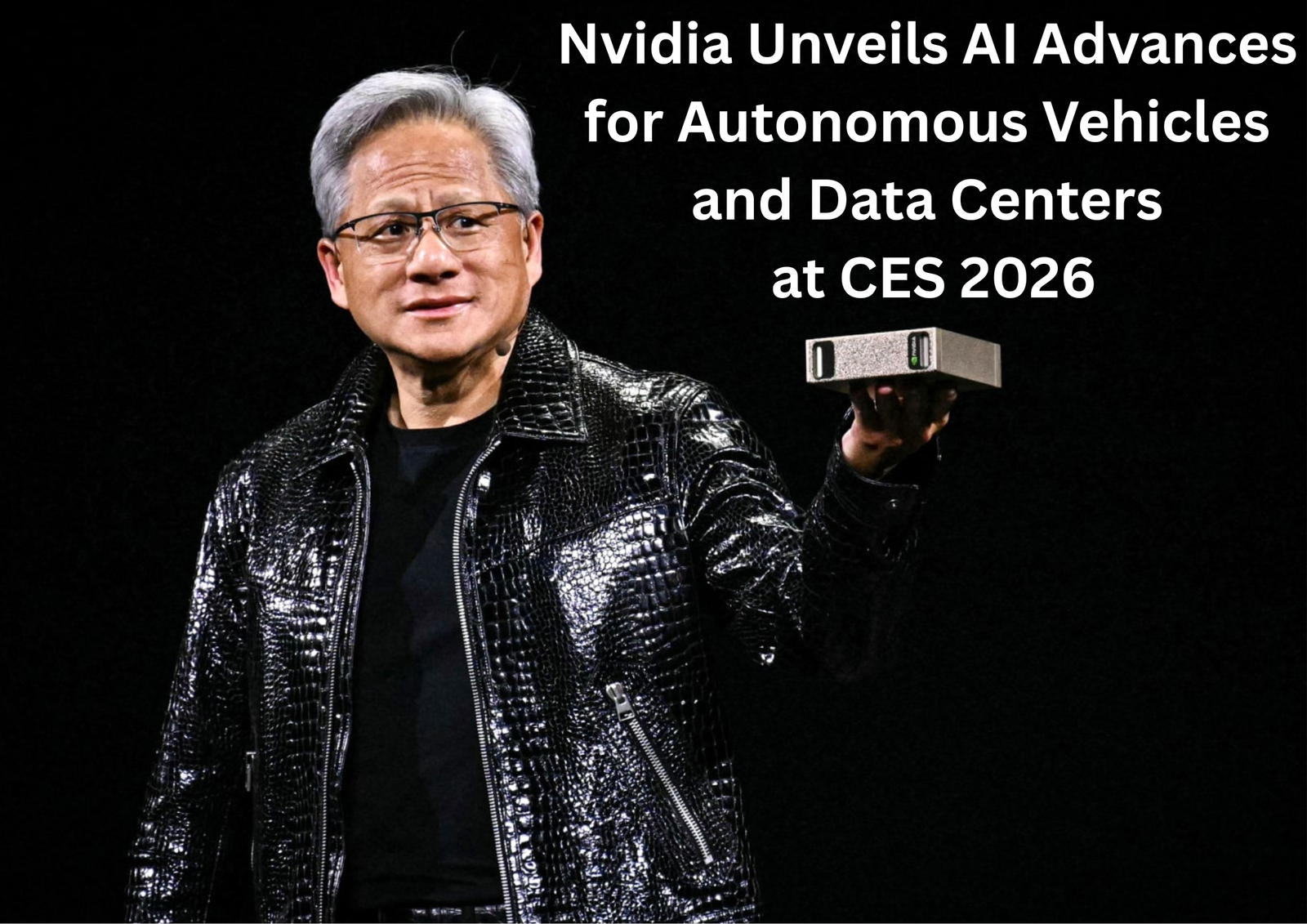
Nvidia used the global stage at CES 2026 to reveal major developments that could reshape both autonomous transportation and large-scale artificial intelligence infrastructure. Speaking at the annual technology showcase, CEO Jensen Huang outlined the company’s latest advances in self-driving intelligence and confirmed production timelines for its next-generation AI computing platform.
As the most valuable publicly traded company in the world, Nvidia is positioning itself not only as a chip manufacturer but as a full-stack AI platform provider spanning vehicles, robotics, and cloud computing.
A New Step Toward Smarter Self-Driving Cars
One of the headline announcements was Alpamayo, a newly introduced AI system designed to enhance how autonomous vehicles interpret and respond to complex real-world situations. According to Nvidia, the platform enables vehicles to reason through uncommon or unpredictable driving scenarios while clearly explaining the decisions they make.
During the presentation, Nvidia demonstrated the technology using a driverless Mercedes-Benz navigating city streets with smooth, human-like behavior. The system, trained directly from human driving demonstrations, showed an ability to adapt naturally to traffic conditions rather than relying solely on rigid rules.
Nvidia confirmed it has already begun manufacturing a driverless version of the Mercedes-Benz CLA equipped with its technology. The vehicle is expected to launch in the United States within months, followed by international markets later in the year. The company also disclosed plans to introduce a robotaxi service in partnership with another firm, with a target launch next year.
Open Access to Autonomous AI Development
In a move welcomed by researchers and developers, Nvidia announced that Alpamayo will be released as an open-source model. Its core framework will be freely available through the AI development platform Hugging Face, allowing engineers and academic teams to customize and retrain the system for their own autonomous vehicle projects.
Industry analysts say this strategy strengthens Nvidia’s influence by encouraging widespread adoption of its AI ecosystem, shifting the company further away from being just a hardware supplier.
Vera Rubin Platform Enters Production
Alongside automotive updates, Nvidia provided new details about its upcoming Vera Rubin AI platform, designed to power the next generation of data centers. The company confirmed that Vera Rubin chips are already in production, with commercial systems expected to ship in the second half of 2026.
Nvidia claims the platform delivers major efficiency gains, allowing AI models to be trained with significantly fewer chips while reducing operating costs. Compared to the previous Blackwell generation, Vera Rubin systems are designed to lower energy usage and streamline data center deployment through simplified hardware architecture.
Designed for the Era of AI Agents
As AI applications evolve beyond simple chat interfaces, Nvidia says computing challenges are shifting toward managing large volumes of contextual information. To address this, Vera Rubin introduces a redesigned storage and memory system that enables faster handling of complex, multi-step AI tasks.
One upcoming configuration, the Vera Rubin NVL72 server rack, is engineered to deliver unprecedented bandwidth for large-scale AI workloads. Nvidia emphasized that future AI systems-often referred to as “AI agents”-will rely heavily on this type of architecture to perform reasoning, planning, and task execution efficiently.
Competition and Market Pressure Grow
The announcements come at a time when Nvidia faces increasing competition from both established rivals and major technology firms developing their own custom chips. While companies such as Microsoft, Amazon Web Services, Google Cloud, and CoreWeave are expected to be among the first adopters of Vera Rubin, others are actively seeking alternatives to reduce dependence on a single supplier.
Despite these pressures, Nvidia executives remain confident that demand for AI infrastructure will continue to grow as organizations redirect traditional computing budgets toward artificial intelligence development.
Looking Ahead
With Alpamayo targeting autonomous mobility and Vera Rubin focused on large-scale AI computation, Nvidia is expanding its reach across multiple sectors simultaneously. The company’s strategy highlights a broader shift in the tech industry-where intelligence, efficiency, and platform integration are becoming as critical as raw computing power.
As AI adoption accelerates worldwide, Nvidia’s latest announcements suggest the company intends to remain at the center of that transformation well into the next decade.
Don’t miss the full analysis of “Zelenskyy Initiates Security Leadership Overhaul With Removal of SBU Chief”-read this blog to understand the power shifts shaping Ukraine’s security future.