
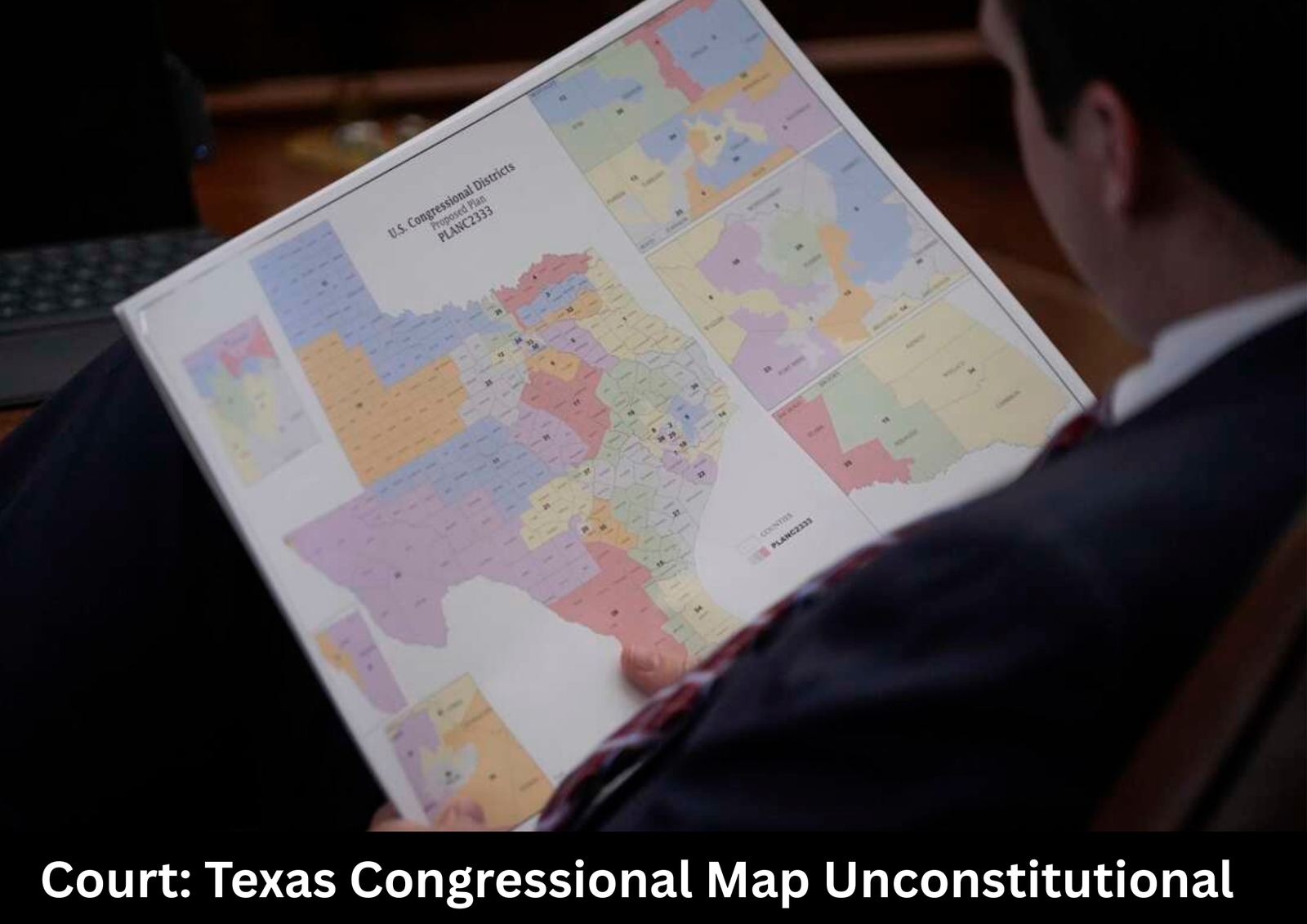
A federal three-judge panel has invalidated Texas’s congressional district map, ruling that the state’s boundaries illegally weakened the political influence of Black and Hispanic voters. The decision, released Wednesday, blocks the use of the current map in upcoming elections and requires lawmakers to produce a new version that complies with constitutional and voting rights standards.
Court Says Minority Communities Were Intentionally Undermined
The judges determined that the 2021 map-drawn by a Republican-controlled legislature-relied on race as a primary tool to manipulate voting districts. According to the ruling, mapmakers split fast-growing minority populations across multiple districts (“cracking”) and heavily concentrated others into a small number of seats (“packing”), reducing their ability to influence election results statewide.
Civil rights organizations and voters of color led the legal challenge, arguing that lawmakers disguised racial gerrymandering as a partisan strategy. Evidence presented in court showed that race, not party preference, shaped key district lines-violating the Equal Protection Clause of the Fourteenth Amendment.
Ripple Effects Across the National Redistricting Battle
The ruling marks a major win for voting rights advocates and could reshape the political landscape in one of the nation’s most influential states. A redrawn map may create more competitive districts and expand opportunities for minority communities to elect candidates of their choice.
The decision also fits into a national trend of courts scrutinizing racially discriminatory redistricting practices. It follows a notable Supreme Court ruling involving Alabama, which reaffirmed protections against racial gerrymandering under the Voting Rights Act.
Texas Attorney General officials have already announced plans to appeal the decision directly to the U.S. Supreme Court, setting up another high-stakes confrontation over voting rights and representation.
What Happens Next
With the 2026 election cycle approaching, the timeline is tight. The Texas legislature must either adopt a lawful replacement map or risk having the court implement its own version. The outcome will influence not only Texas’s political balance but also the broader legal framework governing how states draw their congressional districts.
The final decision from the Supreme Court-should it take the case-could establish a defining precedent for future redistricting battles across the United States.