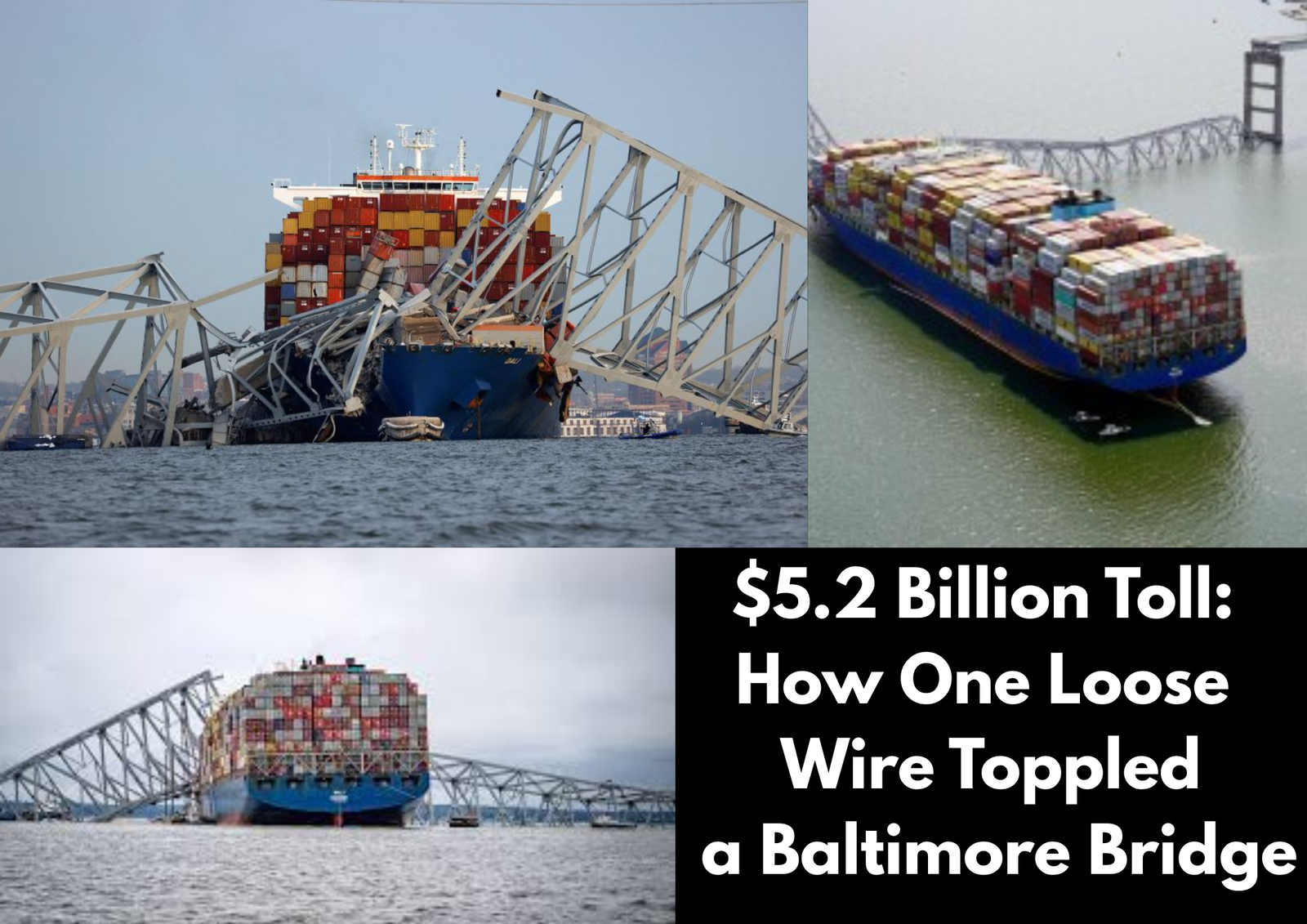
Federal investigators have concluded that a single loose wire deep inside an electrical panel on the cargo ship Dali triggered the catastrophic power failures that led to the destruction of Baltimore’s Francis Scott Key Bridge. The National Transportation Safety Board (NTSB) announced its final findings on Tuesday, closing a year-long investigation into one of the most consequential maritime accidents in recent U.S. history.
A Small Fault With Massive Consequences
According to the NTSB, the loose wire caused the ship to suddenly lose power just moments before it was scheduled to travel beneath the bridge on March 26, 2024. The malfunction shut down propulsion and steering systems simultaneously, leaving the crew unable to control the vessel. Although the crew temporarily restored electricity, the same fault triggered a second blackout minutes later-this time irreversible.
Investigators clarified that the crew acted appropriately during the emergency and were not responsible for the electrical failure. The report emphasized that the faulty wire created a cascading series of electrical breakdowns that were impossible for the crew to address while the ship was already underway.
Impact and Collapse
With no ability to maneuver, the Dali drifted into one of the Key Bridge’s main support columns. The collision caused a near-total collapse of the 1.6-mile span into the Patapsco River, cutting off a critical roadway and temporarily disrupting operations at the Port of Baltimore.
Six construction workers performing overnight road maintenance on the bridge were killed in the incident, turning the disaster into both a transportation crisis and a tragic loss of life.
Economic Fallout
Maryland officials estimate the financial toll of the collapse at up to $5.2 billion, factoring in the cost of rebuilding the structure, supply chain disruptions, and long-term economic impacts on regional commerce. The Key Bridge had served as a vital bypass for commuters and freight traffic, making its loss immediately felt across the state.
Rebuilding the Key Bridge
Plans for a replacement structure are now moving forward, though with higher costs and a longer construction timeline than initially anticipated. Current projections estimate a total price between $4.3 billion and $5.2 billion, roughly double early estimates. State transportation leaders expect the new bridge to be completed by fall 2030, with traffic resuming shortly afterward.
Preparatory work along the river has been underway for months, as crews remove debris and stabilize the surrounding area to make way for full construction activities.
Investigation Concludes, Recovery Continues
With the NTSB’s final report now complete, attention turns fully toward rebuilding and restoring normal operations around the Port of Baltimore. Recovery teams continue clearing remnants of the collapsed bridge from the waterway, while engineers finalize design details for the future span.
The scandal-free conclusion-that a loose wire, not human error, triggered the disaster-brings closure to a year of speculation surrounding the ship’s crew and systems. For Maryland residents and port operators, however, the long road to full recovery is only just beginning.