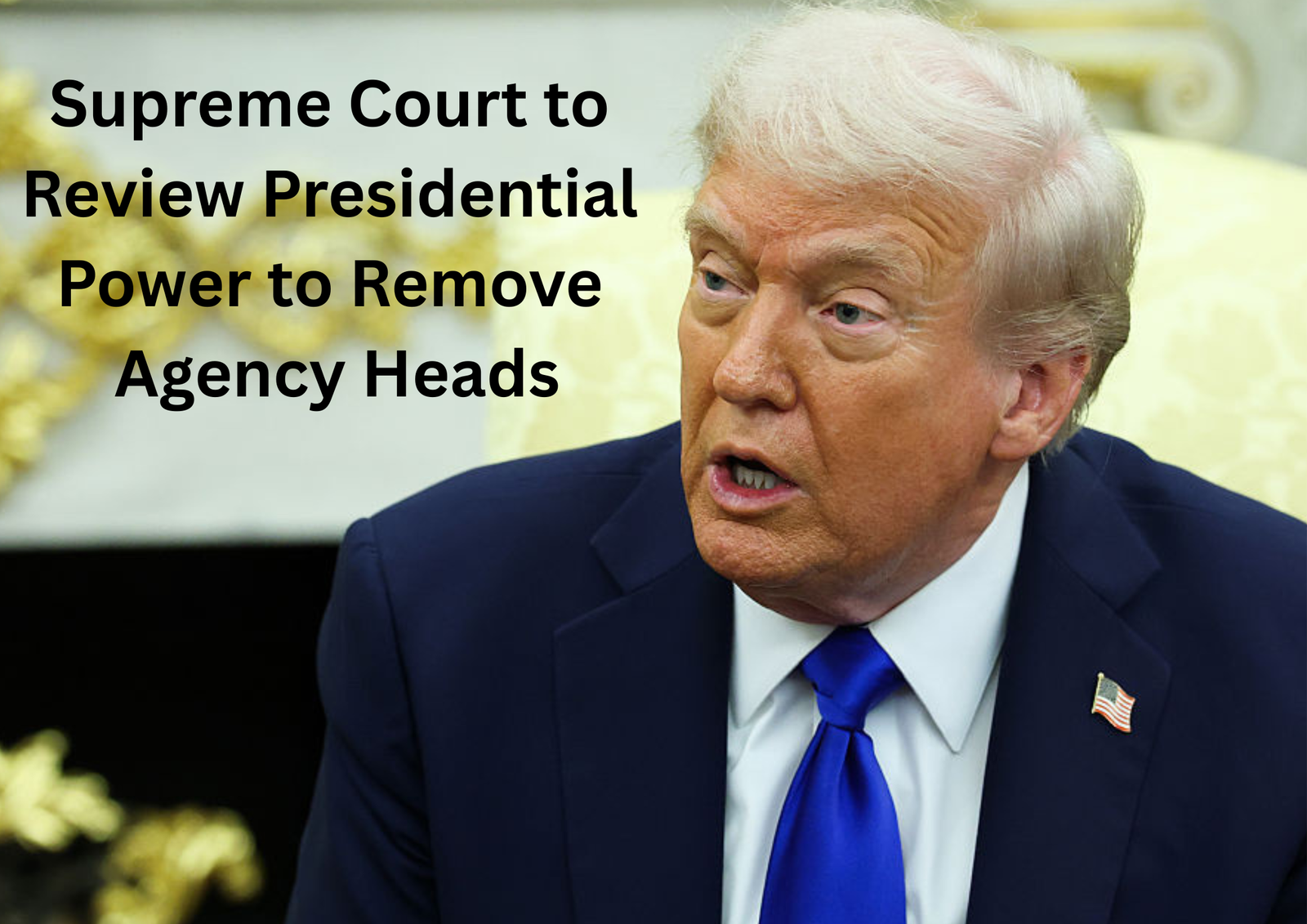
The U.S. Supreme Court has agreed to reopen a long-standing constitutional debate over how much authority a president holds in removing the leaders of independent federal agencies. The decision could dramatically alter the balance of power between the White House and key regulatory bodies across the federal government.
At the center of the case is a legal challenge rooted in dismissals that took place during the political transition following Donald Trump’s return to office. Several employees at the U.S. Agency for Global Media (USAGM) were removed from their positions shortly after the 2024 election, sparking lawsuits over whether those firings were lawful under existing civil service protections.
Lower courts initially blocked the administration from immediately replacing the agency’s leadership, citing a nearly century-old Supreme Court ruling that limits a president’s ability to freely dismiss officials at certain independent agencies. That precedent, established in the 1935 decision of Humphrey’s Executor v. United States, created protected status for agency leaders deemed to operate in a “quasi-legislative” or “quasi-judicial” role.
Now, federal attorneys are urging the Court to overturn that interpretation. The Justice Department argues that such restrictions interfere with the president’s constitutional duty to oversee the executive branch and ensure accountability. In its filing, the department maintained that allowing agency heads to operate beyond direct presidential control weakens democratic responsibility.
The Supreme Court will hear the dispute under the banner of Myers v. United States, a decision that predates the 1935 ruling and supports broad presidential removal authority. Legal scholars say the outcome could reshape how future presidents manage independent agencies.
A reversal would affect a wide range of powerful regulators, including the Federal Communications Commission, the Federal Trade Commission, and the Securities and Exchange Commission. These bodies currently operate with significant insulation from direct political pressure.
This case arrives during an already pivotal term at the Supreme Court. The justices are also preparing to examine another challenge involving the leadership structure of the Consumer Financial Protection Bureau, highlighting a broader judicial review of administrative power.
With a conservative majority on the bench, experts say the Court appears increasingly skeptical of independent agency authority. Over the past few years, the justices have narrowed the reach of administrative courts and tightened limits on how agencies enforce regulations without explicit congressional approval.
Oral arguments have not yet been scheduled, but a final ruling is expected before the Court recesses in June 2026. If the precedent is overturned, presidents would gain sweeping power to replace agency heads at will-an outcome that could permanently reshape the federal regulatory system.