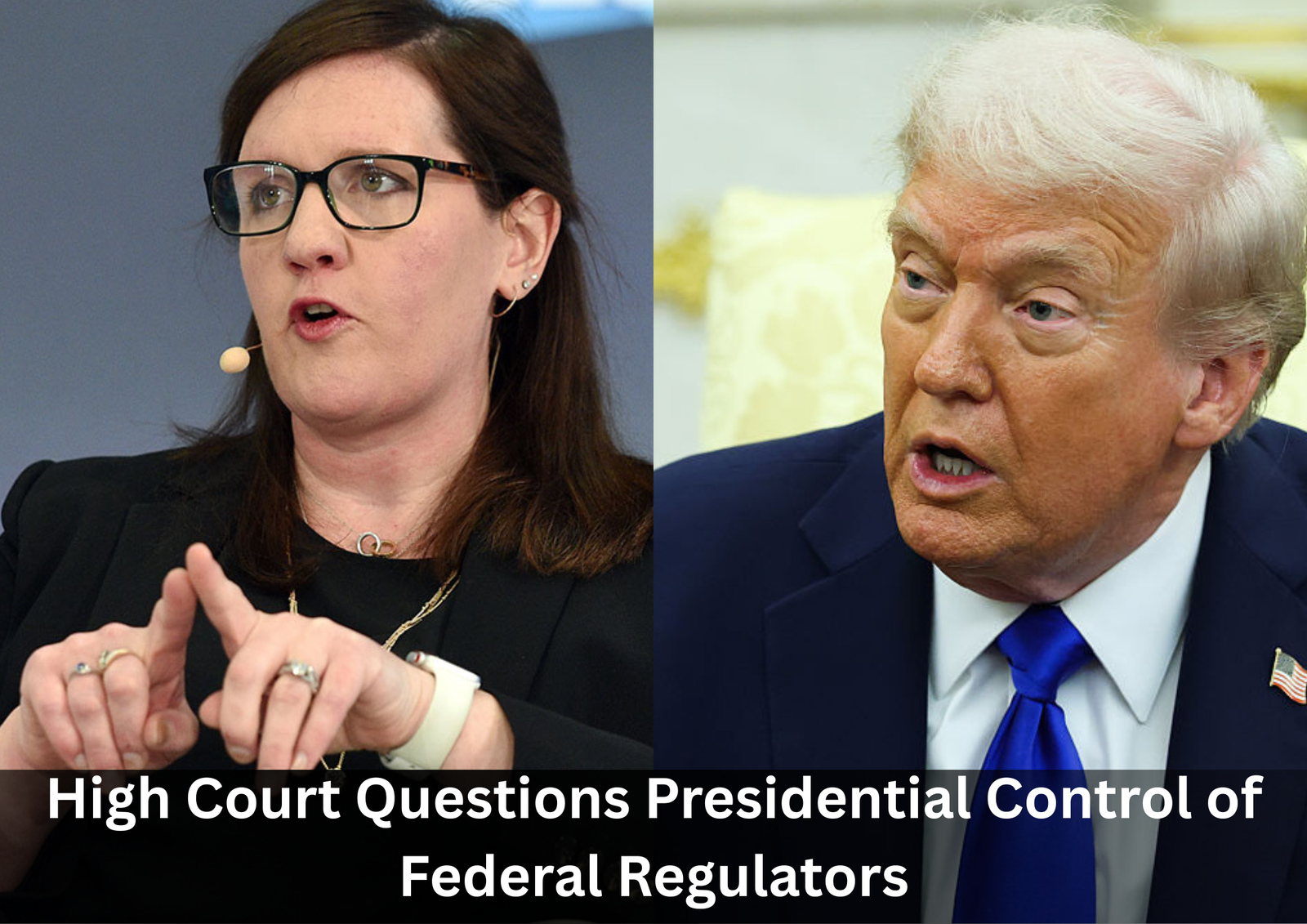
The U.S. Supreme Court on Monday heard arguments in a high-stakes legal battle that could dramatically reshape how much authority future presidents hold over powerful independent regulatory agencies across the federal government.
At the center of the dispute is Trump v. Slaughter, a case brought by a company owned by President Donald Trump. The challenge targets long-standing protections that prevent presidents from freely firing leaders of independent agencies such as the Federal Trade Commission (FTC).
Under current law, commissioners at the FTC can only be removed for specific reasons such as misconduct or failure to perform their duties. The lawsuit argues that this setup violates the Constitution by limiting the president’s authority over the executive branch.
The “Unitary Executive” at the Heart of the Case
The legal argument hinges on the “unitary executive” theory – the idea that all executive power must be fully accountable to the president. Supporters of this view maintain that Congress overstepped its authority by insulating agency leaders from presidential removal.
During the hearing, several conservative justices signaled openness to this reasoning. Justice Brett Kavanaugh emphasized historical practice, noting that early U.S. presidents exercised broad removal powers over executive officials. Justice Samuel Alito raised concerns that agencies like the FTC may operate as a quasi-independent branch of government, while Justice Neil Gorsuch questioned whether existing legal doctrine protecting such agencies remains stable.
Defenders Warn of Institutional Turmoil
On the other side, the court’s liberal justices argued that Congress intentionally created independent agencies to handle complex national challenges without constant political pressure. Justice Ketanji Brown Jackson stated that protected regulators are not a danger to freedom but a deliberate part of constitutional design.
Representing the government, Solicitor General John Sauer cautioned that weakening these protections could destabilize many cornerstone institutions. He warned the court that allowing presidents to remove agency heads at will could trigger widespread uncertainty and undermine long-term policymaking.
Markets Watching Federal Reserve Risk
Legal experts say a ruling in favor of Trump’s company could swiftly impact several major agencies, including the Federal Reserve, the Federal Communications Commission, the Securities and Exchange Commission, and the Consumer Financial Protection Bureau.
Financial markets are following the case closely, particularly over fears that the Federal Reserve’s independence in setting interest rates could be compromised by political pressure if its leadership protections are weakened.
A Case With Long-Term Consequences
The lawsuit is part of a broader legal movement seeking to roll back the power of the administrative state and expand presidential authority. If the Supreme Court overturns precedent that has stood for decades, it would mark one of the most significant shifts in the balance of power between Congress and the presidency in modern history.