

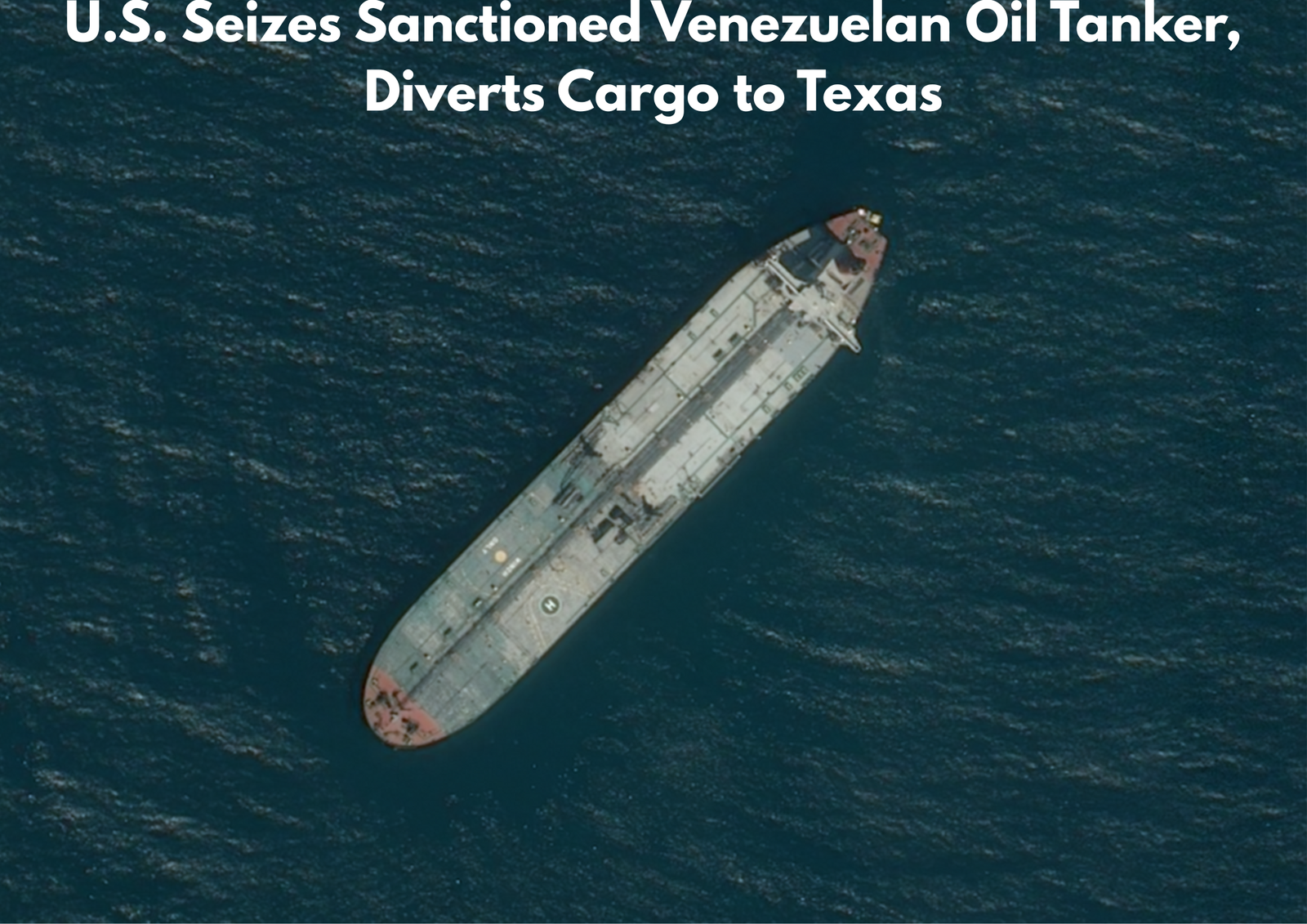
U.S. authorities have taken control of a massive oil tanker linked to Venezuela’s sanctioned crude trade, marking a notable escalation in Washington’s campaign to enforce economic restrictions against the government of President Nicolás Maduro. The vessel, a very large crude carrier known as Skipper, was seized under a federal court order and is now sailing toward the U.S. Gulf Coast, according to officials familiar with the operation.
The tanker was carrying roughly 1.85 million barrels of Venezuelan heavy crude when it was intercepted at sea. American officials said the action was conducted strictly under civil forfeiture and sanctions enforcement laws, distinguishing it from recent security operations in the Caribbean that relied on broader executive powers.
Sanctions Enforcement at Sea
The seizure was authorized by a U.S. federal warrant grounded in sanctions statutes that allow the government to take possession of property associated with blacklisted entities. Officials said the Skipper had been designated as blocked property for years due to its alleged role in transporting oil through covert networks that bypass international restrictions on Venezuelan exports.
According to the Justice Department, the legal authority for the action stems from the International Emergency Economic Powers Act and regulations enforced by the Treasury Department’s Office of Foreign Assets Control. These measures permit the United States to pursue assets tied to sanctioned actors, even when those assets are located outside U.S. territory.
A senior administration official emphasized that the operation was carried out with the support of maritime enforcement agencies and followed established legal procedures. “This was a sanctions case, not a military action,” the official said, underscoring the administration’s effort to frame the move as a law enforcement matter.
A Complex Voyage
Shipping data shows the Skipper departed Venezuelan waters in early December after loading a near-full cargo of crude produced by the state oil company, PDVSA. Initial records listed Cuba as the destination, reflecting Caracas’ long-standing practice of supplying the island with oil under preferential terms.
Shortly after departure, the tanker conducted a ship-to-ship transfer, offloading a small portion of its cargo to another vessel that continued toward the Caribbean. The Skipper then altered course, a maneuver analysts say is often used to obscure final destinations and complicate tracking efforts.
Independent analysts who reviewed satellite imagery said the tanker retained the vast majority of its oil at the time it was intercepted. U.S. authorities did not disclose the precise location of the seizure, citing operational sensitivity.
Headed for the Gulf Coast
Two sources with knowledge of the matter said the seized vessel is now en route to the Texas coast. Because of its size, the supertanker cannot navigate the Houston Ship Channel and is expected to anchor offshore, where its cargo would be transferred to smaller ships capable of reaching port facilities.
Local port officials said they had not received formal notice of the vessel’s arrival, and the U.S. Coast Guard declined to comment on the tanker’s current position or timetable. Such transfers are common for ultra-large vessels and can take several days to complete.
What ultimately happens to the oil remains unclear. In previous forfeiture cases, seized crude has been sold, with proceeds directed to U.S. government accounts or, in some instances, earmarked for humanitarian purposes.
Broader Political Impact
The confiscation adds another layer of strain to already tense relations between Washington and Caracas. U.S. officials have signaled that they intend to intensify enforcement against networks that facilitate Venezuelan oil exports in defiance of sanctions, and additional seizures could follow.
The move also carries diplomatic implications beyond Venezuela. Maritime law experts note that detaining foreign-flagged ships on the high seas can raise complex jurisdictional questions. In this case, questions surrounding the tanker’s registration may strengthen the U.S. position. Authorities in Guyana have said the Skipper was improperly flying their flag, a factor that could render the vessel effectively stateless under international law.
For the Maduro government, the loss of a cargo of this scale represents a significant financial blow at a time when oil exports remain one of its primary sources of revenue. For Washington, the operation signals a renewed willingness to use legal tools aggressively to disrupt sanctioned trade routes.
As the tanker approaches U.S. waters, the episode is likely to reverberate through energy markets and diplomatic channels alike, highlighting how sanctions enforcement is increasingly playing out far from courtrooms-and directly on the world’s shipping lanes.