
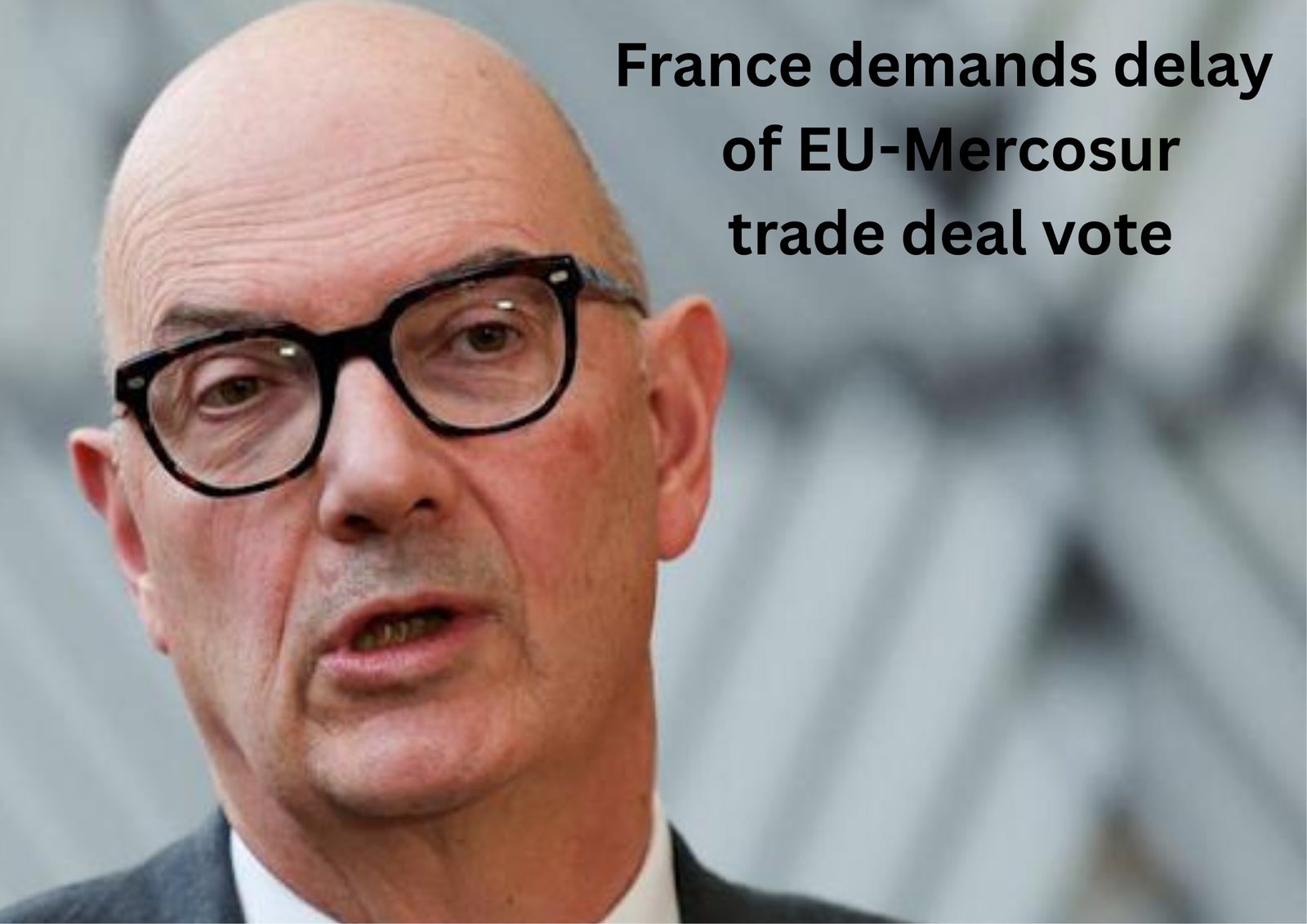
France has asked the European Union to pause plans for a member-state vote on the long-awaited EU–Mercosur trade agreement, warning that proposed protections for European farmers remain unfinished and inadequate.
The request, confirmed by the French prime minister’s office on Sunday, puts fresh strain on a trade pact that has been under negotiation for more than two decades. If completed, the agreement would link the EU with the South American Mercosur bloc-Argentina, Brazil, Paraguay, and Uruguay-forming a market spanning more than 700 million people.
Paris says it is not seeking to block the deal outright but wants more time to secure firm guarantees for Europe’s agricultural sector. French officials argue that current safeguard measures meant to shield farmers from a sudden influx of South American imports are not yet fully defined or operational.
Economy and Finance Minister Roland Lescure has outlined three conditions France considers essential before giving its approval: reliable safeguard mechanisms to prevent disruptive import surges, production standards for Mercosur exporters that match EU rules, and effective controls to enforce those standards at the border. Without clear commitments on all three points, France says it cannot support the agreement in its current form.
The move complicates the EU’s timetable. Denmark, which currently holds the rotating presidency of the Council of the EU, has indicated it intends to keep the process on track. The goal is to hold a vote among member states this week, allowing European Commission President Ursula von der Leyen to travel to Brazil later this month to formally sign the deal.
France’s position reflects mounting pressure from its powerful farming community. Agricultural groups across France and other EU countries fear the agreement would expose them to competition from producers operating under looser environmental and health regulations, potentially undermining already fragile rural economies.
Not all EU members share these concerns. Countries such as Germany, Spain, and Sweden argue that the agreement includes sufficient safeguards and that delaying further risks losing a strategic economic opportunity. Supporters of the deal also warn that prolonged uncertainty could strengthen opposition in the European Parliament or complicate negotiations as Mercosur’s internal leadership changes next year.
The European Commission has so far declined to comment on France’s request, leaving the final decision on the vote’s timing in the hands of member states. With demonstrations by farming groups expected in Brussels later this week, the debate over the EU–Mercosur pact is set to intensify at a critical moment for one of the world’s most significant pending trade agreements.