
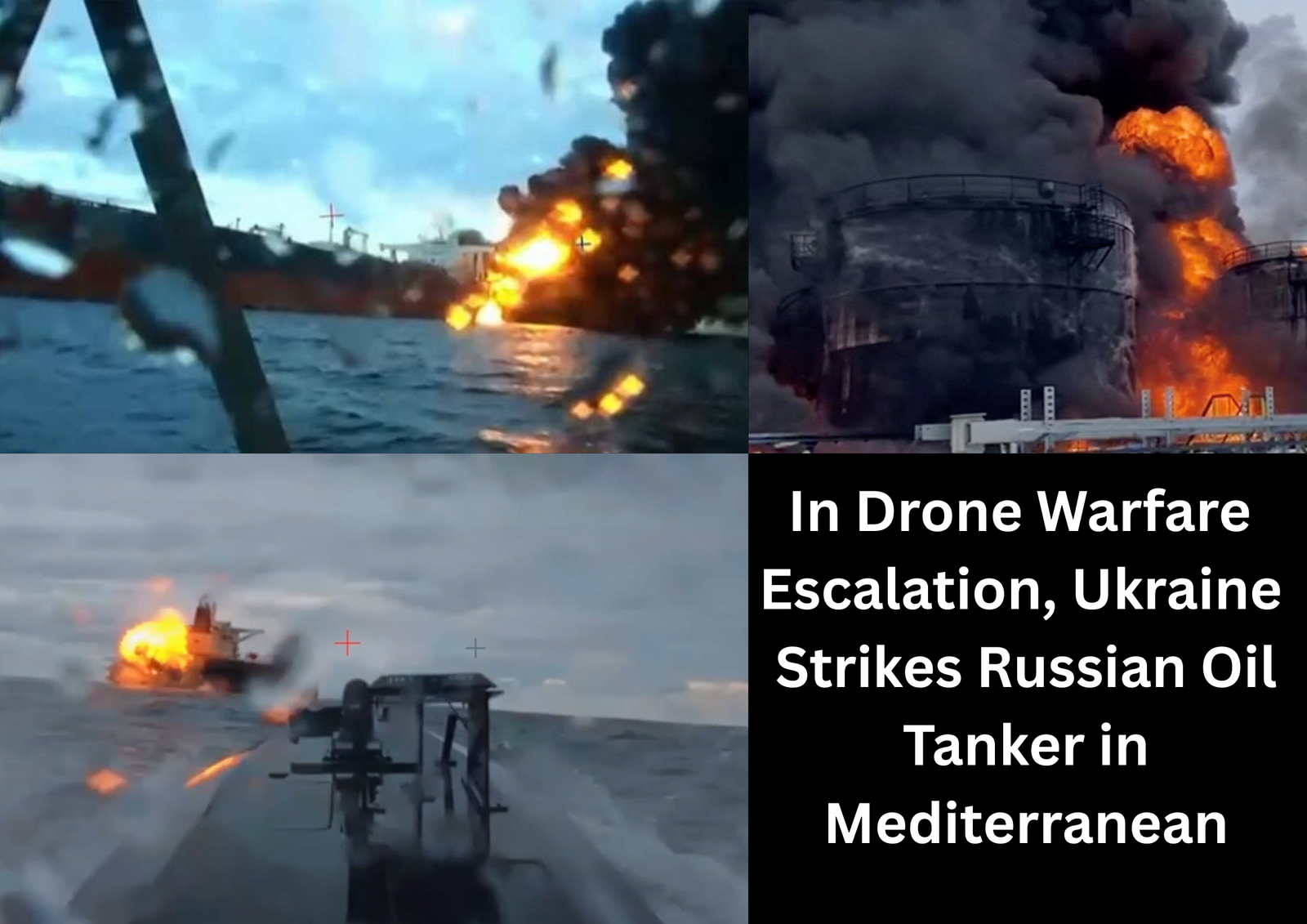
Ukraine has reportedly carried out its longest-range maritime drone operation to date, striking a Russian-linked oil tanker in the Mediterranean Sea, signaling a significant expansion of Kyiv’s military reach beyond the immediate war zone.
According to Ukrainian security officials, an aerial drone operated by Ukraine’s Security Service targeted the oil tanker Qendil while it was sailing in international waters off the Libyan coast. The vessel, which sails under an Oman flag, is alleged to be part of Russia’s so-called “shadow fleet,” a network of ships used to bypass international sanctions on oil exports.
Ukrainian sources stated that the tanker was not carrying oil at the time of the strike, reducing the risk of environmental damage. However, officials claimed the ship sustained serious structural damage that rendered it unfit for continued commercial use. Maritime tracking data indicated the vessel had departed from the Indian port of Sikka and was bound for Russia’s Baltic port of Ust-Luga.
Kyiv has argued that vessels involved in sanction-evasion efforts are legitimate military targets, asserting that profits generated through such operations help finance Russia’s ongoing war. Ukrainian officials described the mission as a complex, multi-phase operation but declined to provide technical details regarding the drone’s launch location or flight route.
If confirmed, the incident would mark the first known Ukrainian drone strike on a maritime target in the Mediterranean Sea. Until now, Ukraine’s drone operations have largely focused on Russian energy facilities, military infrastructure, and shipping routes in the Black Sea region.
Maritime security analysts have noted that the reported strike highlights a growing risk for vessels linked to sanctioned oil trade. Industry observers say the incident underscores how uncrewed aerial systems are reshaping modern naval security, even far from active battlefronts.
Russia has not officially acknowledged the reported damage to the Qendil. Speaking at a year-end press conference on the same day, President Vladimir Putin addressed attacks on what he described as civilian shipping linked to Russia, warning that Moscow would respond to what he labeled acts of piracy. He also suggested such actions could escalate security risks in key maritime corridors.
During the address, Putin reiterated Russia’s stance on peace negotiations, maintaining that Ukraine must accept territorial losses as a condition for talks. He also criticized Western discussions around using frozen Russian assets to support Ukraine, calling such proposals illegal and vowing legal challenges.
The reported strike comes amid increasing international scrutiny of the shadow fleet. Western governments and maritime organizations have raised alarms over aging vessels operating with limited oversight, citing concerns over safety, environmental hazards, and sanction enforcement. Earlier this month, U.S. authorities boarded a sanctioned tanker near Venezuela as part of broader enforcement efforts.
Separately, European Union leaders recently approved a large financial assistance package for Ukraine, committing more than $100 billion in loans to support military and economic needs. The agreement does not immediately rely on seized Russian assets but leaves open the possibility of using them for repayment in the future.
As the conflict continues, the reported Mediterranean operation suggests Ukraine is increasingly willing-and able-to target Russian economic interests far beyond the traditional boundaries of the war.