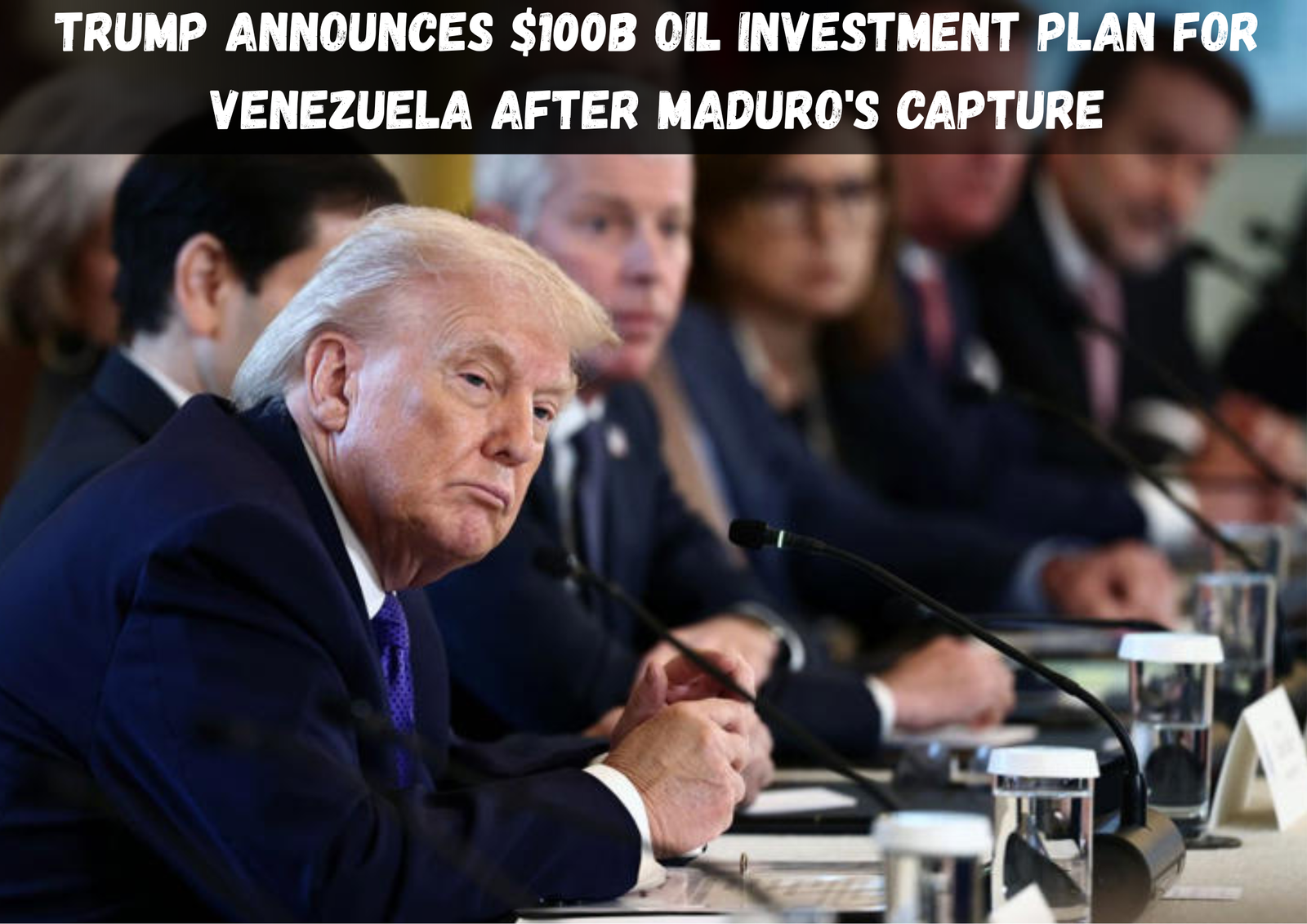
A high-profile White House gathering between President Donald Trump and senior oil executives on January 9 spotlighted a striking split between Washington’s enthusiasm for rebuilding Venezuela’s long-dormant petroleum sector and the private sector’s reservations about committing major capital. While the President promoted a sweeping $100 billion vision and declared Venezuela “open for business,” many corporate leaders warned that investment conditions remain unstable and unpredictable.
White House Push Meets Boardroom Skepticism
During the meeting, President Trump outlined an initiative aimed at overhauling Venezuela’s heavily deteriorated oil infrastructure, arguing that doing so would boost global supplies and support lower prices for U.S. consumers. He told participants that his administration would play a direct role in approving firms to operate inside the country and that agreements with Venezuela’s interim authorities would allow crude shipments to be refined and marketed through U.S. channels under American financial oversight.
However, the pitch drew a cautious – at times restrained – response from industry leaders. Executives from ExxonMobil, ConocoPhillips, and Chevron stopped short of committing sizable investment figures. ExxonMobil chief Darren Woods, referencing past asset seizures by Venezuelan governments, said that without major reforms the country remains “uninvestable,” and any future engagement would require substantial assurances.
Energy Secretary Chris Wright later acknowledged that while interest was present, no large-scale agreements were reached.
Limited Production Today, Tentative Optimism for Growth
Chevron currently stands as the only major U.S. oil company with ongoing operations in Venezuela, representing roughly 20 percent of the nation’s oil output – about one million barrels per day. Though that figure is a fraction of global production, Chevron suggested it could scale output significantly within two years if conditions stabilize.
European firms, such as Repsol and Eni, echoed a degree of optimism, citing the geological potential of Venezuela’s Orinoco Belt. Repsol estimated it could triple production over multiple years under more favorable regulatory and security conditions. ExxonMobil confirmed that it intended to send a technical team to evaluate field prospects. Meanwhile, smaller independent operators appeared more willing to take risks, describing Venezuela as an exceptional long-term opportunity.
Security, Legal Reforms, and Financial Realities Loom Large
Executives repeatedly highlighted physical security, legal certainty, and competitive fiscal frameworks as the minimum prerequisites for multi-billion-dollar investments. When asked about providing protection for energy operations, President Trump signaled the U.S. government would assist and that companies could supplement with their own security assets.
Industry analysts cautioned that output restoration on the scale discussed by the administration would require sustained capital well beyond initial pledges. Estimates indicated that triple-digit billions in funding – spread over more than a decade – would be needed to modernize infrastructure, upgrade refineries, and overhaul pipelines. Analysts also stressed that political stabilization would likely need to precede meaningful private-sector participation.
International Fallout and Political Tensions
The meeting came just days after a U.S. military operation led to the capture of Venezuelan leader Nicolás Maduro and his wife, drawing international criticism. Interim president Delcy Rodríguez has denounced the action and held diplomatic calls with South American and European leaders, characterizing the strike as a violation of sovereignty. Several governments in the region issued statements condemning the U.S. intervention.
The upheaval has also prompted statements from armed groups, including factions in Colombia, calling for regional resistance to U.S. influence. Analysts warn these developments introduce additional geopolitical complications for companies weighing long-term involvement.
Economic Debate and Governance Questions
Economists examining the administration’s plan argued that investment alone will not resolve Venezuela’s deep structural challenges. Ricardo Hausmann, a former Venezuelan planning minister now at Harvard, said that rebuilding the country’s oil sector requires credible democratic institutions, regulatory transparency, and the rule of law. He criticized profit-driven frameworks, contending that recovery must ensure resources sustain the Venezuelan population rather than flow outward.
Experts also noted that the collapse of Venezuela’s once-dominant energy industry stemmed from decades of mismanagement, state seizures, and politicization – including the firing of thousands of skilled oil workers in the early 2000s. Those long-term issues, they stressed, cannot be reversed quickly or solely through foreign capital.
Other Announcements and Comments
During the session, President Trump expressed confidence in Venezuela’s workforce, saying that local labor would likely fill most future technical roles due to their historical experience in heavy crude extraction. He declined to address specifics regarding opposition political figures currently seeking international support.
Venezuela’s interim authorities have also moved to release several political prisoners – a gesture Washington had demanded as part of broader negotiations.
If you’re curious about how “Treasury Launches New Federal Oversight Strategy in Minnesota Amid Concerns Over Public-Fund Misuse,” make sure to read this blog for the full breakdown.