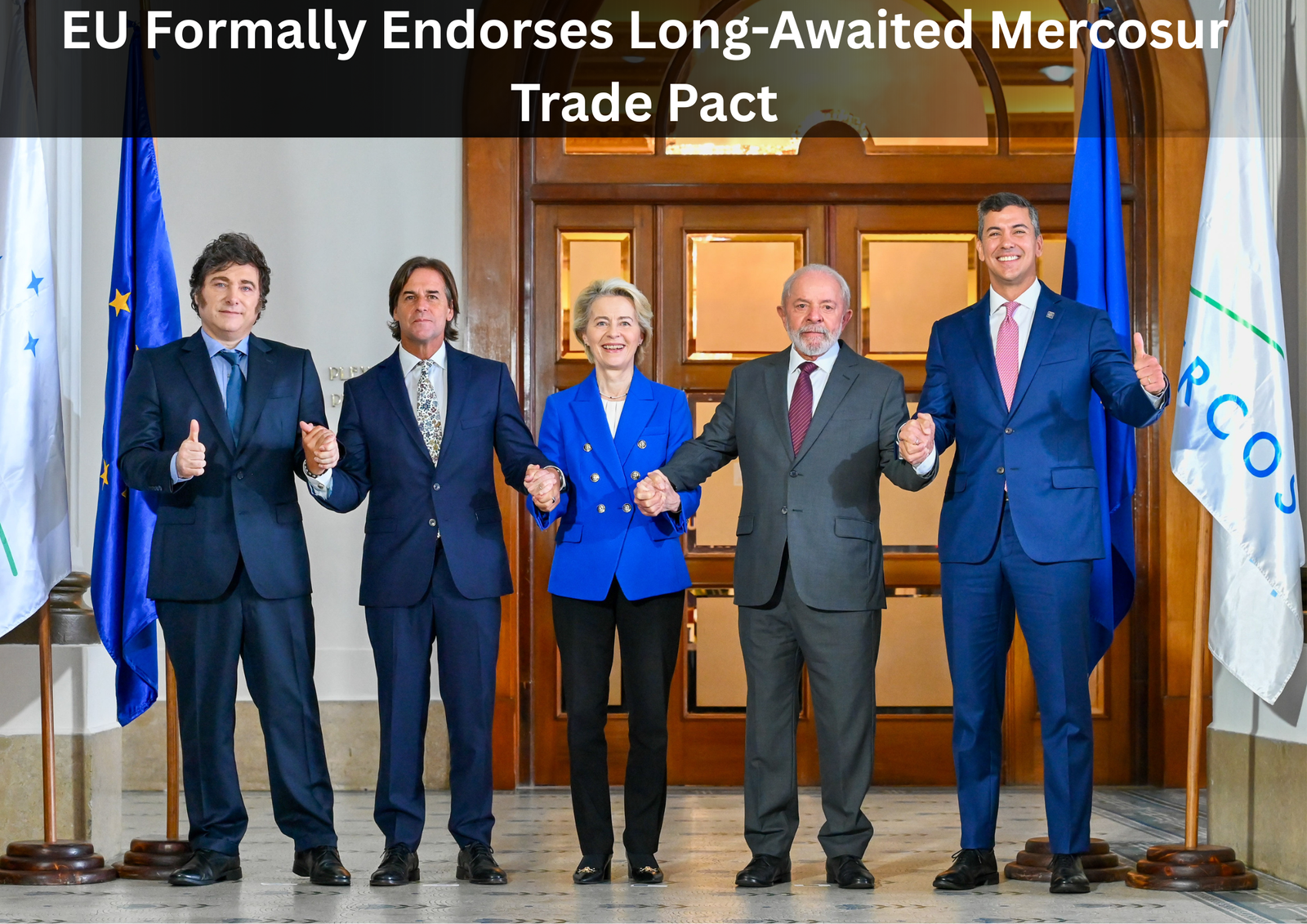
European Union governments have given the green light to a sweeping free-trade pact with the Mercosur economic bloc, marking the end of one of the longest and most complex trade negotiations in EU history. The approval aligns the EU with Argentina, Brazil, Paraguay, and Uruguay to form a vast liberalized market connecting more than 700 million people. The agreement now advances to the European Parliament for a final vote.
Tight Vote Reveals Divisions Among EU Members
The deal cleared under the EU’s qualified majority voting threshold with states representing roughly two-thirds of the bloc’s population backing the proposal. Germany, Spain, and Italy were among the strongest supporters, viewing the pact as a major boost for European exporters. France, Austria, Poland, Hungary, and Ireland rejected the agreement, largely over agricultural and environmental concerns, while Belgium abstained.
Italy’s late support came only after assurances of protective measures for farmers and additional agricultural funding commitments from Brussels. France’s President Emmanuel Macron, who has consistently opposed the pact, now faces blowback at home as opposition parties immediately pushed for a no-confidence motion in parliament.
Economic Stakes and Market Access
Once in force, the agreement will dismantle over 90% of tariffs imposed on EU products entering Mercosur countries. Brussels projects that the pact could add tens of billions of euros to the EU economy over the coming years and open major export corridors for European manufacturers, especially automotive, machinery, and pharmaceuticals. Tariff reductions will be phased in, with Brazil’s 35% import duty on cars gradually eliminated, while incentives will favor electric and low-emission vehicles.
The pact also includes quotas for sensitive agricultural products coming into Europe – such as beef and poultry – and contains protections for traditional European food and beverage products through geographical indication rules.
Supporters Claim Win for Global Trade
European Commission President Ursula von der Leyen welcomed the approval, calling it a major step toward revitalizing rules-based trade partnerships. German Chancellor Friedrich Merz described the outcome as a strategic victory for export-oriented industries, while the country’s automotive sector celebrated the prospect of gaining better access to fast-growing Latin American markets.
To placate domestic concerns, the EU has earmarked €45 billion in support for European farmers expected to face increased competitive pressure from cheaper South American imports.
Farmers and Environmentalists Voice Objections
Protests swept through major European cities following the decision, with farmers in France, Poland, Belgium, and Germany blocking roads and rallying outside government buildings. Many warn that the pact could depress prices and increase imports of lower-cost agricultural goods.
Environmental groups also criticized the agreement, claiming that increased production of beef, soy, and timber could accelerate deforestation in South America despite written safeguards tied to the Paris climate agreement. Activists argue that enforcement mechanisms remain uncertain and weak compared to the environmental risks.
Geostrategic Signal Amid Shifting Global Alliances
The approval carries broader geopolitical weight. Analysts say the EU is attempting to deepen ties with the Global South, diversify access to critical minerals, and counterbalance China’s growing influence in Latin America. Brazil holds substantial reserves of minerals used in clean technology, including major shares of nickel, manganese, and rare earth materials, while Argentina ranks among the world’s top lithium producers.
Brazilian President Luiz Inácio Lula da Silva heralded the deal as a reaffirmation of multilateral cooperation at a time of rising protectionism elsewhere.
Russia Launches Nuclear-Capable Missile Toward Western Ukraine as Major Strikes Cripple Kyiv’s Power Grid – an urgent situation you should read more about on my other blog.