
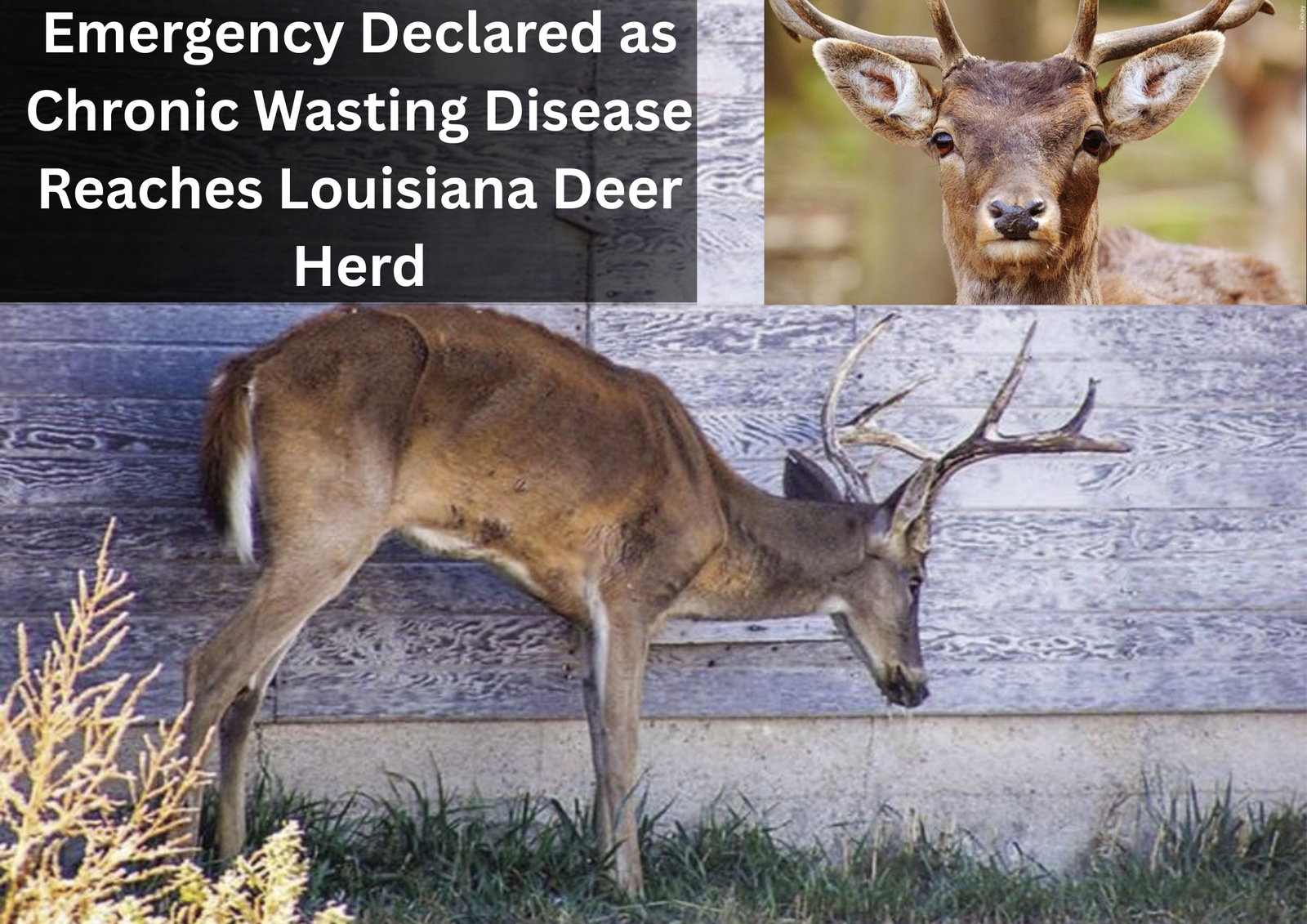
The Louisiana Department of Wildlife and Fisheries (LDWF) has declared a state of emergency following the first confirmed case of Chronic Wasting Disease (CWD) in a deer harvested within Louisiana’s borders. Officials say the positive sample came from a 4.5-year-old buck taken by a hunter on November 30, 2025, in Concordia Parish near the Mississippi River, just north of Ferriday.
The detection marks a significant milestone for the state’s wildlife authorities. Although CWD has been documented in various regions of the United States for several years, Louisiana had not previously recorded a confirmed case originating from a locally harvested deer.
What is Chronic Wasting Disease?
CWD is a neurological disease that affects white-tailed deer and other cervid species. It is caused by misfolded proteins known as prions, which accumulate in an animal’s brain and nervous system. Infected animals may show signs such as:
- Drastic weight loss
- Stumbling or abnormal gait
- Reduced awareness of surroundings
- Increased listlessness or unusual behavior
The disease is considered uniformly fatal and currently has no available treatment or vaccine.
While there is no strong evidence that CWD can be transmitted to humans, both LDWF and the Centers for Disease Control and Prevention (CDC) recommend precautionary testing for meat harvested in areas where the disease is present. The CDC further advises avoiding consumption of meat from animals that test positive.
Emergency Measures and New Restrictions
In response to the detection, LDWF established a CWD Management Zone spanning six parishes: Concordia, Avoyelles, Catahoula, Pointe Coupee, Rapides, and Tensas. The emergency declaration grants the agency enhanced authority to impose containment rules aimed at preventing further spread within the state’s deer population.
Among the immediate changes enacted:
- Supplemental feeding and baiting of deer within the zone is prohibited.
- Placement of attractants or feed to draw deer is no longer permitted.
- Rehabilitation of white-tailed deer fawns is temporarily banned within the affected region.
Officials say these measures help reduce unnatural deer congregation, a primary factor in the spread of prion-based diseases among cervids.
Hunters and Public Asked to Assist With Surveillance
LDWF is urging hunters and local residents to remain alert and report any deer exhibiting neurological or physical abnormalities. Reports of deer displaying severe weight loss, limited mobility, or unusual behavior can help authorities identify new cases early and better monitor movement of the disease.
“Our goal is to protect Louisiana’s native wildlife and address this detection swiftly,” LDWF representatives said in a statement. “Public cooperation will play a critical role in determining how effective our containment strategies are.”
A Regional Challenge With National Context
CWD has slowly expanded across parts of North America, prompting increased surveillance from wildlife agencies and scientific institutions. Although the disease poses no verified threat to human health, it has significant implications for ecological management, hunting traditions, and long-term conservation policy.
Louisiana’s first confirmed positive test adds the state to a growing list of jurisdictions working to prevent establishment and spread of the disease within wild cervid populations.
As monitoring continues, wildlife officials stress that proactive testing, responsible hunting practices, and compliance with emergency rules are essential in preserving local deer herds and maintaining the state’s ecological stability.
Don’t miss the full analysis on “South Carolina Measles Outbreak Surges Past 300 Cases as Infections Accelerate” – read the detailed blog now to stay informed before it’s too late.