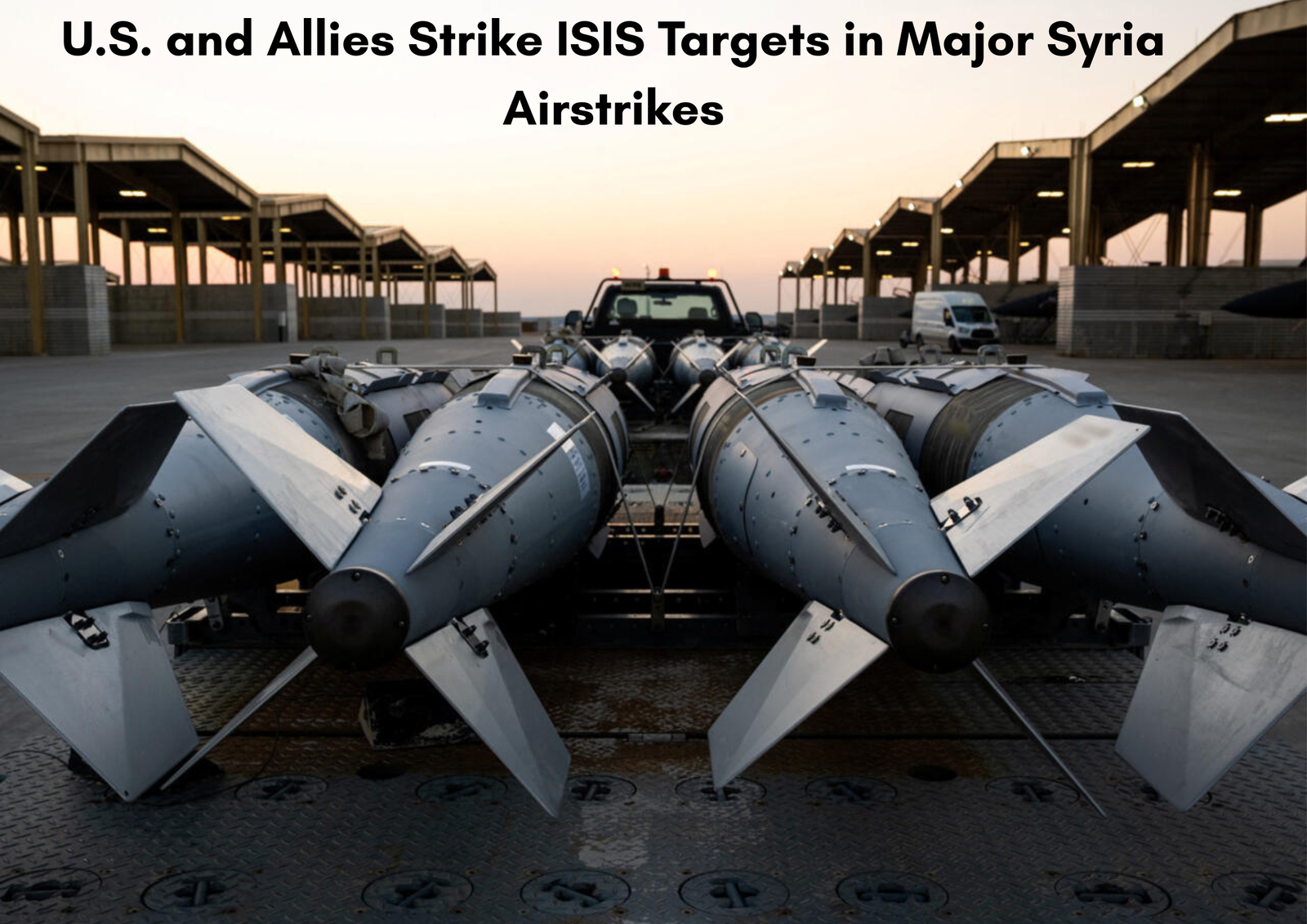
The United States and partner forces carried out a series of extensive airstrikes against Islamic State targets across Syria on Saturday, intensifying a military campaign aimed at dismantling remaining militant networks operating in the country.
Officials confirmed that the strikes were part of an ongoing U.S.-led mission known as Operation Hawkeye Strike, which began late last year following an ISIS attack that killed two U.S. service members and a civilian interpreter in Palmyra. Pentagon officials stated that more than 20 aircraft participated in the latest round of operations, deploying over 90 precision-guided munitions against more than 35 identified targets.
U.S. Central Command described the action as a continued response to what it called a “deliberate and unprovoked” assault on American troops in December 2025. The fallen soldiers – Sgt. Edgar Brian Torres Tovar of Des Moines and Sgt. William Nathaniel Howard of Marshalltown – were members of the Iowa National Guard, a connection that inspired the operation’s Hawkeye codename.
The Pentagon also confirmed that coalition aircraft included U.S. F-15Es, A-10s, AC-130 gunships, MQ-9 drones, and Royal Jordanian Air Force F-16s. Officials did not immediately disclose the precise strike locations or casualties, citing ongoing operational security considerations.
Operation Hawkeye Strike initially commenced on December 19, when U.S. and Jordanian forces carried out what CENTCOM described as a “massive coordinated strike,” launching more than 100 precision munitions at over 70 targets across central Syria. U.S. officials later reported that coalition ground operations between December 20 and December 29 resulted in nearly two dozen ISIS fighters being captured or killed in a series of raids.
In messages posted on X, U.S. officials signaled a firm stance regarding the future of the mission. Central Command stated that those who attack American forces “will be found and held accountable anywhere in the world.” U.S. Defense Secretary Pete Hegseth echoed the sentiment, saying the campaign represented “vengeance, not escalation,” stressing that Washington remained committed to preventing ISIS from re-establishing a territorial foothold in the region.
The strikes come during a period of political realignment inside Syria. After years of grinding conflict, the country entered a post-war phase following the collapse of President Bashar al-Assad’s government in December 2024. Syria is now led by President Ahmed al-Sharaa, a former rebel leader whose faction succeeded in toppling Assad. On Saturday, U.S. Special Envoy for Syria Tom Barrack met with al-Sharaa and Foreign Minister Asaad al-Shaibani in Damascus to discuss reconstruction, governance and future cooperation.
Barrack said Washington “welcomes Syria’s transition” and intends to support the country’s stabilization process as the new government asserts control over former conflict zones.
Despite the shift in leadership, ISIS cells continue to operate in remote desert corridors and remain active in several regions, particularly areas once held by Kurdish-led forces. The extremist group no longer controls major population centers but has increasingly turned to insurgent attacks and ambush tactics.
Hundreds of American troops remain in Syria under Operation Inherent Resolve, the broader multinational campaign tasked with defeating ISIS. In 2025, the Pentagon announced plans to reduce troop levels in Syria and consolidate its bases over time, though senior officials have repeatedly stated that no complete withdrawal will occur until ISIS networks are sufficiently degraded.
Regional analysts say the latest wave of airstrikes signals that the United States intends to maintain its counterterrorism footprint while Syria undergoes political reconstruction.
Minnesota Lawmakers Removed From ICE Facility as Oversight Dispute Escalates – read the full story in my detailed blog to understand why this issue matters.