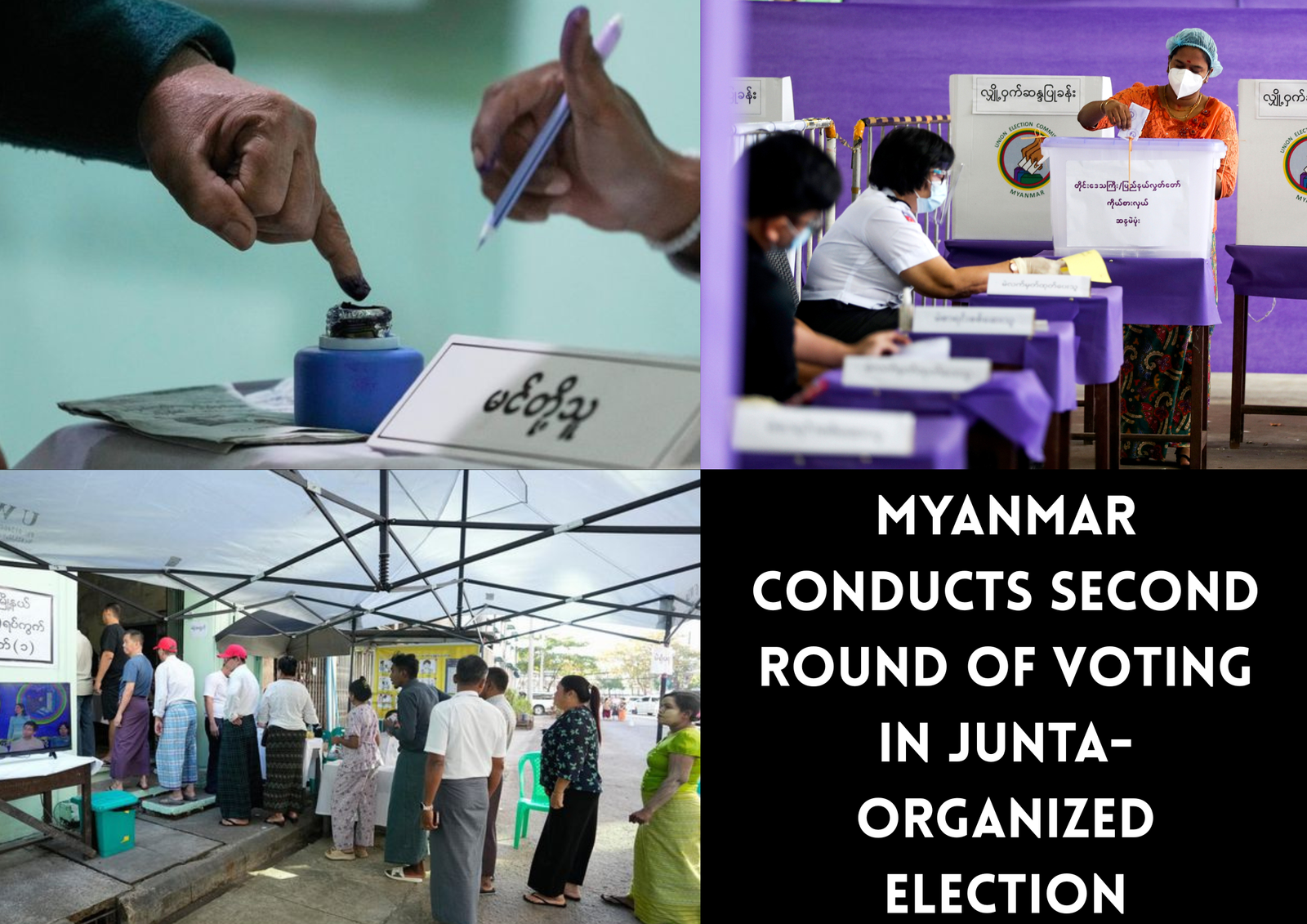
Myanmar’s ruling military continued its controversial push to establish electoral legitimacy on Monday, overseeing a second phase of nationwide voting under conditions that critics describe as coercive, undemocratic, and detached from the country’s conflict-ridden reality. The vote marks the first full general election effort mounted since the military seized power on February 1, 2021, dismantling the elected civilian government and arresting senior opposition leaders.
Voting in Restricted Regions
Polling stations reopened across roughly 110 townships, mainly in ethnic minority and contested border regions including Shan, Kachin, Kayin, Mon, Rakhine, and parts of Bago. Key cities such as Yangon, Mandalay, and Naypyidaw were included in an earlier voting phase conducted in late 2025. Myanmar’s military-appointed Union Election Commission insisted voting was conducted “smoothly,” despite acknowledging the presence of ongoing security threats.
Atmosphere of Fear
Residents and independent observers, however, noted heavy deployments of soldiers and police, frequent street checks, and reports of door-to-door pressure campaigns in several townships. Accounts described towns with shuttered storefronts and minimal public activity as civilians tried to avoid being drawn into a process many view as illegitimate. Large portions of Myanmar remain engulfed in conflict, with anti-junta resistance forces and ethnic armed organizations controlling entire swaths of territory where polling was not possible.
Opposition Silenced
The political playing field remains effectively uncontested. The former ruling National League for Democracy (NLD), which swept the 2020 vote before the coup overturned it, has been dissolved and barred from participating. Its leading figures, including Nobel laureate Aung San Suu Kyi, remain imprisoned under charges widely seen as politically motivated. The junta’s preferred party, the Union Solidarity and Development Party (USDP), stands positioned to dominate the next parliament.
Meanwhile, the shadow National Unity Government (NUG) and a coalition of resistance groups urged citizens to boycott the vote entirely, denouncing it as an attempt to institutionalize military control under a pseudo-civilian framework.
Preliminary Positioning and Results
Initial tallies from the first voting phase, cited by business and regional outlets, indicate the USDP is heading toward overwhelming victory. Official results from the latest round are expected shortly, though few anticipate any surprises given the absence of meaningful political competition and the military’s entrenched constitutional authority.
Condemnation From Abroad
Western governments have refused to recognize the election, labeling it fraudulent and incompatible with democratic norms. The United States, Canada, and the United Kingdom jointly criticized the process, citing ongoing repression, the detention of political opponents, and documented human rights violations since the coup. Foreign ministries and rights groups argue that any new legislature formed under these terms will merely reframe military rule rather than replace it.
Structural Barriers to Democracy
Myanmar’s constitutional framework continues to ensure military dominance regardless of electoral outcomes. The 2008 charter allocates one quarter of parliamentary seats to unelected military officers and preserves direct military oversight over defense, border affairs, and internal security. Newly implemented electoral laws also disqualify candidates accused of undermining “national unity,” a classification routinely applied to opposition figures and resistance groups.
As official results approach, Myanmar’s political future remains clouded by civil conflict, diplomatic isolation, and the absence of avenues for genuine democratic participation.
Protester Climbs Iranian Embassy in London and Replaces Flag During Anti-Government Rally, a bold act drawing global attention. Read my full breakdown in the blog – don’t miss it.