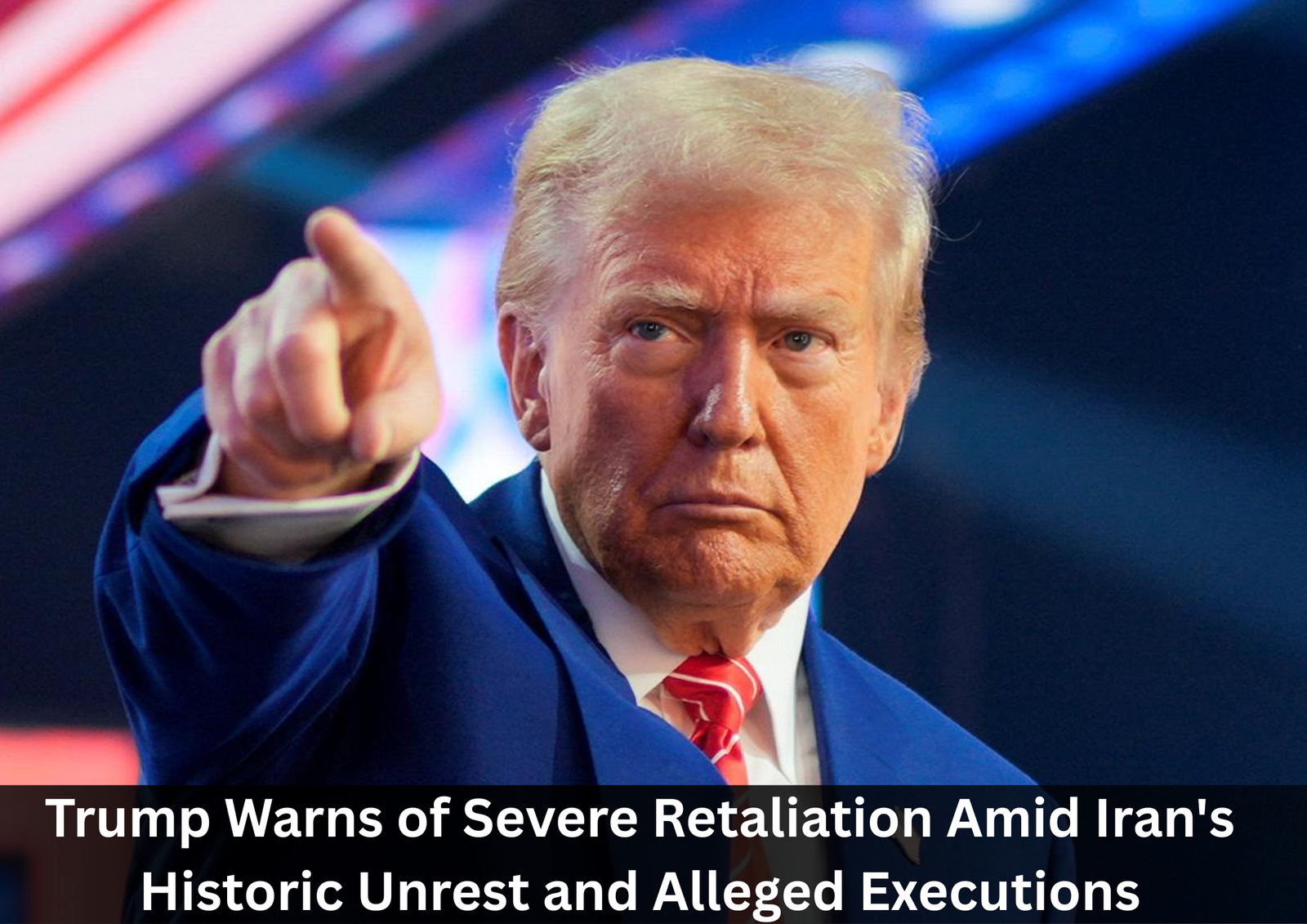
President Donald Trump has issued one of his strongest warnings yet to Tehran, signaling that the United States would take “very strong action” if Iran begins executing detained protesters amid what analysts describe as the most significant domestic unrest the Islamic Republic has faced in years. In a major diplomatic shift, Trump has also suspended planned dialogue with Iranian officials, indicating a dramatic hardening of U.S. policy as the crisis worsens.
Confrontation Escalates and Diplomacy Halts
Speaking in an interview , Trump tied his warning directly to reports that Iranian authorities may carry out mass executions of demonstrators. He emphasized that the United States would not stand by “if young people are being killed for demanding basic rights.” Soon after the interview aired, Trump posted a message to his Truth Social account announcing that scheduled diplomatic exchanges had been canceled until Iran ends what he called “senseless killings.”
He also addressed protesters directly, urging them to keep demonstrating and vowing that assistance would be provided, without specifying what form that support might take.
Death Toll Uncertain as Concern Grows Over Imminent Executions
Human rights organizations and media outlets continue to report conflicting casualty figures from the protest movement, which is now in its third week. Estimates range from just over 2,000 confirmed deaths to unverified claims suggesting numbers as high as 20,000. Video footage circulating online appears to show body bags inside a Tehran morgue, though independent confirmation remains difficult due to severe communication blackouts.
One specific case drawing international alarm involves 26-year-old Erfan Soltani, a protest detainee whose execution is believed to be scheduled for January 15. According to a Kurdish rights group, his family was informed that appeals had been exhausted and the sentence was final.
Authorities have reportedly arrested more than 16,000 people nationwide, including teenagers and university students, as demonstrations spread across all 31 provinces.
Washington Debates Strategy Behind Closed Doors
Senior members of Trump’s national security team met over the weekend to discuss possible U.S. responses. Vice President JD Vance is chairing a series of high-level sessions examining options that range from diplomatic pressure to economic sanctions and potential military action. The president returned to Washington late Tuesday for further briefings.
White House officials have publicly acknowledged that Iran has been sending conflicting private messages about negotiations. Press Secretary Karoline Leavitt confirmed that talks had been considered just days earlier but said the administration does not rule out military options if conditions deteriorate further. Trump also signaled interest in new trade penalties, stating that countries conducting business with Iran could face a 25% tariff-though no implementation details were released.
Historic Unrest Challenges Iran’s Leadership
The protest movement began after a dramatic collapse in the value of Iran’s currency but quickly transformed into widespread opposition against Supreme Leader Ayatollah Ali Khamenei. Demonstrators have targeted government buildings, state media facilities, and clerical institutions, in what analysts describe as the strongest challenge to the Islamic Republic since 2009.
When asked about his objective in Iran, Trump replied that his goal was “to win,” referencing earlier U.S. operations including the raid that killed ISIS leader Abu Bakr al-Baghdadi, the assassination of Iranian commander Qassem Soleimani, and the U.S. capture of Venezuelan leader Nicolás Maduro last year. Iran has warned that any U.S. or Israeli military involvement would make regional assets “legitimate targets.”
Evacuations, Internet Blockade, and International Maneuvering
The U.S. State Department has issued an advisory urging American citizens to leave Iran immediately, recommending that those unable to fly consider land routes into Armenia or Türkiye if conditions permit. The advisory noted that internet access remains severely restricted, with outages now extending beyond five consecutive days.
In a separate development, it was reported that SpaceX is providing free Starlink satellite internet service inside Iran to counter government shutdowns, removing subscription fees for users during the crisis. Meanwhile, Axios revealed that Trump’s Iran envoy secretly met with exiled former crown prince Reza Pahlavi to discuss political developments.
The United States is managing the Iran crisis while simultaneously navigating peace negotiations between Israel and Hamas, the conflict in Ukraine, and the aftermath of the Venezuela operation-an unusual convergence of global flashpoints that diplomats say could reshape U.S. foreign policy moving into 2026.
The topic “Trump’s Credit Card Rate Cap Idea Roils Wall Street, Banks Warn of Credit Squeeze” demands attention – read the full blog to understand the unfolding financial storm.