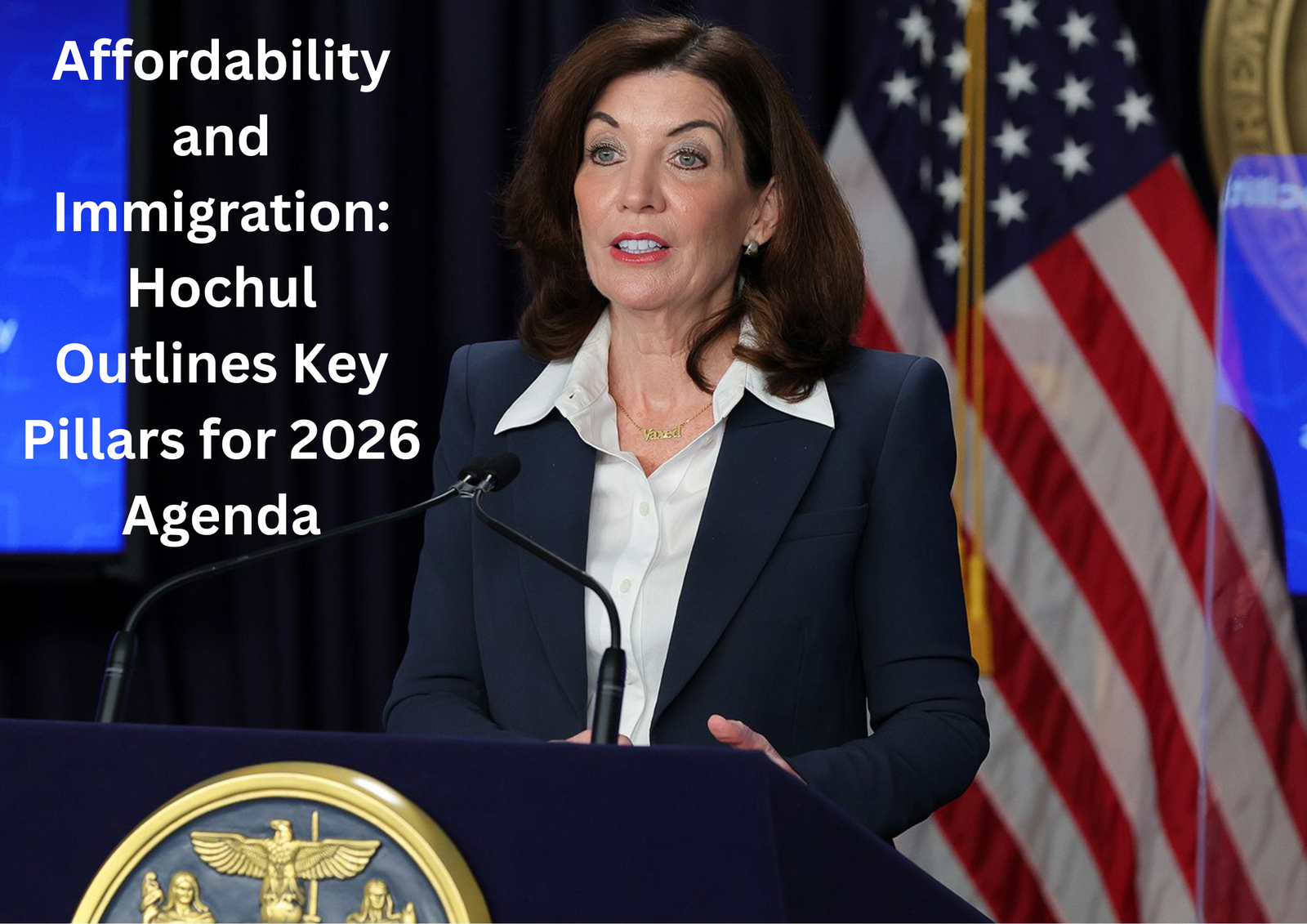
New York Governor Kathy Hochul used her fifth State of the State address on Tuesday to outline a policy blueprint aimed at easing cost pressures for families while sharply countering federal directives coming from President Donald Trump’s administration. The 47-minute speech marked one of Hochul’s clearest displays of political positioning ahead of a competitive re-election year, where she faces both a Democratic primary challenger and a Trump-aligned Republican opponent in the general election.
Democratic strategists view the governor’s race as a bellwether for down-ballot contests, particularly several House seats that could determine control of Congress. Hochul also enters this year governing alongside New York City’s first democratic socialist mayor, Zohran Mamdani, who shares her focus on affordability but advocates for more aggressive taxation of the wealthy – a policy line Hochul has so far rejected.
Focus on Economic Relief and Child Care Expansion
The governor’s most ambitious affordability proposal involves establishing universal, tuition-free child care. To accelerate implementation, Hochul called for an immediate $1.7 billion injection to expand eligibility for state child care support, which officials estimate would cover an additional 100,000 children statewide. Independent budget experts say that a fully scaled program could run between $12 billion and $15 billion annually – a figure that is likely to become central to the year’s fiscal debates.
Housing policy also played a prominent role. Hochul proposed changes to New York’s complex environmental review laws to speed up residential construction that complies with local zoning, part of her long-standing target of adding 800,000 housing units over the next decade. She additionally announced a $50 million rebate initiative for home energy efficiency upgrades and proposed reforms to car insurance claims to curb rate increases linked to drivers breaking traffic laws.
Energy, Utilities, and Union Support
On energy, Hochul prioritized expanding nuclear power generation, describing it as the backbone for a reliable and clean grid after federal regulators moved to block multiple offshore wind projects. The move angered construction trades, who rallied behind Hochul after the Trump administration reversed previously approved offshore wind permits off Long Island. The governor also introduced legislation that would require utilities to disclose executive compensation relative to average worker salaries and justify rate hikes more transparently before state regulators.
Confrontation with Federal Immigration Enforcement
Immigration enforcement emerged as one of the sharpest points of contrast with Washington. Following public outrage triggered by a deadly shooting involving an ICE agent in Minneapolis, Hochul endorsed legislation allowing New Yorkers to pursue civil claims against federal immigration officers in state court for alleged constitutional violations. Another bill would restrict civil immigration arrests without a judge’s warrant at locations deemed “sensitive,” including schools, hospitals, and daycare centers.
“We will not allow masked agents to invade institutions where families expect safety and dignity,” Hochul declared, while still noting that New York continues to cooperate with immigration authorities on criminal matters. Progressive lawmakers applauded the move but signaled they intend to push for further sanctuary-style protections.
Additional Social and Economic Policy Plans
The governor’s wider agenda included proposals to shield houses of worship from targeted protests, restrict AI chatbot access for minors, and provide $30 million in relief payments to farmers harmed by new trade tariffs imposed by the Trump administration. Hochul also announced new consumer safeguards for student loan borrowers in anticipation of federal changes to repayment programs.
Political Reaction Across the Spectrum
Republican leaders immediately criticized the speech, framing it as fiscally reckless and unlikely to provide meaningful price relief. Senate Republicans argued that universal child care and expanded housing subsidies would ultimately lead to higher taxes. In their official response, GOP lawmakers portrayed Hochul as bending to the demands of left-wing activists.
The White House also weighed in, accusing New York of emboldening “criminal illegal immigrants” and pursuing “unreliable green energy schemes,” while climate activists protested outside the capitol over what they described as recent environmental rollbacks. Progressive Democrats, meanwhile, cautiously praised the governor’s immigration stance while urging further action throughout the legislative session.
Election-Year Balancing Act
Hochul enters the election year navigating political pressure from both ideological flanks. Polling from Siena University last month showed her approval rating at 43%, with voters slightly more optimistic than pessimistic about the state’s direction. Trump, by contrast, remains deeply unpopular in New York, with 62% voicing an unfavorable view.
State Democratic leadership expects the president to campaign aggressively against New York’s policies, framing the state as a symbol of progressive governance. Whether Hochul’s affordability agenda can translate into tangible results quickly enough remains a defining question that could shape both her re-election prospects and national Democratic strategy heading into November.
Tensions Surge in Minneapolis as Immigration Crackdown Spurs Protests, Legal Battles, and National Debate – read the full story in my detailed blog, don’t miss it.