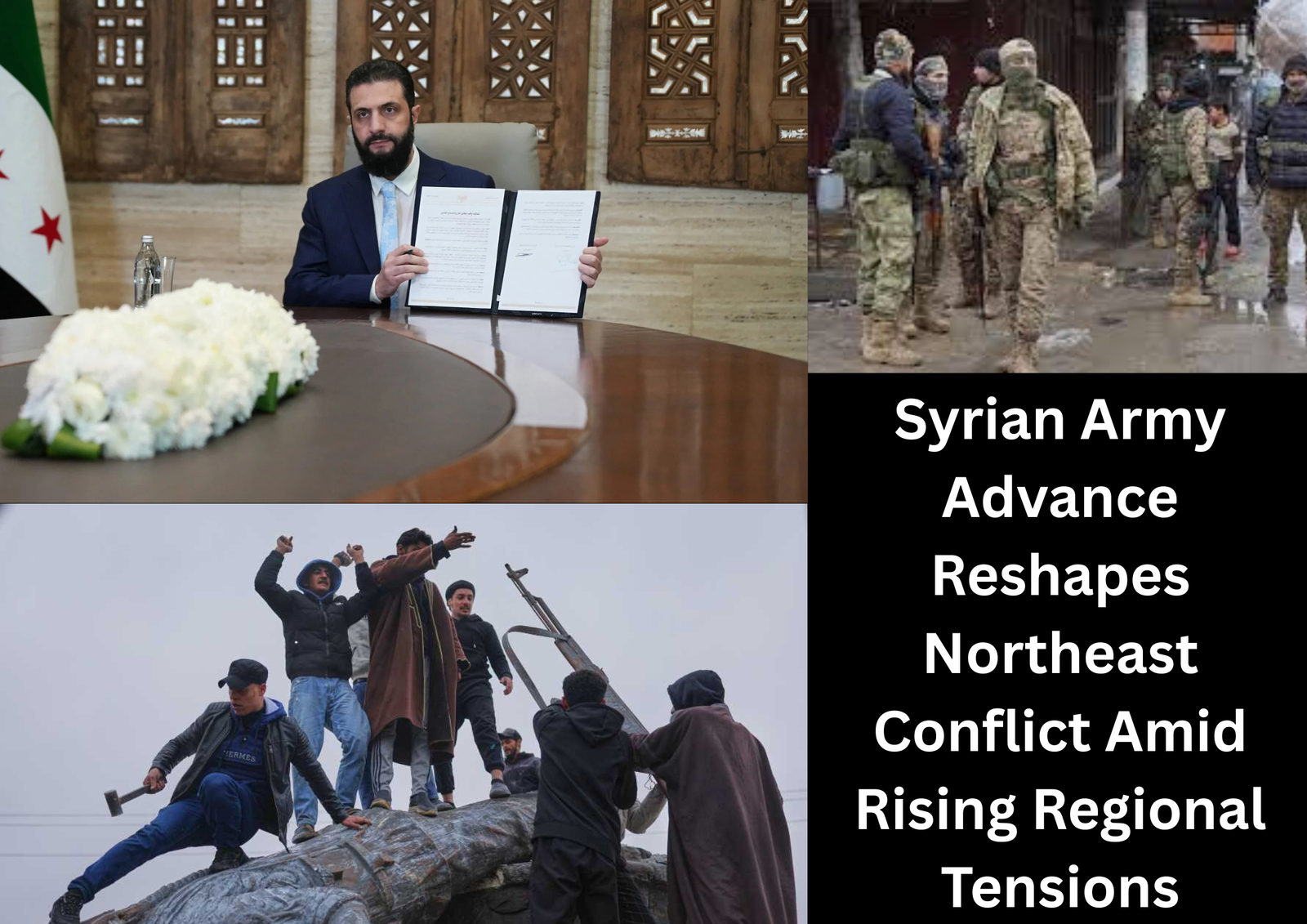
Syrian government troops are spearheading a new military campaign in the country’s northeast, moving into districts long controlled by the Kurdish-led Syrian Democratic Forces (SDF), according to multiple regional and international reporting agencies. The sudden acceleration of operations is reshaping frontlines and introducing fresh uncertainty to an area already entangled in global power dynamics.
The push began early in January after months of political mediation failed to produce an agreement between Damascus and Kurdish negotiators regarding future power-sharing arrangements in areas captured from the Islamic State group. The breakdown reportedly ended Russian-facilitated talks that had aimed to integrate SDF governance structures into the Syrian state.
Military units loyal to Damascus, supported by allied militias, have since moved through the Aleppo countryside toward Raqqa province, seizing several rural communities that had been controlled by the SDF for years. Local footage has circulated on various digital channels showing government personnel replacing SDF insignia with Syrian flags in recaptured towns.
Raqqa – once the self-declared capital of ISIS’s “caliphate” – appears to be the most consequential prize. Analysts say the Syrian army’s multi-directional movement toward the city indicates a broader intention to restore centralized control over strategic corridors in the northeast. Kurdish officials confirmed ongoing clashes across the rural expanse surrounding the province’s urban core.
The United States maintains a limited deployment in parts of the region, including at energy infrastructure sites such as the al-Omar oil field. Washington has signaled its focus remains on counter-ISIS missions and has not indicated plans to block Syrian troop movements. The geographical proximity of Syrian, U.S., and Kurdish forces has nonetheless prompted concerns about miscalculations or unintended confrontations.
Kurdish commanders have cautioned that a prolonged confrontation could compromise security at detention centers holding thousands of individuals affiliated with the Islamic State group. Observers warn that neglect at these facilities could trigger renewed destabilization or unplanned prisoner escapes.
Complicating matters further, Turkey-another major actor in northern Syria-views the SDF as an offshoot of the PKK insurgency and has historically targeted Kurdish-held zones near its border. Ankara is reportedly monitoring the situation closely amid speculation that it could pursue its own military objectives if a power vacuum or destabilizing shift emerges.
Humanitarian groups are raising alarms about the civilian toll. Thousands of residents have reportedly fled active combat areas over the past week, in many cases traveling toward makeshift shelters near the Iraqi frontier or toward enclaves closer to U.S. positions. Aid agencies warn that displacement in the northeast is outpacing available resources and that basic utilities are increasingly stressed after years of conflict.
Diplomatic analysts believe the offensive could mark one of the most significant challenges to Kurdish self-administration since the height of anti-ISIS cooperation a decade ago. How Washington, Ankara, Moscow, and Tehran balance their interests in this evolving theater is expected to determine the next phase of territorial control and governance in Syria.
Rare Southern Snowfall Stuns Florida and Gulf Coast as System Intensifies in the Northeast – an incredible weather twist you shouldn’t miss. Read the full detailed blog for surprising insights!