
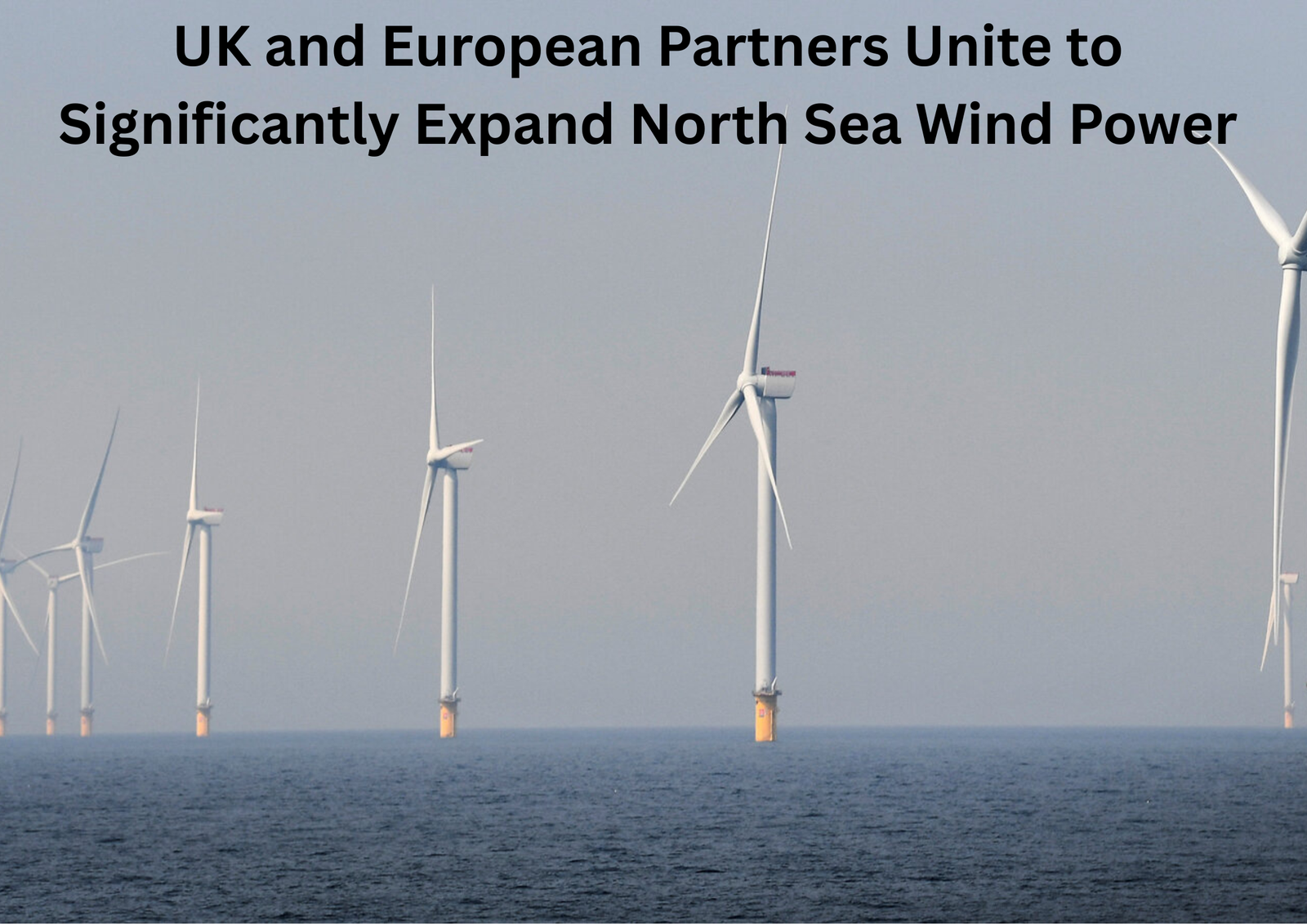
The United Kingdom and nine European nations have agreed to jointly accelerate offshore wind development in the North Sea, unveiling a major clean-energy cooperation aimed at transforming the region into one of the world’s largest renewable power hubs.
The agreement, formalized at the North Sea Summit in Hamburg, commits participating countries to delivering 100 gigawatts of shared offshore wind capacity through cross-border projects. The initiative forms part of a longer-term ambition to reach 300 gigawatts of offshore wind generation by 2050, a target first outlined by regional leaders several years ago.
The UK, represented by Energy Secretary Ed Miliband, joined Belgium, Denmark, France, Germany, Iceland, Ireland, Luxembourg, the Netherlands, and Norway in endorsing the pact. Officials from the European Commission and NATO were also present, underscoring the strategic and security significance of offshore energy infrastructure.
A defining feature of the agreement is the plan to develop wind farms that connect directly to multiple national electricity grids. These projects will rely on an expanded system of high-voltage undersea interconnectors, allowing electricity to flow between countries depending on demand. Supporters say this approach will reduce inefficiencies, stabilize supply, and modernize the North Sea’s aging energy network.
Under the new framework, governments expect at least 20 gigawatts of the jointly developed capacity to be under construction by 2030. Once completed, the full 100-gigawatt build-out could generate enough electricity to supply power to well over a hundred million households across Europe.
Officials involved in the negotiations emphasized energy security as a central motivation, particularly in light of recent geopolitical shocks that exposed Europe’s reliance on imported fossil fuels. By expanding domestic renewable generation and strengthening grid cooperation, leaders argue the region can better protect consumers from volatile global energy markets.
Industry groups welcomed the announcement, pointing to potential cost savings for households and businesses. Integrated offshore grids are expected to reduce congestion and lower the need for compensation payments to wind producers when excess power cannot be transmitted. In the UK alone, interconnector infrastructure has already contributed billions in consumer savings in recent years, according to national grid data.
However, the strategy is not without controversy. Critics in some countries have raised concerns about electricity prices and domestic supply, particularly in nations that export power through interconnectors. Political debate is also ongoing within the UK, where opposition parties differ sharply over the pace and cost of the energy transition.
Alongside the main declaration, several countries – including the UK, Germany, Belgium, Denmark, and the Netherlands – signaled their intent to deepen cooperation on planning, permitting, and cost-sharing for future offshore projects. Energy sector representatives say such coordination is essential to scaling up supply chains and keeping long-term costs under control.
The agreement comes amid strong momentum for renewables across Europe. Wind and solar power have become leading sources of electricity generation, while investment in clean energy continues to rise. With security measures for offshore infrastructure also high on the agenda, the North Sea partnership marks a significant step toward a more interconnected and resilient European energy system.
To understand why Saudi Arabia Reassesses NEOM Ambitions as Vision 2030 Projects Face Financial Pressure, read this blog for crucial insights shaping the kingdom’s economic future and global impact.