
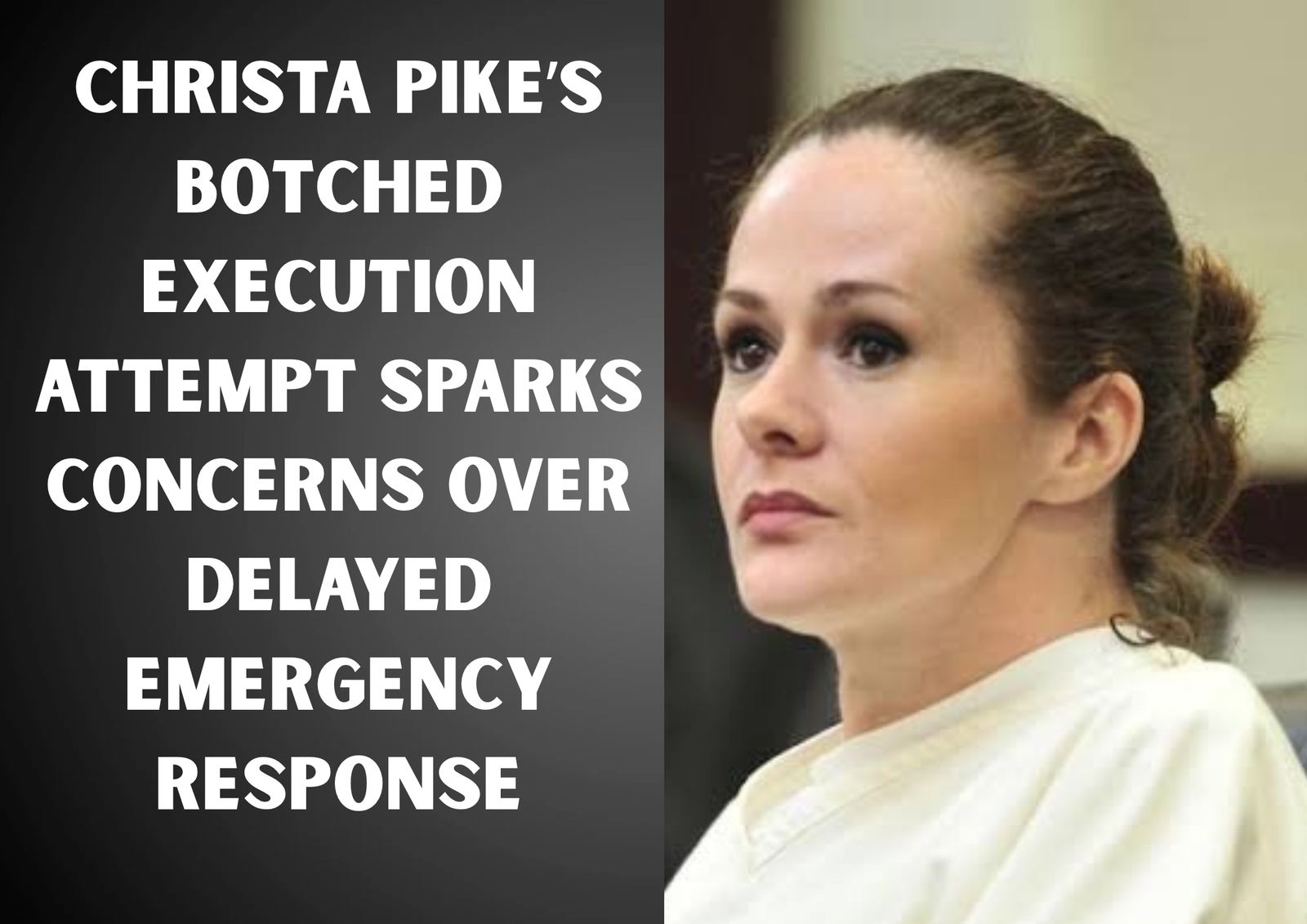
Newly released 911 records reveal confusion, security-code problems and delays in getting emergency medical assistance to Tennessee death-row inmate Christa Pike after a lethal injection failed.
The failed execution of Christa Pike in Tennessee has raised serious questions about prison emergency procedures after newly released 911 records revealed that confusion delayed medical assistance following the September 30 incident.
Pike, 50, survived two doses of the lethal injection drug pentobarbital during an execution attempt at Riverbend Maximum Security Institution in Nashville. She was subsequently taken to a hospital for emergency treatment and later regained consciousness after her condition had deteriorated to the point that her attorneys feared she might not survive.
The newly released records provide a troubling account of the difficulties emergency dispatchers and first responders encountered while trying to verify the request for medical assistance and gain access to the prison.
911 Call Triggered Confusion Over Emergency Access
According to the released transcript, the first emergency call was made at approximately 8:40 p.m. on September 30. The caller informed the dispatcher that prison officials had attempted to carry out an execution but the person was still alive and needed an ambulance.
The caller reportedly explained that two doses of pentobarbital had been administered, yet the intended outcome had not occurred.
However, the emergency response quickly became complicated when the dispatcher requested a security verification code associated with calls originating from the prison.
The caller could not provide the required code, creating uncertainty about whether the request was genuine. The verification procedure was designed to prevent false emergency calls and address security concerns at the correctional facility.
Instead of immediately resolving the situation, the missing code triggered a series of communications between emergency dispatchers, prison personnel and other public safety agencies.
The incident raises questions about why the person requesting urgent medical assistance did not have the necessary verification information and how such a situation should be handled when a person’s life may be in danger.
Emergency Responders Were Initially Told the Call Was False
The confusion continued as dispatchers attempted to establish whether the emergency request had actually come from authorized prison personnel.
At approximately 9:03 p.m., a communication indicated that supervisors had been informed the call was false and that medical assistance was not required at the facility.
This message added another layer of uncertainty for emergency personnel attempting to respond.
Several minutes later, a first responder reported that someone at the prison gate was insisting the emergency was real and demanding that responders be allowed inside. The individual reportedly identified themselves as a state official, but the verification problem remained unresolved.
Prison control personnel also initially indicated that they had not made the emergency call, further complicating efforts to establish what was happening inside the facility.
The situation was eventually clarified, and prison officials confirmed that the request for medical assistance was legitimate.
Emergency responders were permitted to enter at approximately 9:11 p.m., more than 30 minutes after the initial call.
The timeline has intensified concerns about the coordination between correctional officials and emergency services during a potentially life-threatening incident.
Defense Attorney Also Called for Immediate Medical Help
The released records indicate that the initial call was not the only attempt to secure assistance for Pike.
At approximately 9:08 p.m., her attorney, Kelly Gleason, contacted emergency dispatchers and stressed that Pike was still alive and needed immediate, life-saving medical care.
The attorney’s call added urgency to a situation in which emergency personnel were still trying to establish the legitimacy of the original request.
Although emergency vehicles had been dispatched, responders faced difficulties entering the prison grounds. Officials had to resolve the security-code issue and arrange the necessary access before medical personnel could reach the facility’s interior.
The records show how administrative confusion and conflicting information complicated the emergency response at a critical moment.
Pike was eventually transported to a hospital, where she received intensive treatment. The available timeline indicates that the ambulance left the prison grounds considerably later than the initial request for assistance.
Pike Regained Consciousness After Critical Condition
Following the failed execution, Pike’s condition was initially extremely serious. She was unconscious and placed on a ventilator while medical staff worked to stabilize her.
Her attorneys subsequently disclosed that they feared she might be brain-dead and would not survive. However, Pike regained consciousness in early October and gradually began communicating and walking with assistance.
She was discharged from the hospital and returned to the state’s women’s correctional facility, where she continues to receive medical oversight.
Her recovery has added another extraordinary dimension to a case that already raises difficult questions about the administration of capital punishment.
Authorities have not publicly established a definitive explanation for why the two doses of pentobarbital failed to kill her. Possible medical and procedural explanations have included problems involving the intravenous line, the delivery of the drug and Pike’s underlying blood disorder. These possibilities have not been confirmed as the cause.
Legal Questions Surround the Failed Execution
The incident has renewed scrutiny of Tennessee’s lethal-injection procedures and the state’s plans for responding when an execution does not proceed as intended.
One central question is whether existing protocols adequately address the possibility that an inmate survives the full sequence of lethal-injection drugs.
The emergency response has raised a separate concern: whether security requirements can delay urgent medical treatment when prison officials are unable to provide the expected verification information.
Investigators and legal representatives will need to establish how the execution was conducted, why the procedure failed and whether the subsequent medical response followed applicable requirements.
Pike’s legal team has also sought to preserve evidence connected to the failed execution, including relevant medical equipment, records and other materials that could help determine what happened.
A court order requiring the preservation of evidence could prove important as legal proceedings continue and questions about the execution process are examined.
Tennessee Suspends Further Executions Pending Review
Tennessee Governor Bill Lee has paused further executions while the state reviews the circumstances surrounding the incident. The suspension follows another failed execution attempt in the state earlier in 2026, adding to concerns about the reliability of its procedures.
Pike was sentenced to death for the 1995 murder of 19-year-old Colleen Slemmer. Pike was 18 at the time of the killing, which involved a fellow Job Corps participant in Knoxville, Tennessee.
She has spent approximately three decades in state custody and remains the only woman on Tennessee’s death row.
Whether authorities will attempt to execute Pike again remains unresolved. The outcome could depend on the investigation, the findings surrounding the failed procedure and the legal challenges that follow.
For now, the newly released emergency records have shifted attention beyond the failed injection itself to the minutes that followed it.
The central questions remain difficult to ignore: Why was the request for emergency assistance initially treated as potentially false? Why did responders struggle to gain access to the prison? And what safeguards are in place when an execution results in a medical emergency?
The answers could have consequences extending well beyond Pike’s individual case, potentially influencing how Tennessee reviews its execution procedures and emergency-response arrangements in the future.