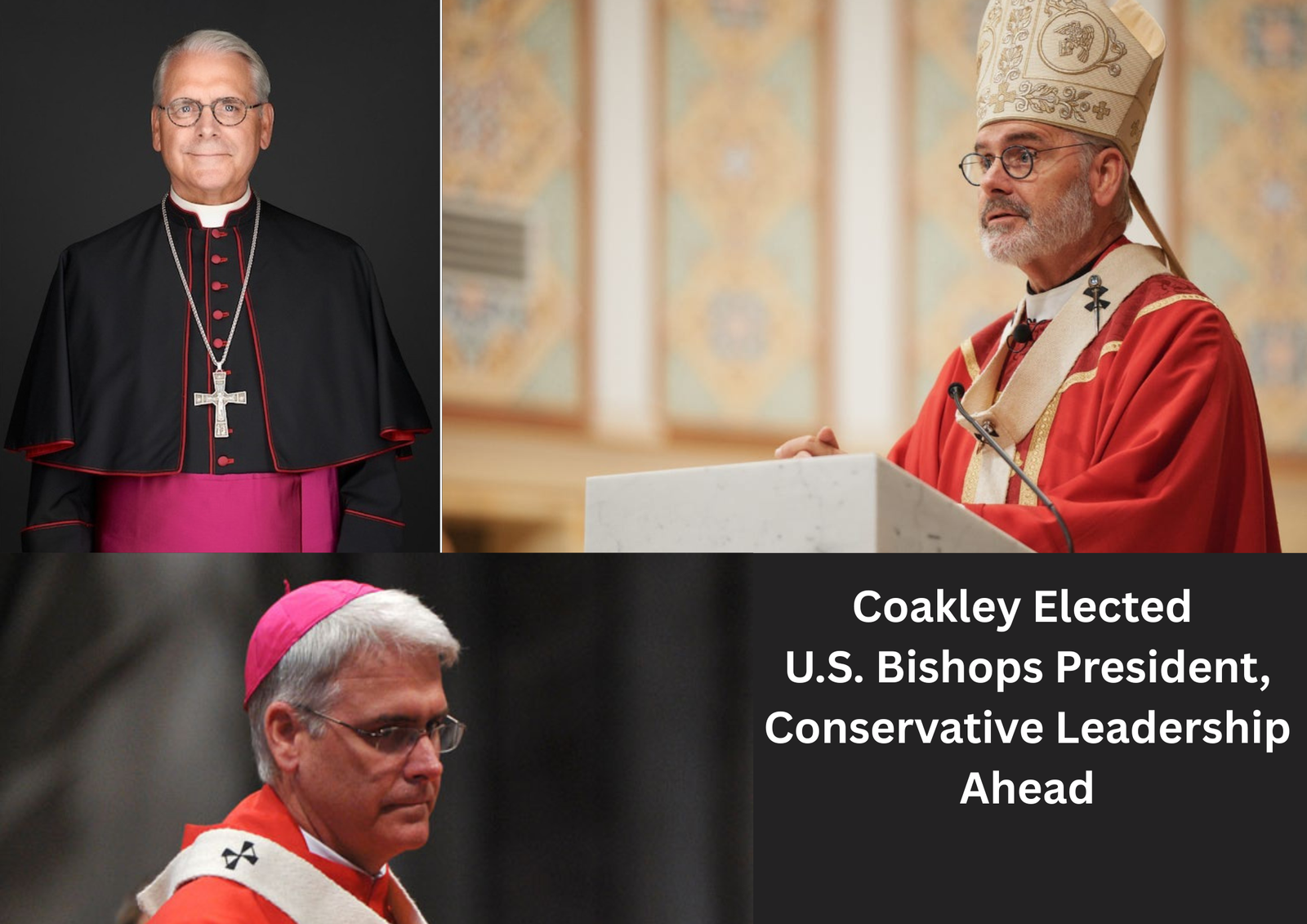
The United States Conference of Catholic Bishops (USCCB) has chosen Archbishop Paul Coakley of Oklahoma City as its new president during the bishops’ fall assembly in Baltimore. Coakley, who previously served as the conference’s secretary, won the election on the third ballot and will serve a three-year term beginning immediately after the assembly.
In a related vote, Bishop Daniel Flores of Brownsville, Texas, was elected vice president. Under church rules, the vice president is automatically regarded as president-elect and is expected to succeed Coakley after his three-year term.
Coakley’s election is widely seen as a shift toward more conservative and politically assertive leadership within the USCCB. A vocal figure on cultural issues, he has long opposed abortion and gender-affirming medical care for transgender individuals, describing these matters as “fundamental” and “non-negotiable.” He has also criticized Democratic Party policies on these topics and supported restrictive immigration measures, including the border wall.
Bishop Robert Barron of Winona-Rochester, Minnesota, founder of Word on Fire Catholic media star, was considered a strong contender, but Coakley ultimately secured the role. The election comes at a time when the Catholic Church in the U.S. faces deep political divides and a decline in membership, especially among more liberal and Latino communities.
Bishop Daniel Flores, the incoming vice president, brings a different perspective to the leadership team. Overseeing a diocese along the U.S.-Mexico border, he has emphasized immigration issues and pastoral care for migrants. Fluent in Spanish and holding a doctorate in theology, Flores is known for his calm, intellectual approach and is regarded as a bridge-builder who favors dialogue over political confrontation. His eventual succession to the presidency in 2028 could signal a change in tone for the conference.
Archbishop Coakley faces immediate challenges, including potential political disputes over religious liberty, ongoing internal tensions within the church, and implementation of immigration policies that have stirred debate among bishops. How he navigates these issues will shape the direction of the USCCB during his tenure.