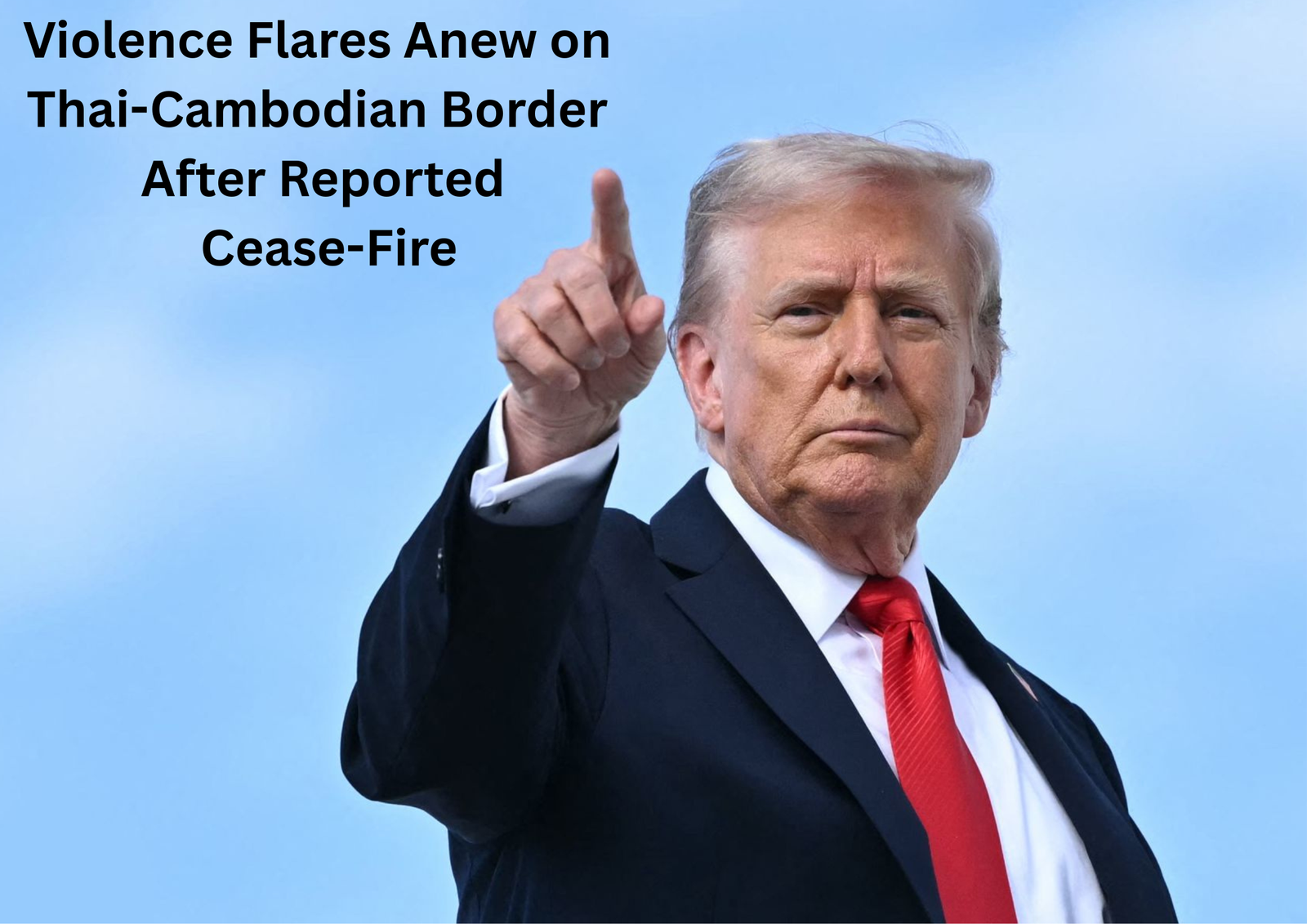
Armed confrontations along the disputed Thai–Cambodian border continued through the weekend, casting doubt on claims by U.S. President Donald Trump that the two Southeast Asian nations had agreed to reinstate a ceasefire.
On Friday evening, President Trump announced via his Truth Social account that leaders from Thailand and Cambodia had consented to halt hostilities and return to an earlier peace arrangement facilitated with assistance from Malaysian Prime Minister Anwar Ibrahim. According to Trump, the renewed truce was set to take effect immediately and would stabilize the region after recent deadly incidents involving landmines.
However, statements from both governments soon contradicted the announcement. Thai defense officials confirmed that fighting had not stopped, while Cambodia’s defense ministry accused Thai forces of launching air operations into Cambodian territory early Saturday.
Thailand Rejects Ceasefire Without Conditions
Thailand’s Prime Minister Anutin Charnvirakul publicly disputed the notion that a ceasefire was in place. He explained that during discussions with President Trump, Thailand made clear that any pause in military action would depend on concrete steps by Cambodia, including ending attacks, withdrawing troops from contested areas, and removing landmines.
“Trust requires action,” Anutin said, adding that Thailand would continue military operations until it no longer perceived threats to its territory or civilians. He also firmly rejected Trump’s characterization of the recent landmine explosion as accidental, stating that the incident was deliberate and resulted in serious harm to Thai soldiers.
Escalation Along the Border
Despite diplomatic efforts, violence has intensified. Thai public broadcaster ThaiPBS reported that at least six Thai soldiers were killed after being struck by rocket fragments. Cambodian authorities stated that Thai fighter jets conducted multiple bombing runs inside Cambodia on December 13, dropping several munitions on what Thailand described as military targets.
Both sides have accused each other of endangering civilians. Thai officials said rocket attacks damaged residential areas near the border, while Cambodia claimed Thailand destroyed infrastructure near the Preah Vihear temple, a historically sensitive site long at the center of the dispute.
The renewed clashes have resulted in at least 21 deaths this week, with officials estimating that roughly 700,000 residents have been displaced across both countries as communities flee active combat zones.
A Dispute Rooted in History
The border conflict stems from a long-standing disagreement over territorial boundaries dating back to colonial-era maps drawn in 1907, when Cambodia was under French rule. Thailand has consistently argued that these maps are flawed. Tensions escalated further after a 1962 ruling by the International Court of Justice granted Cambodia sovereignty over the Preah Vihear temple area.
Earlier this year, Malaysia brokered a ceasefire under international pressure, including trade-related warnings issued by the Trump administration. While a more detailed agreement was later finalized during a regional meeting in October, sporadic violence and escalating rhetoric eventually unraveled the deal.
Questions Over Global Mediation Efforts
The breakdown of the Thailand–Cambodia truce has raised broader questions about the durability of several international agreements championed by President Trump. Other conflict zones where Trump has claimed diplomatic success are also facing renewed instability.
In central Africa, a recently signed peace arrangement between the Democratic Republic of Congo and Rwanda has been strained by fresh violence, particularly in South Kivu province. Meanwhile, Trump’s proposed framework to end the Israel–Hamas conflict in Gaza remains unresolved, with intermittent fighting continuing.
As clashes persist in Southeast Asia, regional leaders and international observers are urging renewed diplomatic engagement, warning that prolonged violence risks destabilizing the wider region.