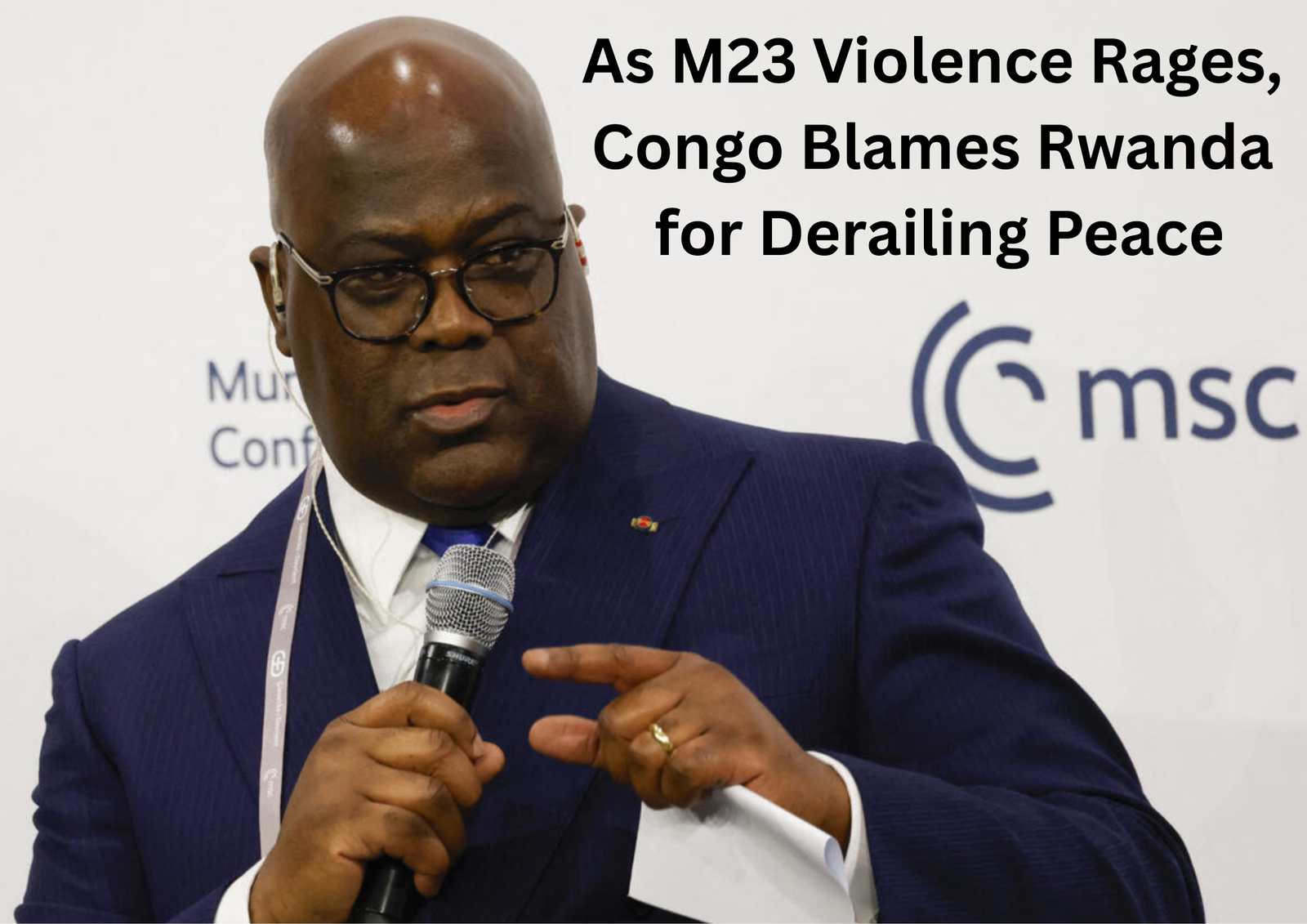
The President of the Democratic Republic of Congo, Félix Tshisekedi, has accused neighboring Rwanda of violating a recent peace agreement, warning that renewed fighting with the M23 rebel group is pushing the region back toward instability. The accusation comes as clashes intensify across the mineral-rich eastern provinces, raising concerns about regional security and global supply chains.
Accusations Surface During High-Profile Meeting
President Tshisekedi made the allegations public on December 8 during a meeting in Kinshasa with U.S. Republican presidential nominee Donald Trump. While the Congolese leader did not detail the specific actions he believes violate the agreement, he described Rwanda’s conduct as a direct breach of the fragile deal aimed at reducing cross-border tensions and rebel activity.
The meeting focused heavily on security developments in eastern Congo and their broader economic consequences, particularly for global industries that depend on the country’s natural resources.
M23 Gains Territory Amid Ongoing Denials
The M23 rebel group has seized large portions of territory in North Kivu province in recent months. The United Nations and several Western governments have repeatedly accused Rwanda of backing the group, claims that Kigali continues to deny.
Despite the presence of U.N. peacekeepers and a regional military force, the rebels have expanded their influence since launching a major offensive. The fighting has forced hundreds of thousands of civilians from their homes, worsening an already fragile humanitarian situation.
Global Economic Stakes Highlighted
Eastern Congo is home to vast reserves of cobalt, coltan, and tin-materials essential for electronics, renewable energy technologies, and electric vehicles. During his discussions with President Tshisekedi, Donald Trump drew a direct connection between regional stability and U.S. manufacturing.
“If stability collapses here, it will affect electric vehicle production in America,” Trump said, emphasizing that access to Congo’s minerals is now tied to national economic security.
Trump’s Africa Visit Signals Growing U.S. Focus
Trump’s stop in Kinshasa was part of a broader African tour that included visits to Rwanda and South Africa, marking his most significant international outreach since securing the Republican nomination. He framed the trip as both a humanitarian mission and an effort to safeguard American economic interests, criticizing previous U.S. engagement in the region as ineffective.
Regional Diplomacy Under Strain
The disputed peace agreement is part of ongoing mediation efforts led by the East African Community and the African Union. Multiple ceasefires brokered over the past two years have collapsed, often within weeks of being announced.
President Tshisekedi’s public criticism of Rwanda now casts serious doubt on whether the current deal can survive, signaling a sharp deterioration in diplomatic relations between the two neighbors.
Violence Continues as Pressure Grows on World Powers
As of early December 2025, active combat continues between Congolese forces and M23 fighters. Aid agencies report growing displacement, rising food shortages, and weakening health services across several conflict-affected districts.
The latest allegations are expected to increase international pressure-especially on the United States and European partners-to respond more forcefully to claims of cross-border involvement and to reinforce civilian protection efforts in eastern Congo.