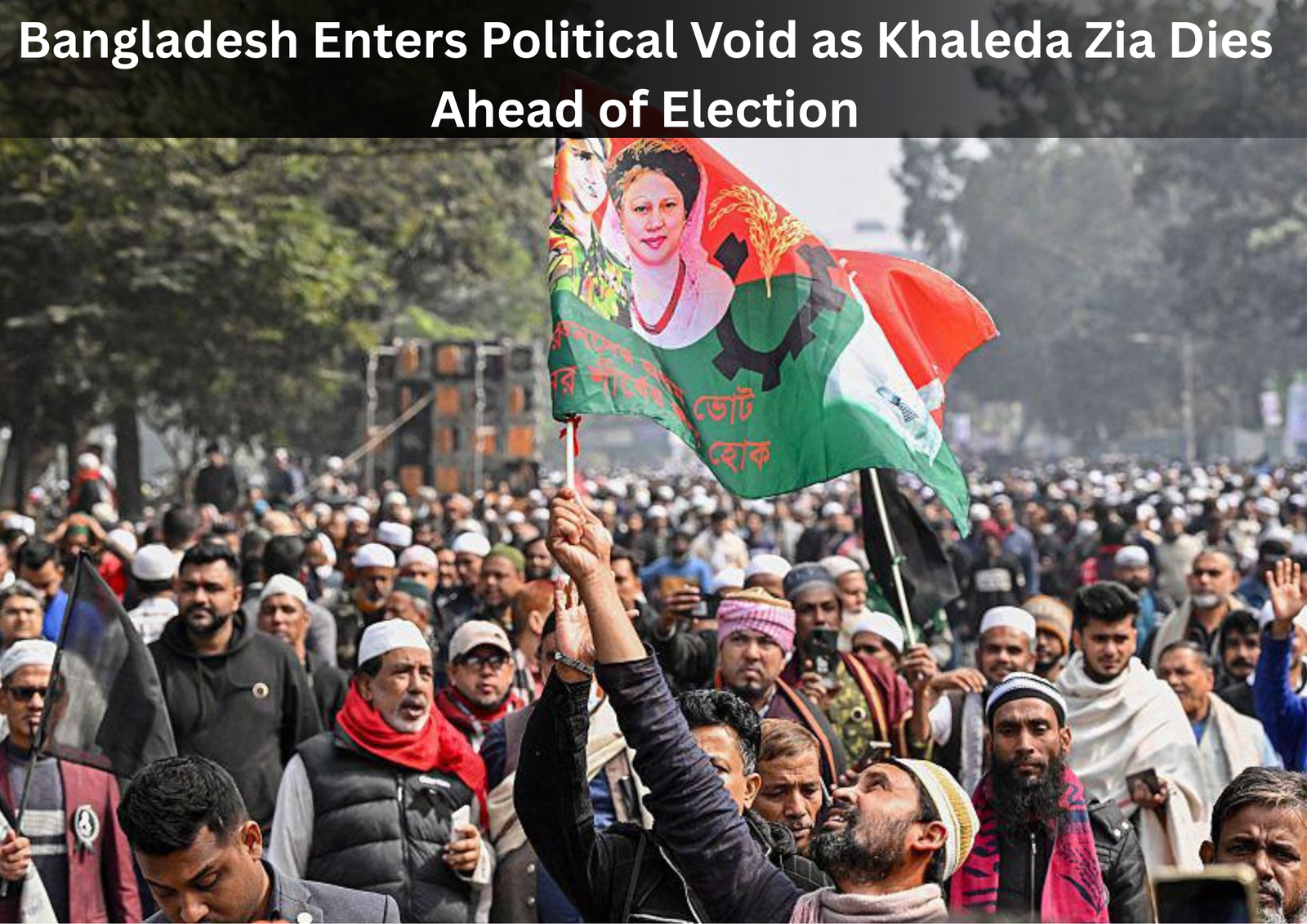
The passing of former Bangladeshi Prime Minister Khaleda Zia has introduced a new layer of uncertainty into the country’s already tense political environment, just weeks ahead of scheduled national elections. Zia, a towering figure in Bangladesh’s opposition politics for decades, died at the age of 79 following a prolonged illness, according to official statements
Zia’s death marks the end of an era for the Bangladesh Nationalist Party (BNP), which she led for nearly forty years. Her influence extended far beyond party lines, shaping national debate and defining political rivalries that dominated Bangladesh’s governance since the early 1990s.
Funeral and Public Reaction
Funeral prayers were held at Dhaka’s National Eidgah, drawing large crowds of party leaders, supporters, and members of the public. Security across the capital was visibly heightened, with authorities citing concerns over public order. After the ceremony, Zia was laid to rest at Banani Graveyard alongside close family members.
While the government announced a day of national mourning, the atmosphere surrounding the funeral reflected broader political tensions. Reports from various observers noted restricted movement in parts of the city and a heavy presence of law enforcement. Prime Minister Sheikh Hasina, Zia’s long-standing political rival, did not attend the funeral, a decision that drew attention both domestically and abroad.
Health, Convictions, and Final Years
In recent years, Khaleda Zia had largely withdrawn from public life due to declining health. In 2018, she was convicted in corruption cases that her supporters consistently described as politically motivated. She remained imprisoned until 2020, when authorities granted her a conditional release on humanitarian grounds.
The conditions of her release prevented her from traveling abroad for advanced medical care or resuming political activity. Since then, she had been receiving treatment under close supervision, spending much of her remaining time in medical facilities in Dhaka.
Implications for the BNP and Elections
Zia’s death comes at a sensitive moment for the BNP, which has announced a boycott of the upcoming elections, arguing that the current political environment does not allow for a free and fair vote. Without its founding leader, the party now faces pressing questions about leadership, unity, and strategy.
Her son, Tarique Rahman, who lives in exile in London and serves as the party’s acting chairman, is expected to guide the BNP through this transition. Analysts remain divided on whether Zia’s passing will energize opposition supporters or intensify internal divisions within the party.
A Polarizing Political Legacy
Twice elected prime minister, Khaleda Zia governed Bangladesh from 1991 to 1996 and again from 2001 to 2006. Alongside Sheikh Hasina, she defined a period of intense political rivalry often characterized by protests, boycotts, and deep partisan divides.
Supporters remember her as a defender of democratic values and civilian rule, while critics associate her tenure with allegations of corruption and political instability. Regardless of perspective, her impact on Bangladesh’s modern political history is undeniable.
International Response
International leaders and organizations expressed condolences following news of her death. Statements from regional figures and the United Nations emphasized the need for calm and inclusive political dialogue during this sensitive period.
As Bangladesh moves closer to election day, Khaleda Zia’s death has reshaped the national conversation. The coming weeks will reveal how her absence influences political participation, public sentiment, and the country’s democratic trajectory.
Stay informed as Federal Court Halts Planned End to Temporary Protected Status for Four Nations-read this detailed blog to understand the legal impact and what it means moving forward.