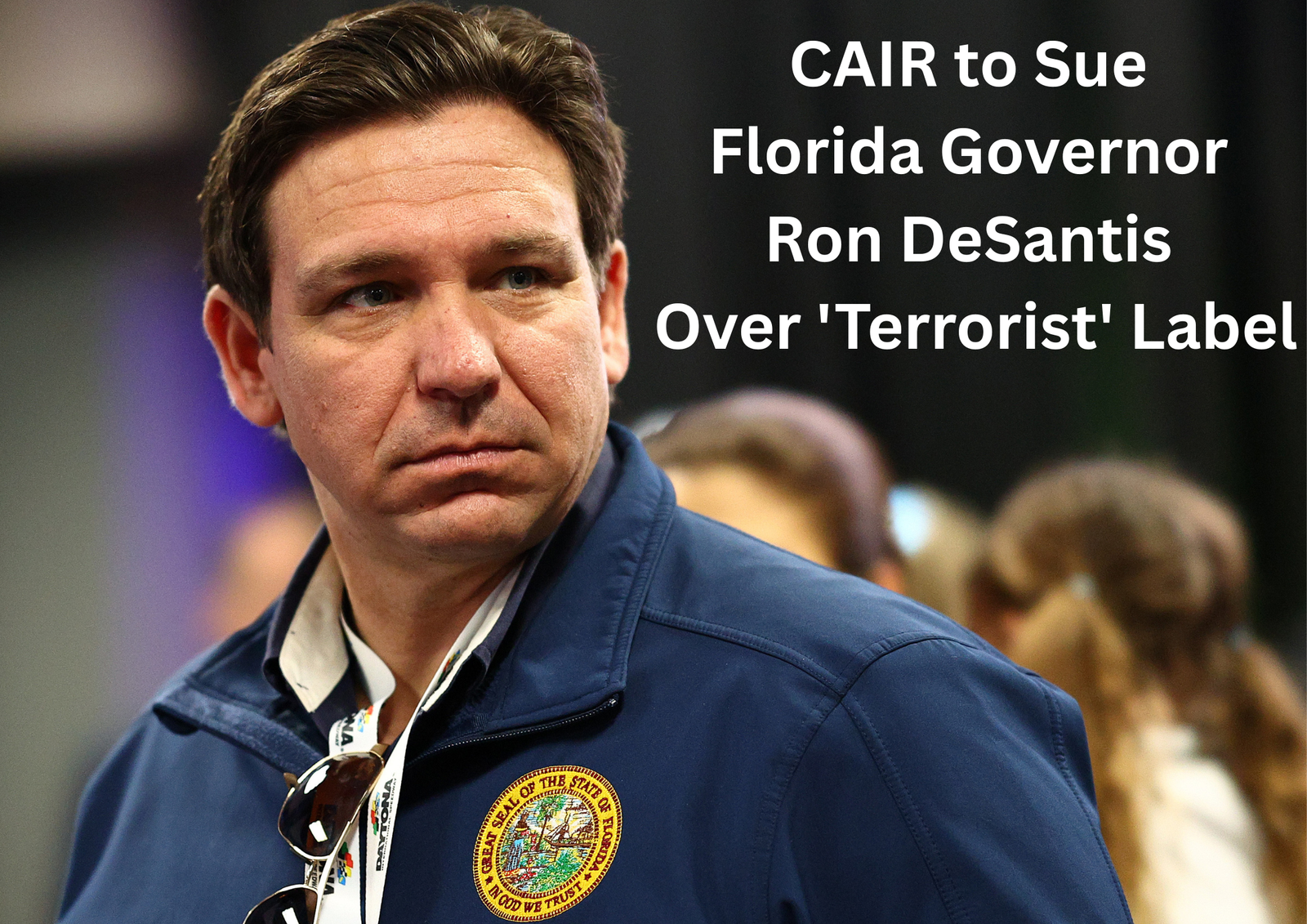
A sweeping executive order signed by Ron DeSantis has placed Florida at the center of a growing national legal dispute after the governor moved to formally label the Council on American-Islamic Relations as a terrorist organization.
The order, issued Monday, directs all Florida state agencies to immediately cut ties with the advocacy group and prohibits any public funds, contracts, or investments from being connected to the organization. The move also applies to public universities and state law enforcement agencies.
CAIR, one of the most prominent Muslim civil rights organizations in the United States, swiftly condemned the action and announced plans to challenge the designation in federal court. Group leaders called the order unconstitutional, arguing it targets protected speech and advocacy efforts related to Middle East policy and domestic civil rights enforcement.
“This order attempts to criminalize political expression and silence a community through governmental power,” a CAIR spokesperson said in a written statement. Legal filings are expected within days.
The governor’s office justifies the decision by alleging that CAIR maintains indirect relationships with extremist networks, including Hamas, which is officially designated as a foreign terrorist organization by the U.S. government. CAIR has repeatedly rejected such claims, stating that no U.S. court has ever found the organization guilty of providing material support to terrorism.
The Florida directive mirrors a similar action taken earlier this year in Texas, where state officials issued an order severing ties with CAIR. That decision is also being challenged in federal court and has not yet been upheld.
Several constitutional scholars have raised serious legal concerns about both state actions. Under federal law, the authority to designate a foreign terrorist organization rests solely with the U.S. Secretary of State. Because CAIR operates as a domestic nonprofit organization, critics argue that state-level “terrorist” designations hold no legal standing under national security statutes.
Despite this limitation, the Florida order carries immediate practical consequences inside the state. Any existing partnerships between CAIR and state agencies are now barred, and future financial relationships are prohibited.
Civil liberties organizations across the country criticized the decision, warning that it could create a dangerous precedent. Advocacy groups argue that labeling domestic nonprofit organizations as terrorist entities based solely on political positions could undermine First Amendment protections and invite broad government retaliation against lawful dissent.
Florida officials defend the move as a matter of public safety. “The state has a responsibility to ensure taxpayer resources are not linked, even indirectly, to extremist agendas,” a spokesperson for the governor said.
As of Tuesday evening, no lawsuit had yet been formally recorded in federal court, but CAIR leadership confirmed litigation is imminent. The coming legal battle is expected to test the boundaries of state authority, national security law, and the constitutional protections surrounding political speech and nonprofit advocacy.