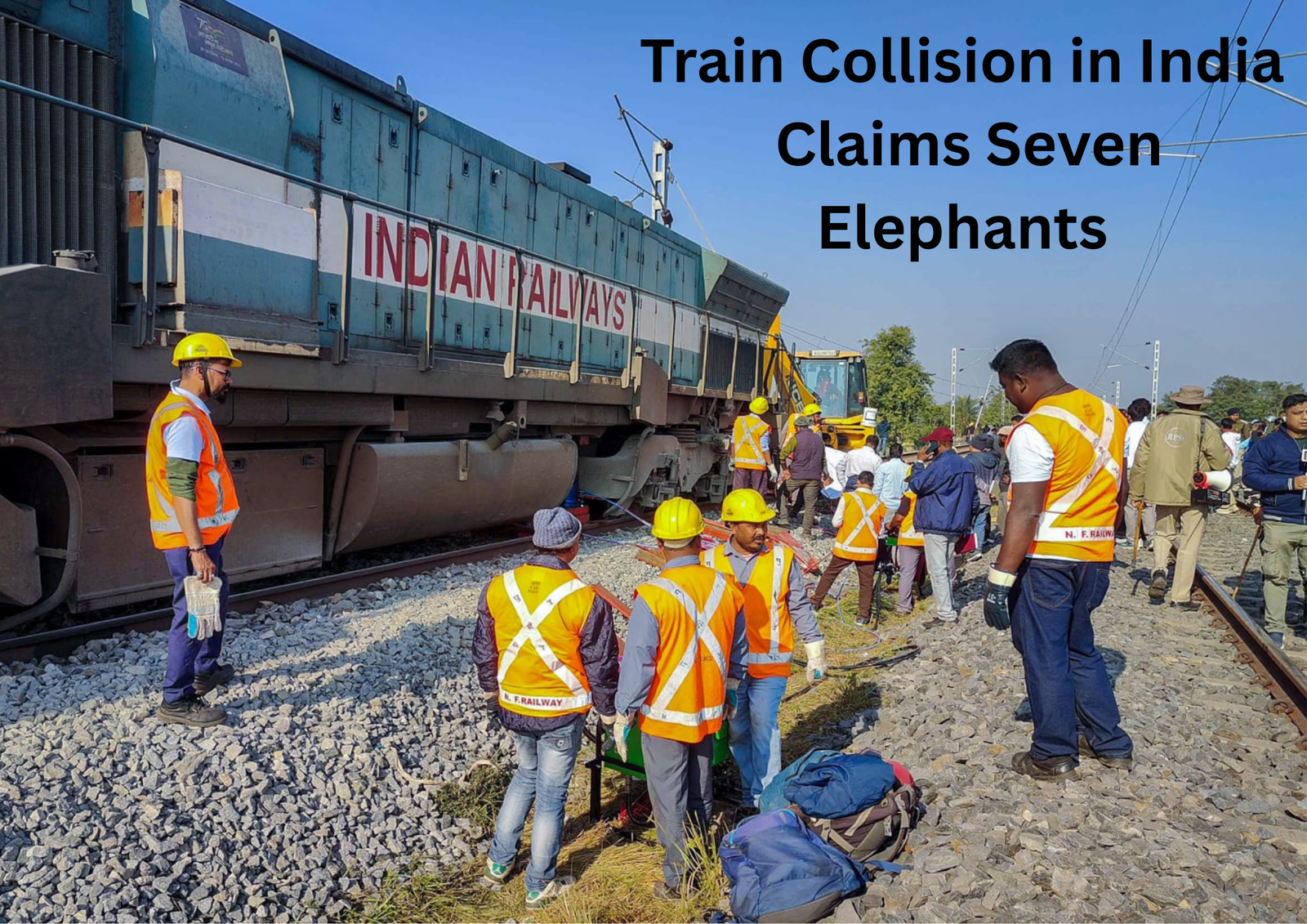
A high-speed passenger train struck a herd of wild elephants in India’s northeastern state of Assam early Saturday, killing seven animals and injuring a calf, while causing a partial derailment of the train. Authorities confirmed that no passengers or crew members were hurt in the incident, which occurred in a forested stretch of Hojai district, roughly 125 kilometers southeast of Guwahati.
The collision involved a New Delhi-bound Rajdhani Express carrying about 650 passengers. Railway officials said the train’s driver noticed a large group of elephants on the tracks and immediately activated the emergency braking system. Despite slowing down, the train was unable to stop in time and struck the animals, derailing the engine and five coaches upon impact.
Railway staff quickly evacuated around 200 passengers from the affected coaches and moved them to undamaged cars. Emergency teams were dispatched to the site, and alternative transportation was arranged for travelers heading toward Guwahati. After safety checks and clearance operations, the train was later able to resume its journey, while rail traffic in the area faced several hours of diversions and delays.
Forest department officials reported that the elephants killed included three adults and four juveniles. A young calf survived the impact but sustained injuries and was treated by veterinarians. Post-mortem examinations were conducted on the deceased animals before they were buried near the site, following established wildlife protocols.
The Northeast Frontier Railway clarified that the location of the accident is not officially designated as an “elephant corridor.” Such corridors are areas identified by authorities where trains are required to reduce speed and follow heightened safety measures due to frequent elephant crossings. India has around 150 recognized elephant corridors, with a significant concentration in the northeastern region.
Wildlife experts say the incident highlights a growing challenge in balancing infrastructure development with conservation. Assam is home to one of the largest populations of Asiatic elephants in the country, estimated to be between 6,000 and 7,000 animals. As forests shrink and habitats become increasingly fragmented, elephant herds are often forced to move through agricultural land and across railway tracks in search of food and water.
Veteran conservationist Kushal Konwar Sarma noted that habitat loss has scattered elephant populations, making their movement patterns less predictable. “Once their ancient migratory paths vanish, elephants are forced to venture wherever resources remain,” he stated.“Railway lines often cut through these paths, increasing the risk of fatal encounters.”
Various technological solutions, including motion sensors and vibration-based alert systems, have been tested to warn train drivers of elephant presence. On-the-ground results have been disappointing, as maintaining these systems across such expansive regions has proven difficult.
Government data indicates that train accidents are among the leading causes of accidental elephant deaths in India, second only to electrocution. In Assam alone, at least a dozen elephants have reportedly been killed in train-related incidents since 2020. The risk is particularly high during harvest season, when elephants are drawn toward ripening crops near human settlements.
Saturday’s collision has renewed calls from conservation groups for stricter speed regulations in sensitive zones, improved coordination between railway and forest departments, and more effective land-use planning to preserve wildlife corridors.
As cleanup operations concluded and rail services gradually returned to normal, the loss of the elephants served as a stark reminder of the ongoing conflict between expanding infrastructure and the protection of India’s iconic wildlife.