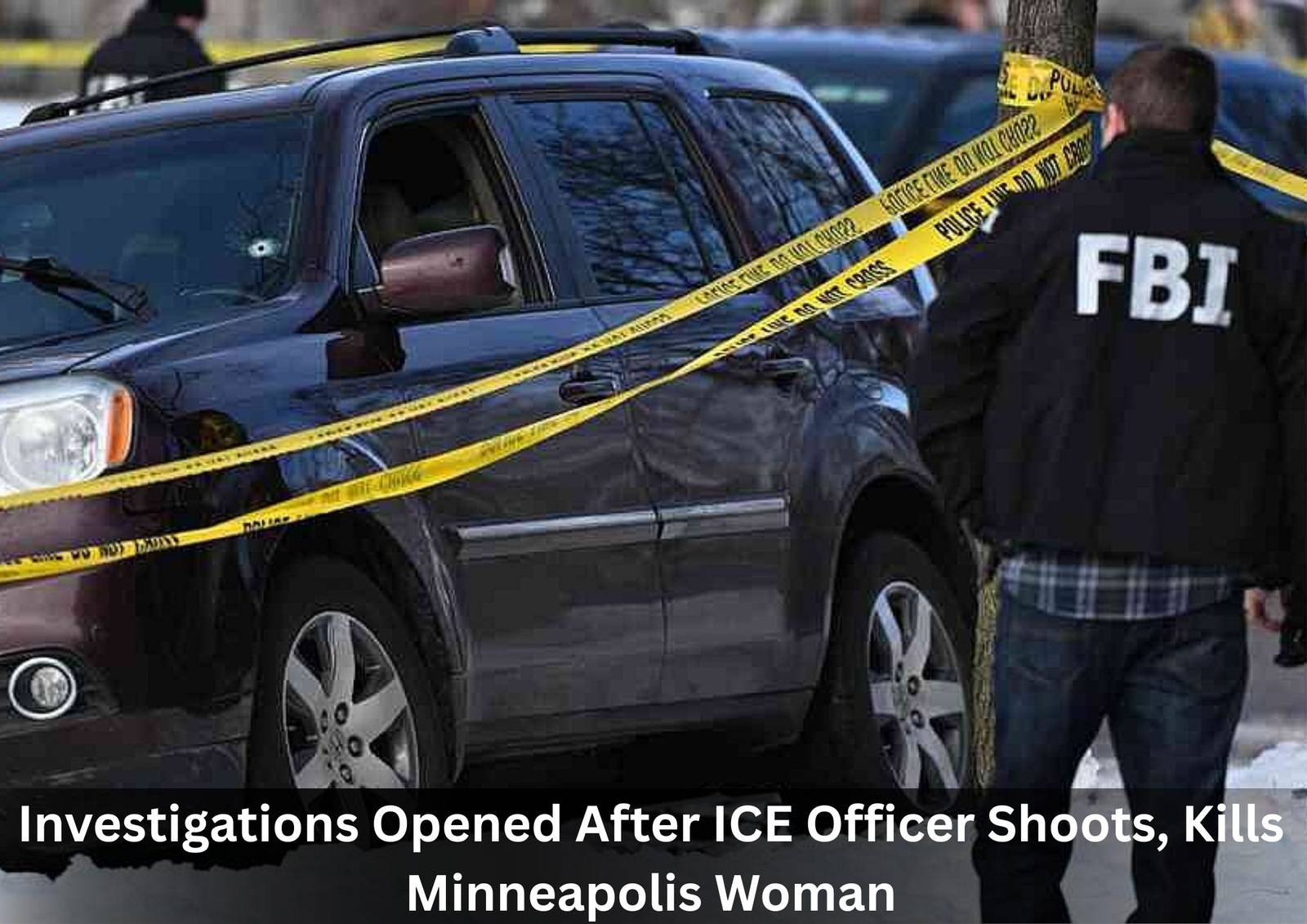
A veteran Immigration and Customs Enforcement (ICE) officer who survived a high-profile injury last summer fatally shot a 37-year-old woman in Minneapolis this week, setting off a series of overlapping investigations, public demonstrations, and heightened security measures across the city.
The fatal encounter occurred Wednesday in a south Minneapolis neighborhood after ICE personnel attempted to drive down a narrow residential street and came upon a car partially stopped in their path. The driver was later identified as Renee Nicole Good.
Confrontation Captured on Video
Video recorded by bystanders shows two ICE agents rushing to Good’s vehicle and attempting to open the driver-side door while shouting commands. A third officer, confirmed by senior Homeland Security officials to be Jonathan Ross, positioned himself directly in front of her vehicle.
Footage shows Good reversing briefly before moving forward again. Her wheels appeared angled slightly to the right rather than directly toward Ross, though it remains unclear whether the car made physical contact with him before shots were fired. Ross discharged multiple rounds, striking Good. Her vehicle sped forward, colliding with parked cars a short distance away. She died from her injuries a short time later.
After the shooting, Ross approached the crashed vehicle before retreating and instructing others to summon emergency services. Witnesses reported that Ross and at least one additional ICE agent left the scene in another vehicle.
Officer Previously Injured During 2025 Pursuit
Officials later confirmed that Ross is the same ICE officer who made headlines in June 2025 after being dragged approximately 100 yards by a fleeing suspect during a traffic stop in Bloomington, Minnesota. Court documents from that case describe Ross breaking a vehicle window and attempting to open the door when the driver accelerated, pulling him at high speed across a curb before he was thrown from the car. Ross sustained deep lacerations that required more than 30 stitches.
The suspect in that case, Roberto Carlos Muñoz-Guatemala, was convicted in December 2025 of assaulting a federal officer. Sentencing is pending.
Homeland Security officials highlighted Ross’s service record, noting more than a decade with ICE and his selection to an elite Special Response Team requiring extensive firearm proficiency and continuous tactical certification.
Polarized Political Reaction
The incident immediately drew starkly different responses from local and federal officials.
Homeland Security Secretary Kristi Noem defended the shooting, asserting that Ross “acted within his training to protect himself and colleagues” and accused Good of obstructing federal operations.
Vice President JD Vance referenced the 2025 dragging incident while speaking to reporters, suggesting such a history could make an officer “highly alert to the threat posed by a vehicle.”
Local leaders voiced serious objections. Minneapolis Mayor Jacob Frey and Minnesota Governor Tim Walz both condemned the shooting and renewed demands for ICE to leave the city and state.
ICE’s use-of-force directive states that deadly force may only be used when an officer has a reasonable belief of imminent death or serious injury. The policy specifically discourages firing at moving vehicles unless the vehicle itself poses an immediate lethal threat and no safer alternative exists.
Law Enforcement Experts Raise Concerns
Several policing specialists questioned the tactical decisions made during the encounter.
Former Minneapolis Police Chief Medaria Arradondo argued that standing in front of a running vehicle increases risk and noted that deadly force must meet a high threshold. Retired FBI agent Michael Harrigan cautioned against allowing previous traumatic encounters to influence judgment, stating each confrontation must be evaluated independently.
Former ICE deputy chief of staff John Amaya echoed concerns about firing into moving vehicles and noted that most ICE officers receive limited training in managing large civilian crowds-an increasingly common scenario when immigration enforcement operations draw public attention.
Investigations Shift and Legal Pathways Examined
Initially, federal and state agencies shared investigative responsibility. By Thursday, however, the FBI and U.S. Attorney’s Office informed the Minnesota Bureau of Criminal Apprehension (BCA) that it would no longer participate. BCA officials said they expect a full federal investigation and that findings will be provided to both state and federal prosecutors.
Legal scholars emphasized that federal officers enjoy certain immunity protections but can still face state charges if actions fall outside authorized duties.
National Guard Staged Amid Protests
Public demonstrations emerged throughout the city following the shooting, leading Governor Walz to pre-position the Minnesota National Guard as a precaution in case of escalating unrest. Officials said Guard units would assist with infrastructure protection and allow local agencies to focus on investigative work and public safety. The Minnesota State Patrol also mobilized 85 members of its Mobile Response Team.
Walz stated that officials “have every reason to believe peace will hold,” but said Guard units would remain ready should conditions deteriorate.
Curious why “U.S. Military Activity in Greenland Sparks Lawmaker Questions and Investor Unease” is trending? Don’t miss the full story-read this blog for deeper insights and context.