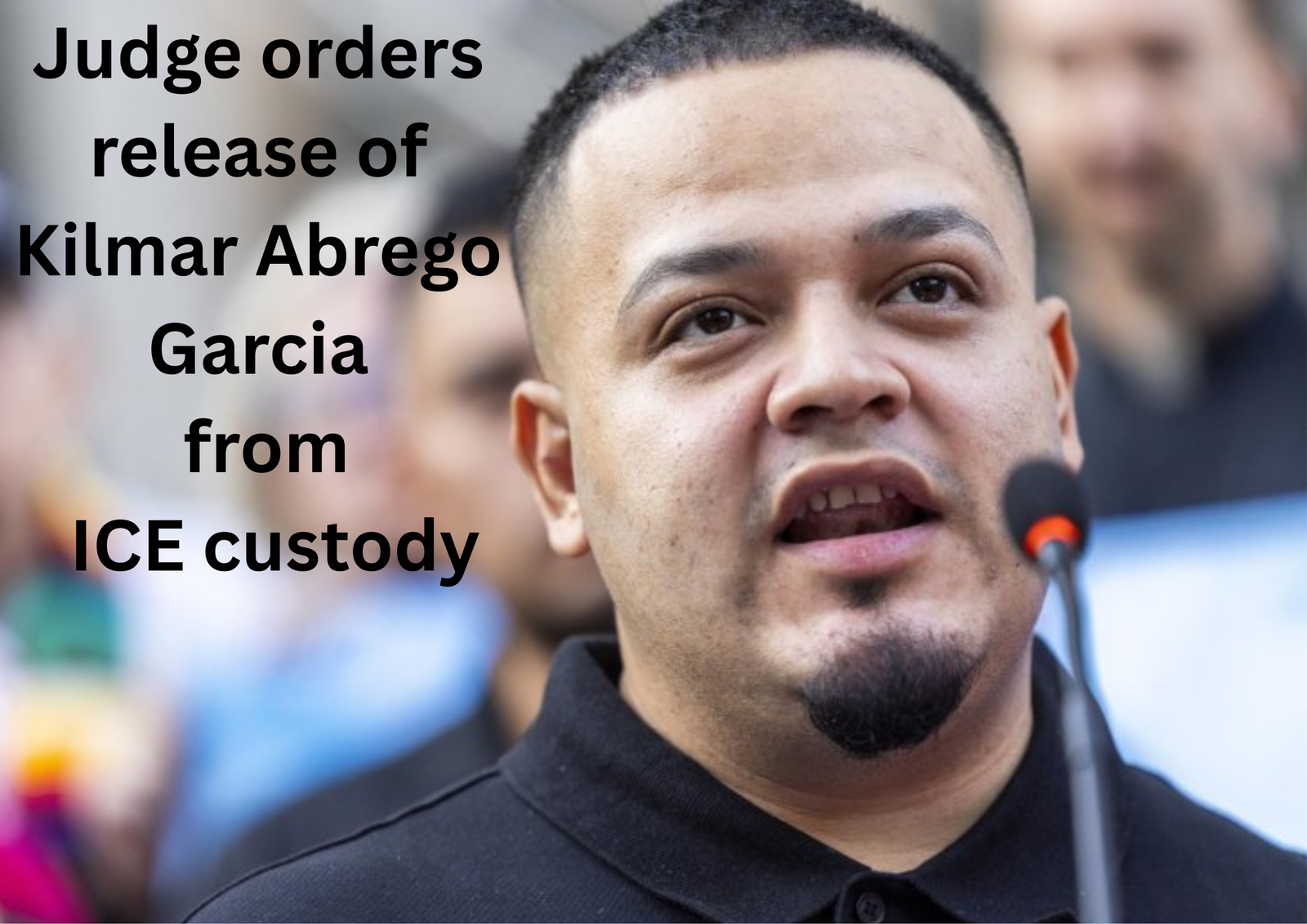
Kilmar Abrego Garcia, a 30-year-old undocumented immigrant from El Salvador who has lived in Maryland for years, walked out of federal immigration custody on Thursday after a judge ruled his detention had no legal foundation. The decision came from U.S. District Judge Paula Xinis, who concluded that government lawyers misrepresented key facts about his immigration status and the basis for removing him from the United States.
In a sharply worded 31-page ruling, Xinis stated that no valid deportation order is currently in place for Abrego Garcia, making it unlawful for ICE to continue holding him for removal. She also wrote that both Justice Department attorneys and an ICE official gave inaccurate testimony last month, asserting he would be deported to Liberia because Costa Rica had withdrawn an offer of residency. The court found that Costa Rica’s promise to accept him as a refugee never changed and remained “clear and unconditional.”
Xinis said the government’s actions over several months showed that his detention “was not for the purpose of facilitating removal,” but rather reflected a pattern of inconsistent and misleading claims.
Abrego Garcia’s case has drawn national attention throughout the Trump administration due to its unusual legal twists. In March, he was mistakenly deported to El Salvador despite a standing 2019 court order shielding him from return because of documented risks to his safety. Officials had accused him of belonging to the MS-13 gang-an allegation he continues to deny. He was sent back to the United States in June to face unrelated human smuggling charges in Tennessee, where he has pleaded not guilty.
After a federal judge in Nashville released him into the custody of his brother in Maryland over the summer, ICE detained him again, beginning a new series of attempts to deport him. According to Xinis, officials notified Abrego Garcia multiple times that he would soon be removed to Uganda, Eswatini, or Ghana, even though none of those nations had agreed to receive him. The court questioned why the government pursued “impossible destinations” instead of Costa Rica, his preferred option and a country willing to accept him.
His attorney, Simon Sandoval-Moshenberg, described Thursday’s release as a major step forward. “This ruling is an enormous relief for our client and a reaffirmation of due process,” he said after picking Abrego Garcia up from a remote Pennsylvania detention center.
The Trump administration forcefully pushed back on the judge’s decision. Department of Homeland Security spokesperson Tricia McLaughlin called the order “judicial overreach by an Obama-appointed judge” and insisted the government would contest the ruling “at every level of the courts.”
Although no longer in ICE custody, Abrego Garcia remains under strict conditions stemming from the criminal case in Tennessee. He must live with his brother in Maryland, stay within the state unless granted permission to travel, and limit outings to work, worship, medical care, and court-related matters. He is also required to check in regularly with ICE’s Baltimore field office.
His trial on human smuggling charges is scheduled for January. He is currently seeking dismissal of those charges, and some of the related proceedings have been sealed.
Judge Xinis ended her ruling by noting that intervention from the courts had become necessary, writing that the circumstances of the case “demonstrate the judiciary’s essential role.” Her decision adds another dramatic chapter to a legal saga involving wrongful deportation, international negotiations, and escalating tension between federal judges and immigration authorities.