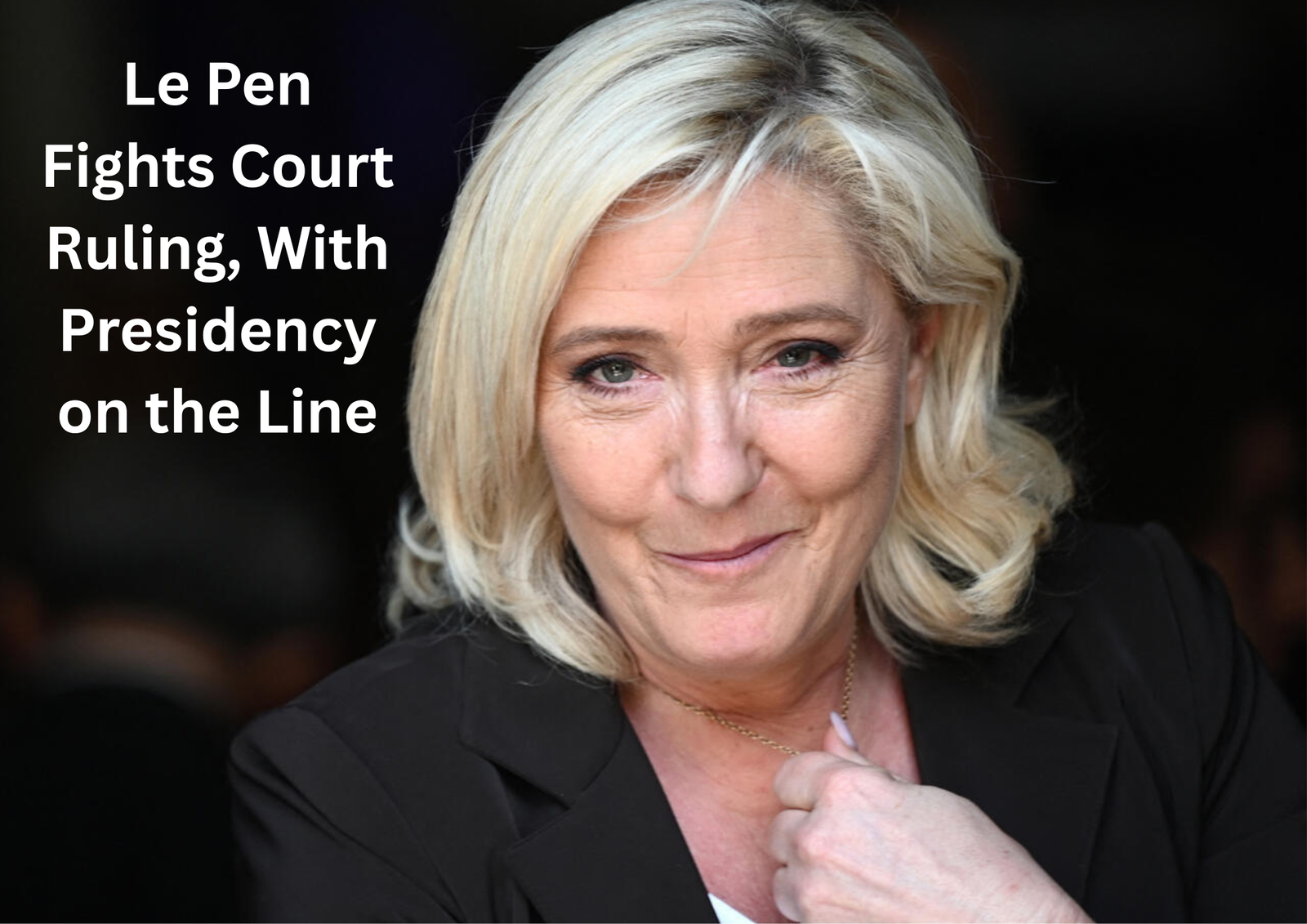
Marine Le Pen returned to the Paris Court of Appeal on Tuesday to contest a conviction that currently prevents her from holding public office, injecting fresh uncertainty into France’s political landscape ahead of the 2027 presidential race. The far-right leader insisted she committed no wrongdoing and accused European Union institutions of failing to clarify the rules governing parliamentary assistant contracts.
A Case That Could Reshape the Election
Le Pen and several senior figures from the National Rally party were found guilty in March 2025 of misusing European Parliament funds by employing staff for party activities in France rather than for EU parliamentary work. Although the court concluded no personal enrichment occurred, judges criticized what they described as an “organized system” that diverted public funds. The ruling included a four-year prison term-partially served through electronic monitoring-a significant financial penalty, and a five-year prohibition on running for office.
The ongoing appeal, overseen by Judge Michèle Agi, is scheduled to span five weeks and includes eleven other defendants. A final judgment is not expected until mid-2026, months before candidates must file for the 2027 race.
Competing Narratives Inside the Courtroom
During arguments, Le Pen maintained that her party had followed standard procedures and shared organizational information openly. She pointed to the European Parliament as having failed to flag compliance concerns early on. Legal representatives for the Parliament rejected this defense, arguing that Le Pen’s position contradicted her previous criticisms of EU oversight.
High Political Stakes and Possible Outcomes
Political analysts believe the decision could dramatically alter the trajectory of France’s next presidential contest. Among the scenarios under discussion are the possibility of the conviction being overturned entirely, the ban being shortened, or the original sentence being upheld. A harsher sentence, though considered unlikely, remains legally possible.
Le Pen has portrayed the original ruling as a blow to democratic competition, asserting that the ban amounts to an attempt to remove her from contention at a moment when polls show the National Rally advancing.
Succession Plans and Shifting Dynamics
The case stems from a 2015 notification by then-European Parliament President Martin Schulz to French prosecutors. For Le Pen, the appeal represents a pivotal test in her years-long effort to rebrand the party and mainstream its image-an effort that included replacing her father, Jean-Marie Le Pen, and abandoning the National Front name.
If the ban remains in place through 2027, party leadership has signaled that 30-year-old Jordan Bardella, the current National Rally president, is prepared to assume the presidential candidacy. Bardella has gained visibility and favorable polling – with some surveys suggesting he may outperform Le Pen in a general election scenario – and has warned that excluding Le Pen would set “a troubling precedent for democratic life.”
Japan–South Korea Leaders Signal Closer Security Ties and Cultural Unity During Nara Summit, a development worth watching closely – read the full blog for deeper insights.