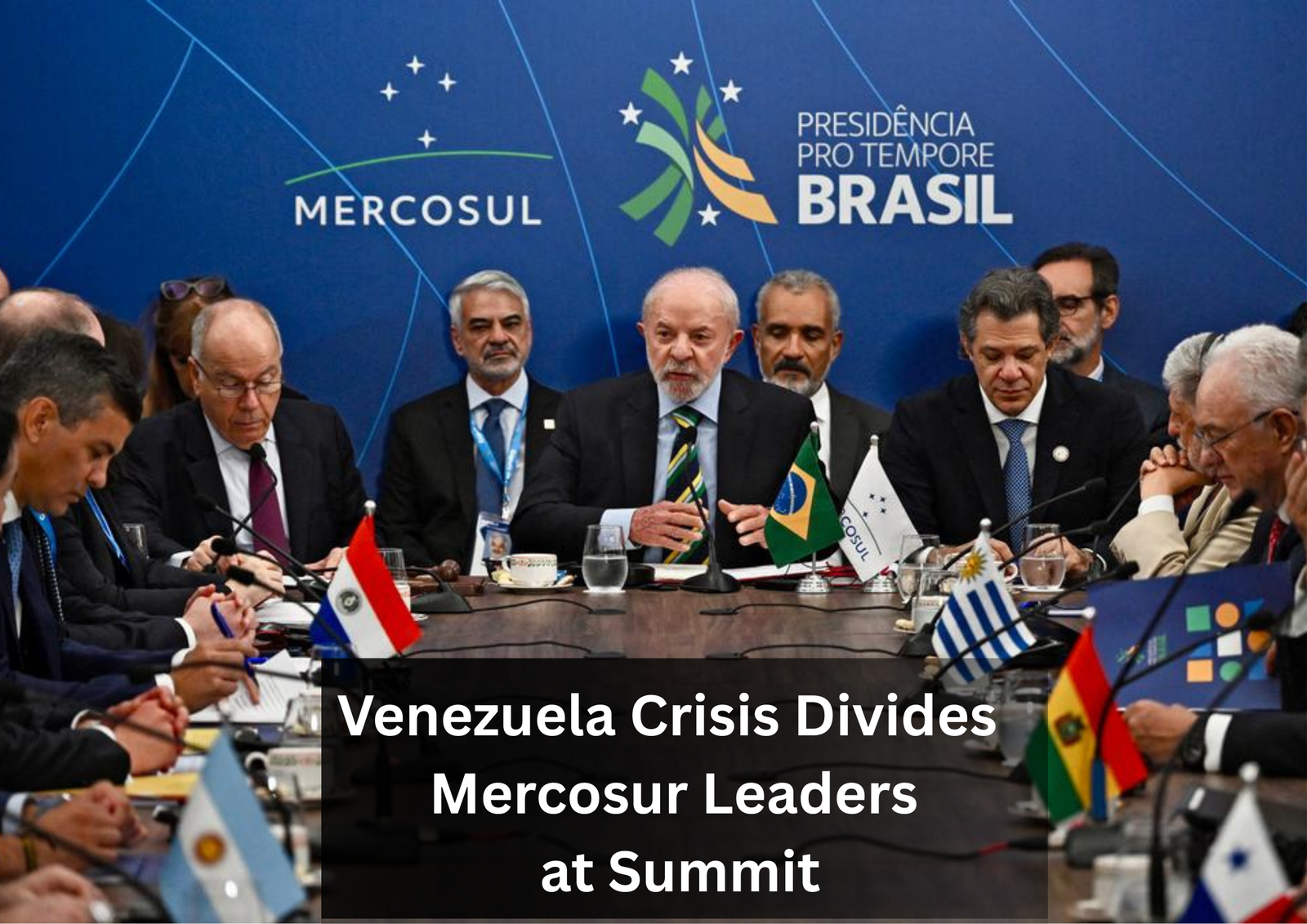
Leaders of the Mercosur trade bloc convened this week in Foz do Iguaçu, Brazil, facing sharp disagreements over how to respond to Venezuela’s deepening political and humanitarian crisis. What was intended to be a forum focused on regional economic cooperation instead exposed widening diplomatic fractures across South America, particularly between Brazil and Argentina.
Brazilian President Luiz Inácio Lula da Silva used the summit to issue a forceful appeal for restraint and diplomacy, warning that any foreign military involvement in Venezuela could destabilize the entire continent. Speaking to fellow heads of state, Lula stressed that escalating tensions risk igniting a broader regional conflict and urged international actors to prioritize dialogue over force. He emphasized that Venezuela’s crisis, while severe, should be resolved through negotiations and democratic mechanisms rather than external intervention.
Lula’s comments were widely interpreted as a response to growing U.S. pressure on the Venezuelan government, including stepped-up enforcement of economic sanctions. According to Brazilian officials, recent maritime actions linked to sanctions enforcement have heightened anxieties in Brasília about the possibility of an unintended military confrontation in Caribbean waters.
Argentina’s president, Javier Milei, took a sharply different tone, highlighting the ideological divide within Mercosur. Milei argued that Venezuela under President Nicolás Maduro poses a direct threat to regional security and accused some regional leaders of being too lenient toward Caracas. He described the Maduro government as authoritarian and violent, asserting that stronger international pressure is necessary to prevent further instability and human rights abuses.
The public disagreement between Lula and Milei underscored the challenge Mercosur faces in presenting a unified foreign policy stance. While Brazil has positioned itself as a mediator advocating engagement and de-escalation, Argentina has aligned with a tougher approach that prioritizes accountability and sanctions.
These divisions were reflected in the summit’s final communiqué. The statement acknowledged the gravity of Venezuela’s situation, describing the humanitarian and political conditions as unacceptable and calling for a peaceful, democratic resolution that respects fundamental rights. However, the declaration stopped short of directly condemning the Maduro government, a compromise that reportedly followed intense negotiations among member states.
Observers noted that the carefully worded language was designed to preserve consensus within the bloc, even as underlying disagreements remain unresolved. Smaller Mercosur members expressed concern that overtly partisan language could weaken the group’s cohesion at a time when regional economic cooperation is already under strain.
Tensions were further amplified by developments beyond the summit halls. Earlier this week, U.S. authorities intercepted a foreign-flagged oil tanker in international waters in the Caribbean Sea, suspecting it of transporting Venezuelan fuel products in violation of sanctions. The action followed another similar seizure days earlier, signaling a more assertive enforcement posture by Washington.
U.S. officials have stated that these measures are intended to limit financial flows to the Venezuelan government, which remains under extensive international sanctions. However, critics in the region argue that such operations increase the risk of miscalculation, particularly given Venezuela’s strategic location and the presence of multiple naval forces in nearby waters.
Brazilian diplomats, speaking on condition of anonymity, expressed concern that continued maritime seizures could provoke retaliation or accidental clashes. They warned that even isolated incidents could quickly escalate, drawing neighboring countries into a crisis with far-reaching consequences.
The Mercosur summit ultimately highlighted the difficulty South American nations face in balancing principles, security concerns, and geopolitical realities. While there is broad agreement that Venezuela’s crisis has had devastating effects on its population and the region, consensus on the path forward remains elusive.
As leaders departed Foz do Iguaçu, there was little indication that differences between dialogue-focused and pressure-driven approaches would narrow anytime soon. For Mercosur, the challenge now is maintaining internal unity while navigating one of the most complex and sensitive political crises in the hemisphere-one that continues to test the limits of regional diplomacy.