
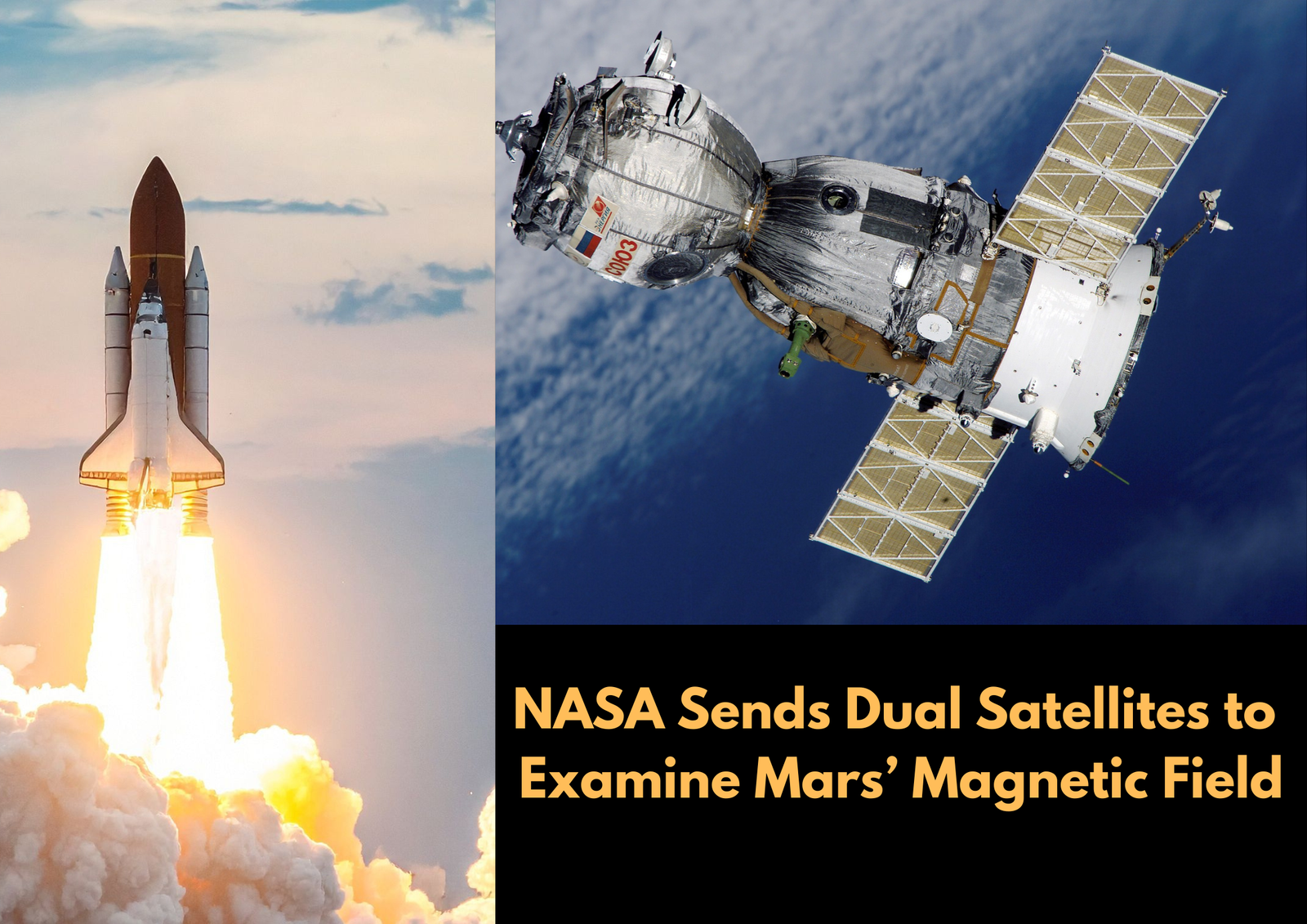
NASA has taken another bold step in Mars exploration with the successful launch of its twin ESCAPADE spacecraft, designed to study the planet’s strange and fragmented magnetic field. The two small satellites, nicknamed Blue and Gold, lifted off aboard a Blue Origin New Glenn rocket from Cape Canaveral Space Force Station at 2:45 PM ET on November 9, 2025.
The liftoff marked a major moment for both NASA and Blue Origin, as it was New Glenn’s first interplanetary mission and its third flight overall. Following a smooth ascent, the rocket’s upper stage released both satellites into space, and NASA confirmed strong communication signals from each probe shortly after separation.
The ESCAPADE mission, short for Escape and Plasma Acceleration and Dynamics Explorers, is led by researchers from the University of California, Berkeley’s Space Sciences Laboratory. It is part of NASA’s Small Innovative Missions for Planetary Exploration (SIMPLEx) program, which focuses on affordable yet high-impact planetary science projects.
Mars, unlike Earth, lacks a global magnetic shield. Instead, it has localized patches of magnetism locked into its crust. This creates a chaotic and shifting magnetic environment that interacts directly with the solar wind-the constant stream of charged particles from the Sun. The twin ESCAPADE probes will orbit Mars in tandem to measure how the solar wind strips away parts of the planet’s atmosphere and transfers energy through its magnetic regions.
By comparing real-time data from both spacecraft, scientists hope to better understand how Mars lost most of its atmosphere over billions of years, transforming from a once warm and potentially habitable planet into the dry, frigid world we know today. The mission aims to provide insight into the processes that shape not only Mars’ climate history but also the evolution of other planets exposed to solar radiation.
The spacecraft are expected to reach Mars in late 2026, where they will begin orbiting the planet and gathering synchronized data. The total cost of the project is estimated at $80 million, with UC Berkeley managing science operations valued at around $57 million. Rocket Lab, which built the two spacecraft, oversaw their design, manufacturing, and integration, while NASA’s Launch Services Program handled the launch arrangements.
With ESCAPADE now en route, NASA continues to push forward in its mission to uncover the secrets of Mars and its dynamic relationship with the Sun-another step toward understanding the evolution of worlds across our solar system.


