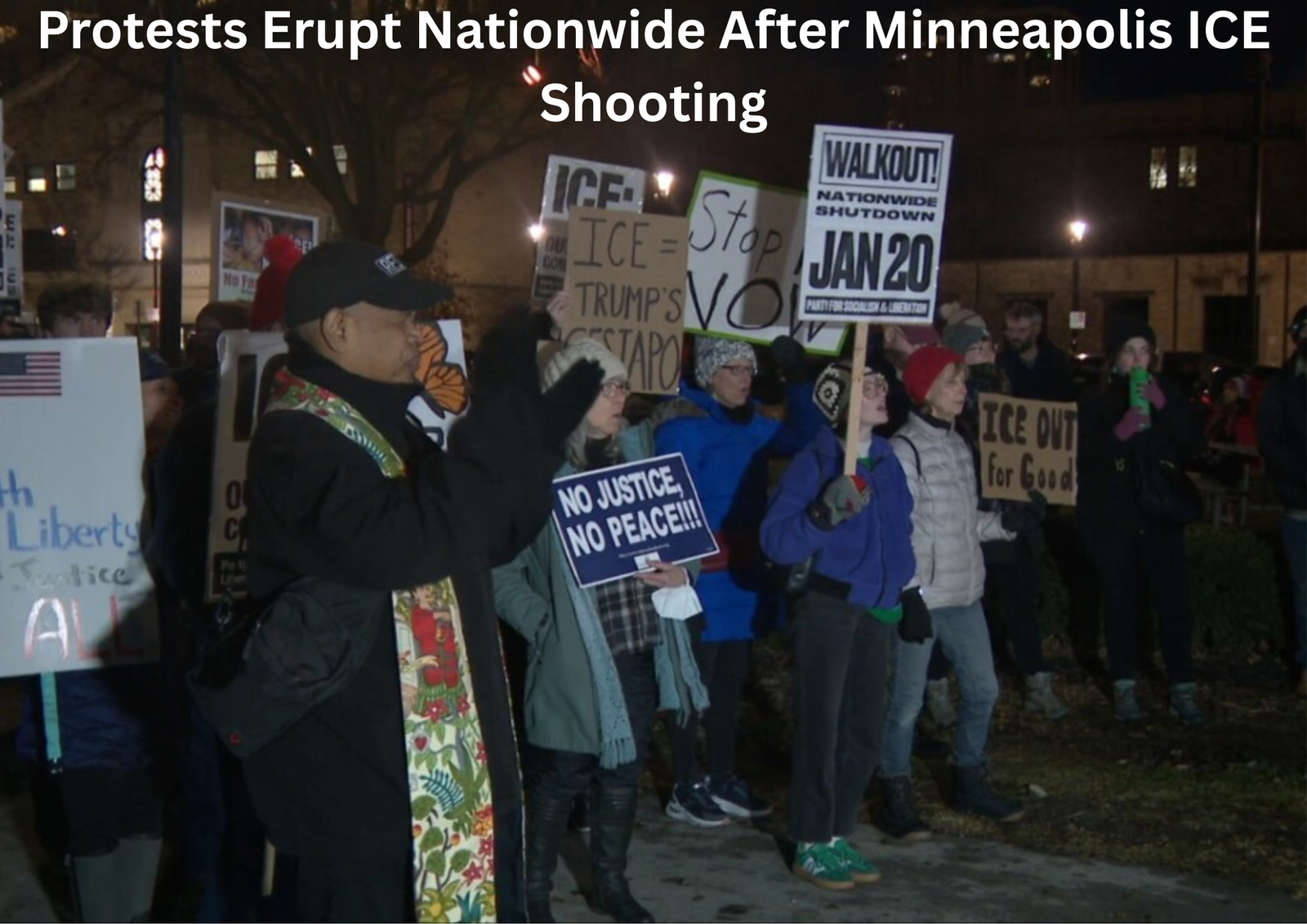
Large demonstrations and solidarity marches were held across multiple U.S. cities this weekend after a woman was fatally shot during an Immigration and Customs Enforcement operation in South Minneapolis, an incident that has drawn national scrutiny, political condemnation, and competing federal and state narratives.
Fatal Encounter Sparks Controversy
The confrontation unfolded on the morning of January 7, when ICE agents approached the vehicle of 37-year-old Renee Nicole Good, who had dropped off her young child at school moments earlier. According to newly surfaced videos filmed by agents and bystanders, Good remained in her SUV as officers attempted to open the driver-side door. As the SUV backed up and began to move forward, an ICE officer fired multiple rounds into the vehicle. The SUV then accelerated into a parked car and utility pole.
Good, a U.S. citizen, was later pronounced dead. Witnesses said emergency crews took more than ten minutes to reach her, navigating snow-covered streets crowded with federal vehicles.
Victim and Agent Profiles Emerge
Family members described Good as a poet and mother who had relocated to Minneapolis with her wife and children. Her spouse said they stopped in the neighborhood after noticing residents alerting one another to immigration enforcement activity using horns and whistles.
Federal authorities identified the shooting officer as Jonathan Ross, a longtime ICE agent and military veteran. Records show he was previously injured during a 2025 enforcement operation in a Minneapolis suburb, an incident in which the suspect later received a federal conviction for assault on an officer.
Divergent Official Narratives
Officials in Washington defended the shooting as an act of self-defense, arguing that Good attempted to weaponize her vehicle against officers. Homeland Security leadership labeled the act “violent” and referred to Good as an agitator interfering with a lawful operation.
State and local leaders rejected that account, calling the characterization misleading and politically motivated. Minneapolis Mayor Jacob Frey criticized the federal response, saying video evidence suggested Good was attempting to leave the area rather than strike officers. Minnesota Governor Tim Walz condemned what he called an avoidable tragedy and accused the administration of escalating tensions by deploying large numbers of armed federal personnel.
The FBI opened a federal investigation into the shooting, while state officials announced they would conduct their own probe after saying they had been excluded from aspects of the federal review.
Tense Weekend Protests in Minneapolis
The shooting triggered demonstrations that grew larger and more confrontational by Friday night. Approximately 1,000 protesters gathered outside a downtown hotel where ICE agents were reportedly staying. Police declared an unlawful assembly after individuals forced access to part of the building and threw snow, ice, and other objects at officers. One police officer sustained minor injuries. Authorities reported nearly thirty arrests, most resulting in citations and releases.
City officials stressed that the majority of demonstrations in Minneapolis have been peaceful, though they warned that criminal property damage or assaults on officers would result in charges.
Movement Expands Nationally
Over the weekend, hundreds of additional protests were documented across the country. Advocacy groups coordinated actions in states including Texas, Ohio, Florida, Kansas, and New Mexico, with rallies also held in Washington, D.C. Participants denounced the Minneapolis shooting and broader immigration enforcement policies.
Several protesters said they joined because of concerns over federal deployments in civilian neighborhoods and the visibility of immigration raids. In Minneapolis, marchers criticized the normalization of what they described as aggressive federal operations.
Political Pressure Intensifies
The Department of Homeland Security has confirmed it sent thousands of federal officers to Minnesota as part of an expanded enforcement effort tied to ongoing immigration fraud investigations. Officials stated the deployment was among the largest in the department’s history.
Humanitarian groups and community networks have responded by developing alert systems that notify neighborhoods of federal operations in real time. Similar systems have reportedly appeared in other cities experiencing increased enforcement activity.
On Saturday, three members of Congress from Minnesota attempted to tour an ICE facility in the Minneapolis federal building. After a brief entrance, they were directed to leave. The representatives accused ICE of obstructing legislative oversight. A federal court previously ruled that the administration could not restrict such visits.
Aftermath and Broader Context
The shooting comes nearly six years after the killing of George Floyd in Minneapolis, an event that reshaped national debates around policing, state power, and use of force. While recent protests have been largely non-violent, Minneapolis police reported an increase in emergency calls related to immigration operations, including reports of abandoned vehicles and temporary street blockages.
Good leaves behind three children. Her family has called for transparency and accountability, and civil rights groups have pledged legal support as investigations proceed.
Grateful Dead Co-Founder Bob Weir Dies at 78, sparking deep reflection across the music world. For full coverage, make sure to read my latest blog linked on my other page.