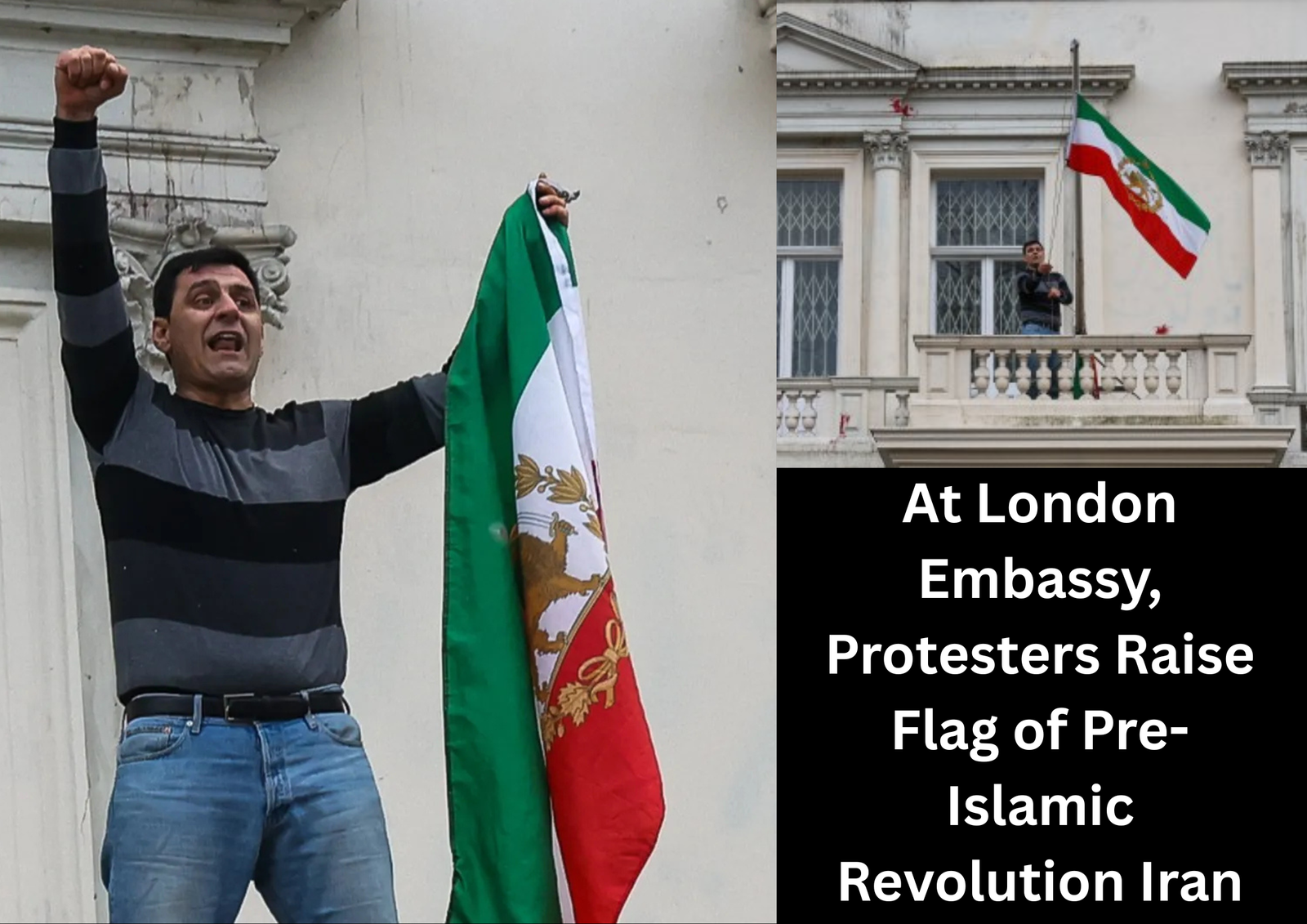
A large demonstration outside the Iranian embassy in London took an unexpected turn on Saturday when a protester scaled the front of the building and swapped the country’s flag in full view of a cheering crowd.
The individual climbed a balcony above the embassy entrance, removed the current national flag of the Islamic Republic, and hoisted the historic “Lion and Sun” emblem – a flag used before the 1979 revolution and still adopted today by monarchist and opposition communities. Footage posted by demonstrators showed hundreds applauding as the flag was raised. Embassy officials later confirmed that the original flag was restored to its pole and shared an image online.
Police estimated the crowd at between 500 and 1,000 people during peak hours. Officers moved quickly to secure the perimeter and prevent entry into the building. Two arrests were made on charges of aggravated trespass, with one case also involving assault against an emergency worker. Authorities said they are searching for a third individual who left the scene. The Metropolitan Police described the rally as “managed safely” and said additional units remained in the area for several hours as a precaution.
Saturday’s protest was part of a growing wave of international solidarity actions linked to unrest inside Iran. Demonstrations also took place in Berlin, Paris, and outside the White House in Washington, D.C., where protesters carried placards, chanted against the Iranian government and waved versions of pre-revolutionary flags.
Inside Iran, nationwide rallies triggered in late December by economic grievances have evolved into a broader political movement calling for systemic change. Human rights organizations report dozens of deaths and thousands of detentions in connection with the unrest. Internet access has been heavily restricted as authorities attempt to disrupt communication between protest groups. Critics say the current wave represents one of the most serious challenges faced by the country’s leadership in years.
Governments in Europe and North America have publicly criticized Iran’s handling of the protests. Leaders from the United Kingdom, France, and Germany issued joint remarks condemning the reported use of violent force and urged Iranian authorities to allow peaceful assembly. In Washington, political figures cautioned that widespread repression would carry diplomatic consequences, though no suggestion of military intervention was made.
Exiled opposition figures have also intensified their messaging. Reza Pahlavi, the son of Iran’s last Shah, encouraged supporters to continue demonstrations and to display opposition symbols in public spaces. In online statements he said the movement had shifted from sporadic protests to organized pressure aimed at reclaiming city centers and challenging the ruling establishment.
The Iranian government has accused foreign powers of fueling unrest and has warned that participants could face severe legal consequences. Officials have labeled some protesters as “enemies of the state,” a term associated with serious penalties under Iranian law.
The weekend’s flag incident in London now stands as one of the most high-profile symbolic gestures of the international protest wave – an image of defiance that quickly spread across social media platforms used by Iranian diaspora communities around the world.
With Greenland Rejects U.S. Takeover Bid as NATO Tensions Rise making headlines, global politics is shifting fast. For deeper insight, you need to read this blog!