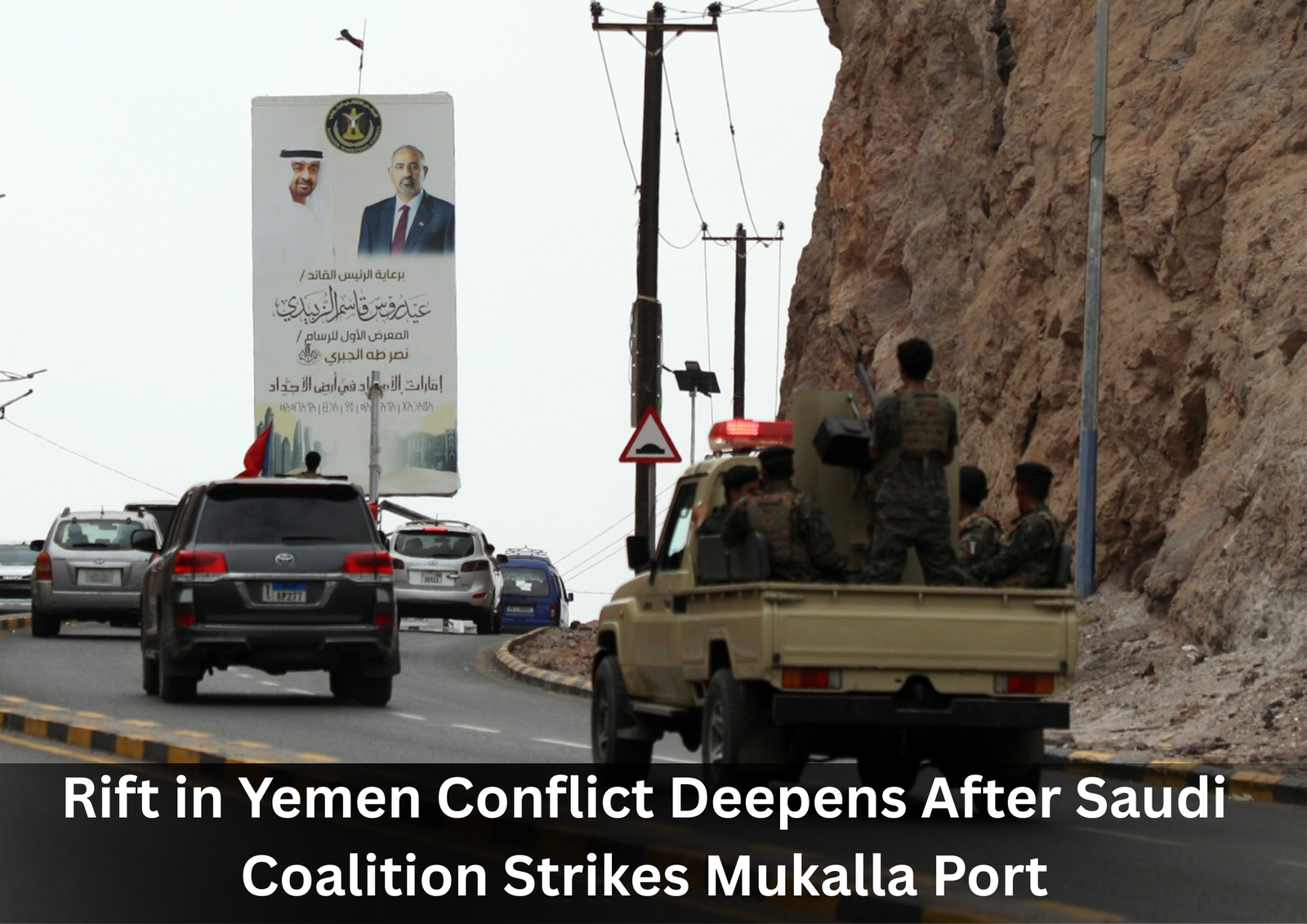
Yemen’s long-running conflict entered a new and more complex phase this week after the Saudi-led military coalition carried out an airstrike on port infrastructure in the eastern city of Mukalla, underscoring growing tensions between former allies fighting on opposing sides of the war.
The strike, confirmed by Saudi Arabia’s Ministry of Defense, targeted key facilities at Mukalla’s main port, a vital commercial and humanitarian gateway in Hadramawt province. Saudi officials stated that the port was allegedly being used to facilitate illegal weapons transfers, claiming the operation was conducted to uphold a United Nations arms embargo and safeguard regional security interests.
Mukalla, however, is not under the control of Yemen’s internationally recognized government. Instead, it is administered by the Southern Transitional Council (STC), a powerful southern separatist movement backed by the United Arab Emirates. The strike therefore marked a rare and highly sensitive moment in the conflict: a military action by one coalition partner against another.
A Strike Amid Rapid Territorial Shifts
The airstrike occurred during a period of swift military expansion by the STC. In recent days, the group has advanced far beyond its traditional southern strongholds, seizing control of large swaths of territory previously held by forces loyal to Yemen’s internationally recognized leadership.
These gains reportedly extend into central provinces such as Shabwa and Marib, areas long viewed as strategically and symbolically important. The STC’s momentum has significantly altered battlefield realities, weakening the position of the Saudi-backed government while elevating the separatists as a dominant military force in southern and central Yemen.
Observers say the timing of the Saudi strike was not coincidental. By hitting a major economic asset under STC control, Riyadh appeared to be signaling opposition to the separatists’ unilateral expansion and challenging the shifting balance of power within the anti-Houthi alliance.
Conflicting Accounts of Damage and Casualties
According to Saudi officials, the operation was precise and avoided civilian harm. The defense ministry said the strike focused exclusively on infrastructure allegedly linked to arms smuggling and denied reports of fatalities.
STC representatives and local sources in Mukalla offered a different account. They reported damage to port equipment, including storage areas and loading machinery, and said at least one person was killed while others were injured. The STC condemned the attack as an unjustified escalation, accusing Saudi Arabia of undermining a critical economic lifeline for eastern Yemen.
The port of Mukalla plays a crucial role in importing food, fuel, and humanitarian supplies. Any disruption to its operations raises concerns for civilian populations already facing severe economic hardship and food insecurity.
Fractures Within the Anti-Houthi Coalition
The incident has brought long-standing divisions within the Saudi-led coalition into sharp focus. While Saudi Arabia and the UAE have shared the objective of countering the Iran-aligned Houthi movement in northern Yemen, their strategic priorities in the south have increasingly diverged.
The UAE has invested heavily in supporting local southern forces, particularly the STC, which seeks to reestablish an independent southern state. Saudi Arabia, by contrast, has continued to back Yemen’s internationally recognized governing body, emphasizing national unity and centralized authority.
The STC’s recent military successes have effectively sidelined government-aligned forces across much of southern Yemen, calling into question the future role of the recognized leadership. Analysts suggest the Saudi airstrike reflects growing frustration in Riyadh over the STC’s actions and the diminishing influence of its allies on the ground.
A War Entering a New Phase
Beyond the immediate political fallout, the developments may fundamentally reshape Yemen’s conflict dynamics. With the STC now controlling extensive territory, a new front is emerging that could shift the war’s focus from a primarily Saudi-Houthi confrontation to a broader north-south struggle.
Such a transformation carries significant risks. A direct confrontation between the STC and the Houthis could intensify fighting across central Yemen, drawing in regional actors and complicating already fragile diplomatic efforts aimed at de-escalation.
Humanitarian organizations are also watching closely. The disruption of port operations and transport routes threatens aid delivery to millions of Yemenis who depend on external assistance for survival.
Uncertain Path Ahead
As regional and international stakeholders assess the implications of the Mukalla strike, it remains unclear whether the incident will prompt renewed negotiations or trigger further military escalation. What is clear is that Yemen’s conflict has entered a more fragmented and unpredictable stage.
The airstrike has exposed the fragile nature of alliances built on shared enemies rather than shared political visions. With former partners now openly challenging one another, prospects for a unified approach to ending the war appear increasingly remote.
For Yemen’s civilian population, already enduring years of violence and deprivation, the latest developments represent yet another layer of uncertainty in a conflict with no clear end in sight.
Read the full analysis on “Trump Blocks Major Water Infrastructure Measures, Citing Taxpayer Concerns” to understand the political impact, funding debate, and what it could mean for future public projects.