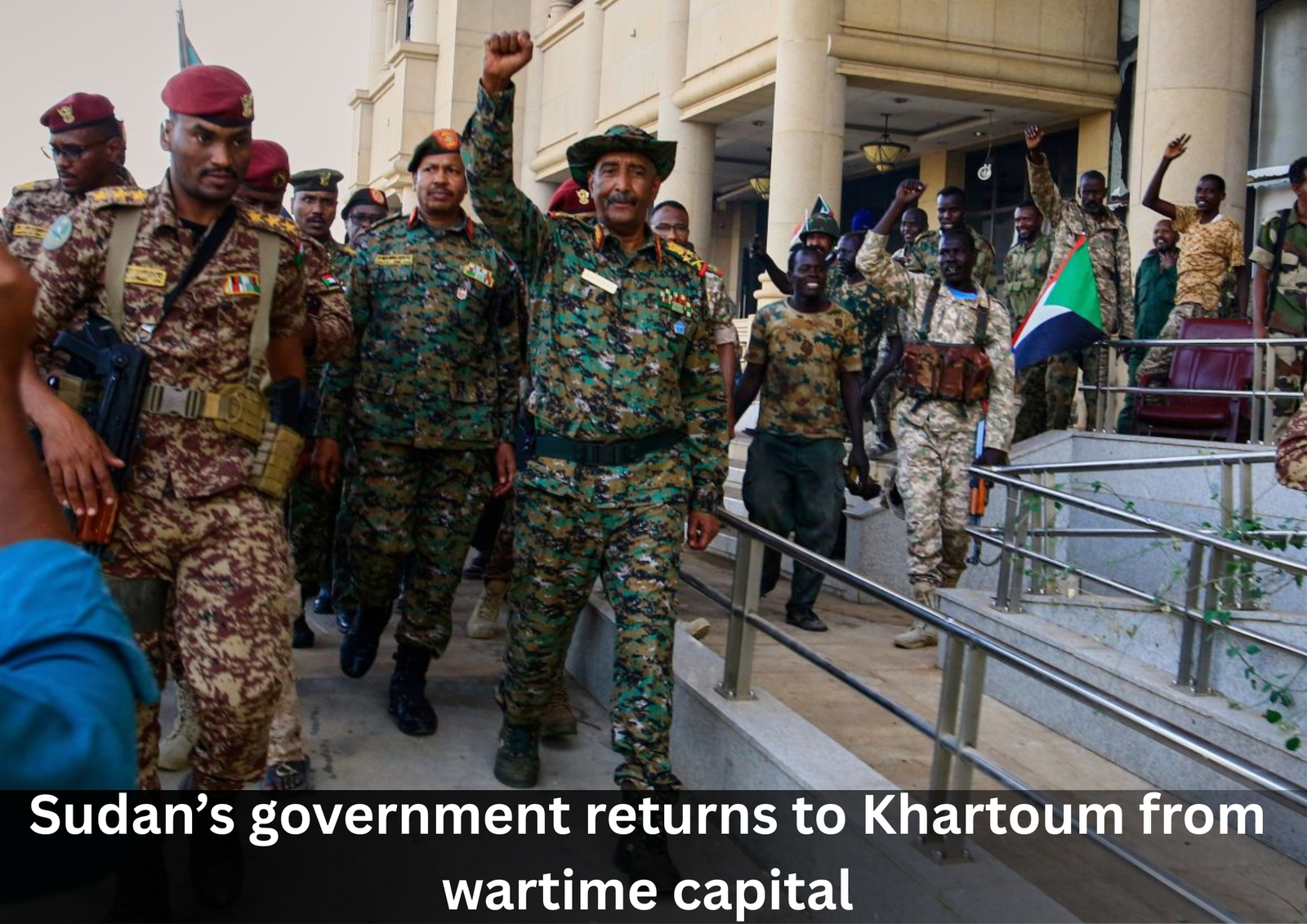
Sudan’s military-led administration has officially returned to Khartoum for the first time in nearly three years, marking a symbolic shift in the country’s fraught political transition. Prime Minister Kamil Idris confirmed the government’s reinstatement to the capital on Sunday, calling it the beginning of a “Government of Hope” and announcing 2026 as Sudan’s “year of peace.”
Idris said the immediate priority was stabilizing life for residents who have endured prolonged conflict, displacement, and the collapse of daily services. Authorities laid out plans to restore electricity, water networks, and waste collection systems, while also committing to reopen hospitals and revive the education sector. Rehabilitation of the University of Khartoum – one of Sudan’s most prominent institutions – was listed among the first restoration projects. Economic goals include stabilizing the national currency, easing inflationary pressures, and boosting national production.
The government originally fled to Port Sudan in April 2023 after violent clashes erupted in Khartoum between the Sudanese Armed Forces (SAF) and the paramilitary Rapid Support Forces (RSF). Much of the capital – encompassing Khartoum city, Omdurman, and Bahri – fell under RSF control during the early phase of the war, turning the country’s political center into one of the world’s deadliest urban battlegrounds. The SAF reclaimed the city in March 2025 after months of incremental gains, later declaring the state cleared of RSF forces in May.
The toll on Khartoum has been staggering. Large portions of the city are damaged or destroyed, with government buildings, commercial districts, schools, and utilities heavily affected. Humanitarian workers described basic services as “nearly non-operational” as late as October. Displacement has reached historic levels: roughly five million residents fled at the height of the war, and tens of thousands are believed to have died. As civilians cautiously returned to the city, many encountered destroyed homes and improvised burial sites marking the streets and neighborhoods they once lived in. UN experts estimate that restoring core infrastructure in the capital could require around $350 million.
Sudan’s civil war erupted after relations between General Abdel Fattah al-Burhan, head of the army, and his one-time deputy, RSF commander Mohamed Hamdan Dagalo, deteriorated beyond negotiation. The fighting unleashed a humanitarian disaster. Nationwide, an estimated 150,000 people have been killed and nearly 12 million displaced internally and across borders – a displacement level aid workers say exceeds any other conflict currently active.
Although Khartoum has seen relative calm since early 2025, combat continues in other regions. To the south, RSF forces have pushed through the Kordofan corridor following the army’s retreat from its final stronghold in Darfur last year. In a statement on Friday, the military claimed it dealt major losses to RSF fighters through coordinated air and ground operations across Darfur and Kordofan, reporting the destruction of dozens of vehicles and the deaths of hundreds of combatants. Independent verification remains difficult, and RSF officials did not immediately respond to the claims.
Both warring factions have faced international accusations of torture, mass killings, and systematic abuses throughout the conflict. UN personnel described the North Darfur city of el-Fasher as a “crime scene” after gaining access in late October, following its takeover by RSF forces. More than 100,000 civilians fled during an 18-month siege, with survivors reporting targeted killings and detentions on an ethnic basis. Peace negotiations have collapsed on multiple occasions, and foreign involvement has prolonged the conflict through arms transfers and political backing.
For Sudanese civilians, the government’s return to Khartoum offers a symbolic milestone – but peace remains far from guaranteed. Officials acknowledge that lasting stability will depend on ending regional fighting, rebuilding institutions, and reuniting a deeply fractured society. For now, the country heads into 2026 with cautious optimism and an ambitious promise of national reconciliation.
Hamas Signals Readiness for Gaza Governance Transfer as Diplomatic Efforts Advance – a developing shift that deserves attention. Don’t miss the full insight in this blog, read now!