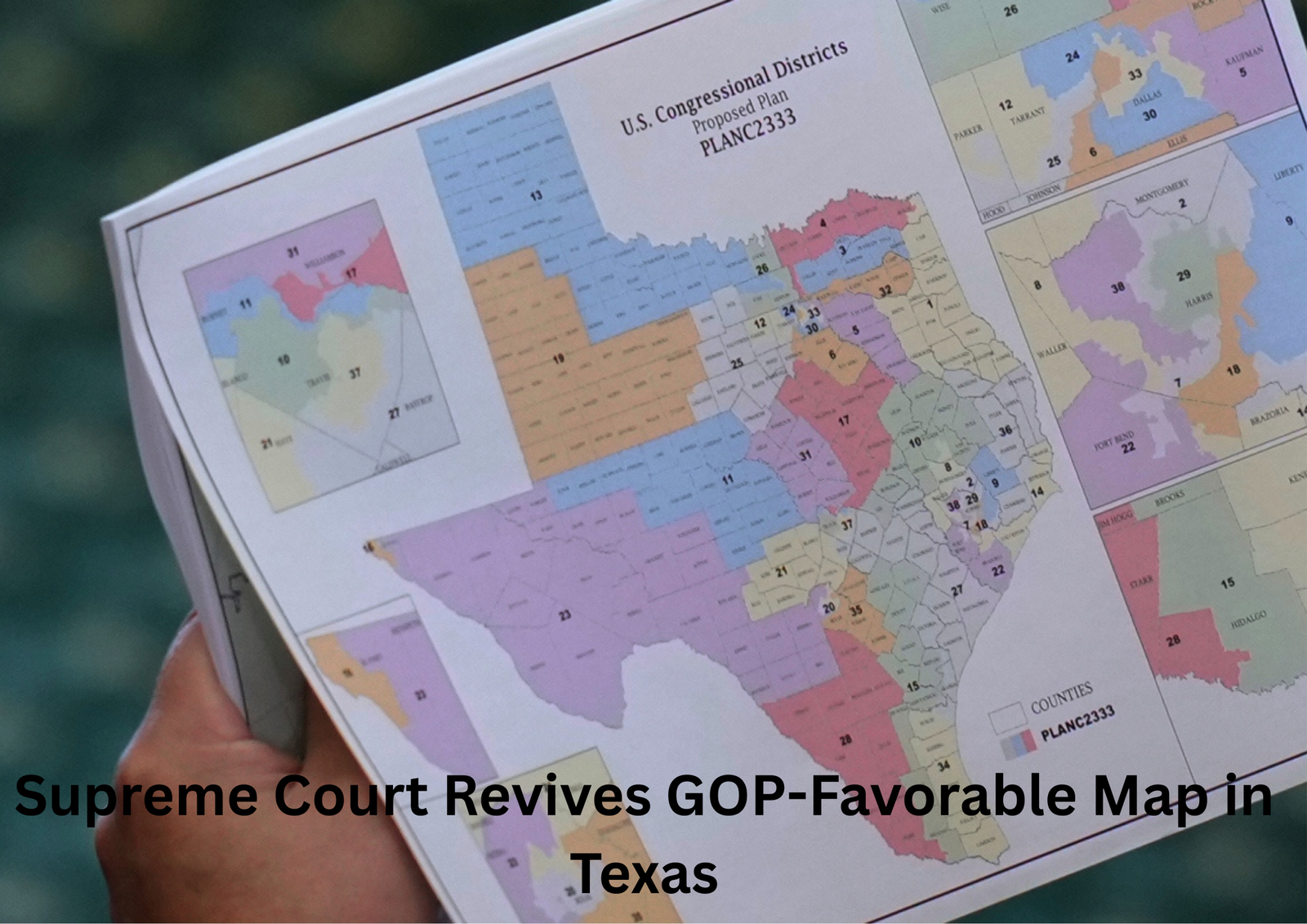
The U.S. Supreme Court has given Texas the green light to use its latest Republican-drawn congressional map for the 2026 midterm elections, a move that immediately reshapes the political landscape in one of the country’s fastest-growing states. The late-night ruling, released Wednesday, came in response to an emergency request from Texas officials who argued that further delays would disrupt the upcoming election cycle.
In a 5–4 decision, the court’s conservative majority reinstated the map drafted by the GOP-led legislature in 2023. The lower federal court that initially blocked the map had determined it likely violated the Voting Rights Act by weakening the influence of Black and Hispanic voters in several districts. That ruling is now paused while the legal fight continues.
The redistricting plan has been the subject of intense national attention-not only because Texas gained additional congressional seats after the 2020 census, but also due to reports that President Donald Trump played an unusual role in encouraging specific district boundaries. Analysts say the map could give Republicans a significant advantage by concentrating Democratic-leaning voters into fewer districts.
Civil rights groups and the U.S. Department of Justice had challenged the map, arguing it was crafted in a way that diluted minority voting power. A three-judge panel agreed, calling for a new map that offered more equitable representation. With the Supreme Court’s intervention, that order is effectively on hold.
Although the justices provided no detailed explanation for their ruling-a common practice in emergency cases-the decision ensures the contested map will be used in 2026 even as litigation continues. All four liberal justices dissented.
Election experts project that the map could allow Republicans to secure as many as 26 of Texas’s 38 House seats, even as the state’s population becomes increasingly diverse. The outcome could influence control of the U.S. House, where both parties are expected to wage fiercely competitive battles next year.
The ruling adds another chapter to a decade of legal disputes over Texas’s redistricting practices. Critics say the state repeatedly adopts political boundaries that disadvantage minority communities, while supporters argue the maps reflect legitimate partisan strategy.
With candidate filing deadlines approaching, campaigns in Texas must now organize and launch under the disputed district lines-lines that may still change depending on the eventual outcome of the case. For now, however, the Supreme Court’s decision sets the stage for a high-stakes election under boundaries drawn with clear political intent.