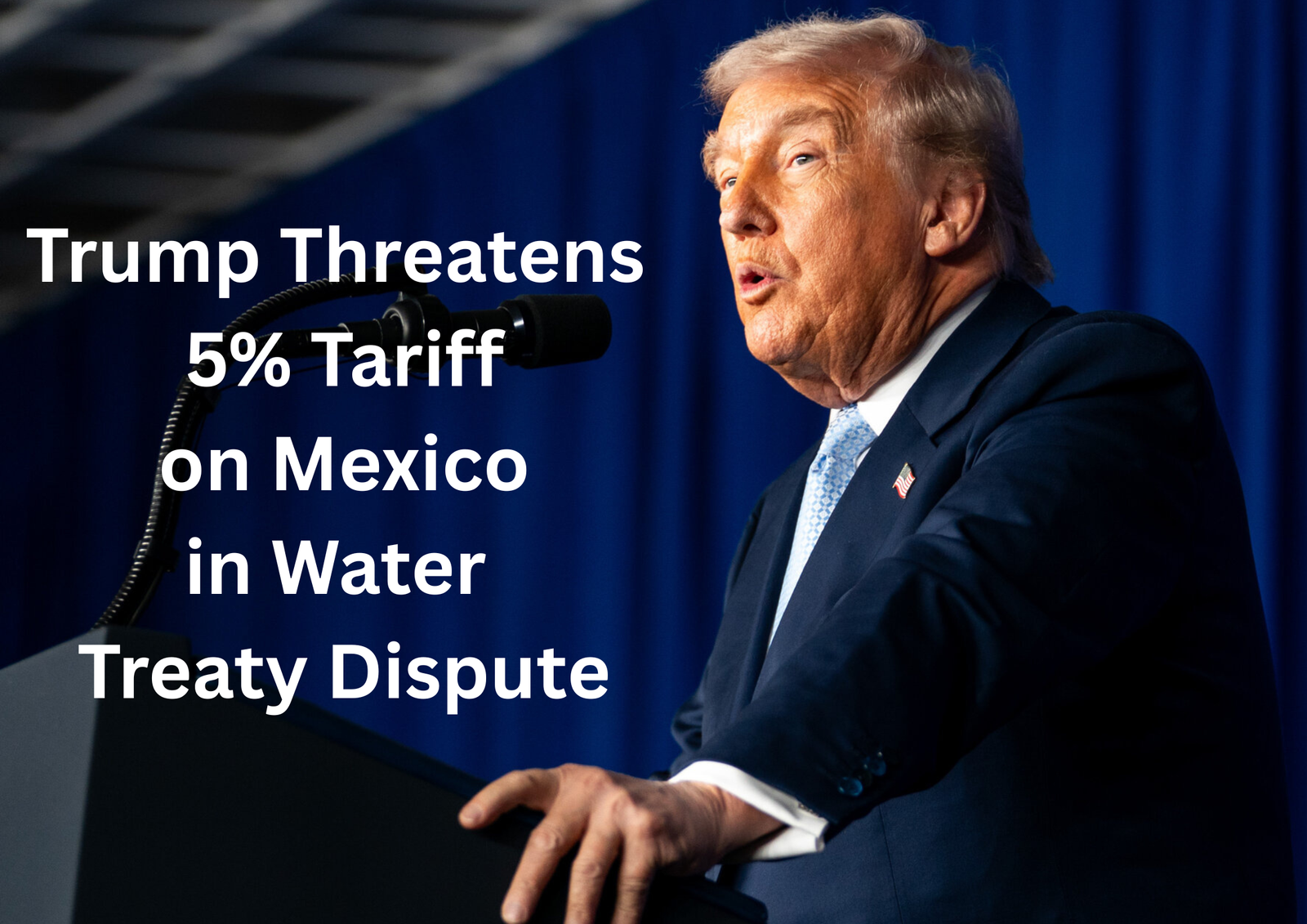
The Trump administration has issued a sharp warning to Mexico, threatening a series of escalating trade penalties over what U.S. officials describe as Mexico’s failure to meet its water delivery obligations under a decades-old international treaty.
In a recorded message released Monday, President Donald Trump announced instructions to begin the process of imposing a 5% tariff on all Mexican imports, set to take effect early Friday morning. The administration says the tariff will move forward if Mexico does not immediately deliver water required under the 1944 U.S.–Mexico water agreement, which regulates the shared use of the Rio Grande and other river systems.
According to the president’s statement, the pressure would intensify rapidly. If the water shortfall continues past mid-December, the tariff could jump to 30%.
Treaty at the Center of the Conflict
The dispute stems from the 1944 treaty that governs how water from shared river basins, including the Rio Grande, is allocated. Under the agreement, Mexico must transfer a defined amount of water to the United States across five-year cycles. The current cycle is set to conclude in October 2025, and U.S. officials-particularly from Texas-say Mexico is significantly behind on its commitment.
American agricultural communities that rely on cross-border water supplies have grown increasingly vocal, warning that delayed deliveries threaten both crop production and regional economic stability.
Business Groups Raise Economic Alarms
Reaction from U.S. industry leaders was swift. The U.S. Chamber of Commerce criticized the proposed tariffs, warning of serious disruptions to supply chains and higher prices for consumers. Business leaders argue that the tariff strategy may conflict with the United States-Mexico-Canada Agreement (USMCA), which governs North American trade relations.
Analysts caution that steep import taxes would likely raise costs across multiple sectors, including automobiles, food products, manufacturing components, and consumer electronics.
Mexico Rejects Tariff Pressure
Mexico’s president, Claudia Sheinbaum, condemned the tariff threat, calling it an unacceptable form of economic pressure. Mexican officials emphasized that the water shortfall is closely tied to prolonged drought conditions in northern Mexico, which have strained reservoir levels and agricultural output.
Mexico has urged continued diplomatic negotiations rather than punitive trade action, saying the issue must be resolved through technical cooperation instead of economic coercion.
Political and Legal Challenges Emerge
The announcement has sparked criticism across the U.S. political landscape. Lawmakers from farming regions warned that Mexico could retaliate with its own penalties, potentially hurting American agricultural exports. Meanwhile, political opponents argued that wide-scale tariffs would increase everyday costs for families already dealing with inflation concerns.
Legal experts have also questioned whether the United States can lawfully impose trade penalties to enforce a water treaty. Using tariffs in this way, they note, could face challenges not only under USMCA but also at the World Trade Organization.
Echoes of Trump’s Past Tactics
This is not the first time Trump has used tariff threats as leverage against Mexico. During his first term, similar tactics were deployed to pressure the Mexican government on immigration enforcement issues, often resulting in last-minute negotiations. The current conflict, however, is narrowly focused on water obligations rather than border security.
What Comes Next
With the first tariff deadline only days away, officials from both governments are expected to hold urgent talks in an effort to prevent a major trade confrontation. As of Monday evening, no agreement had been announced, and both economies now face mounting uncertainty as the clock counts down.