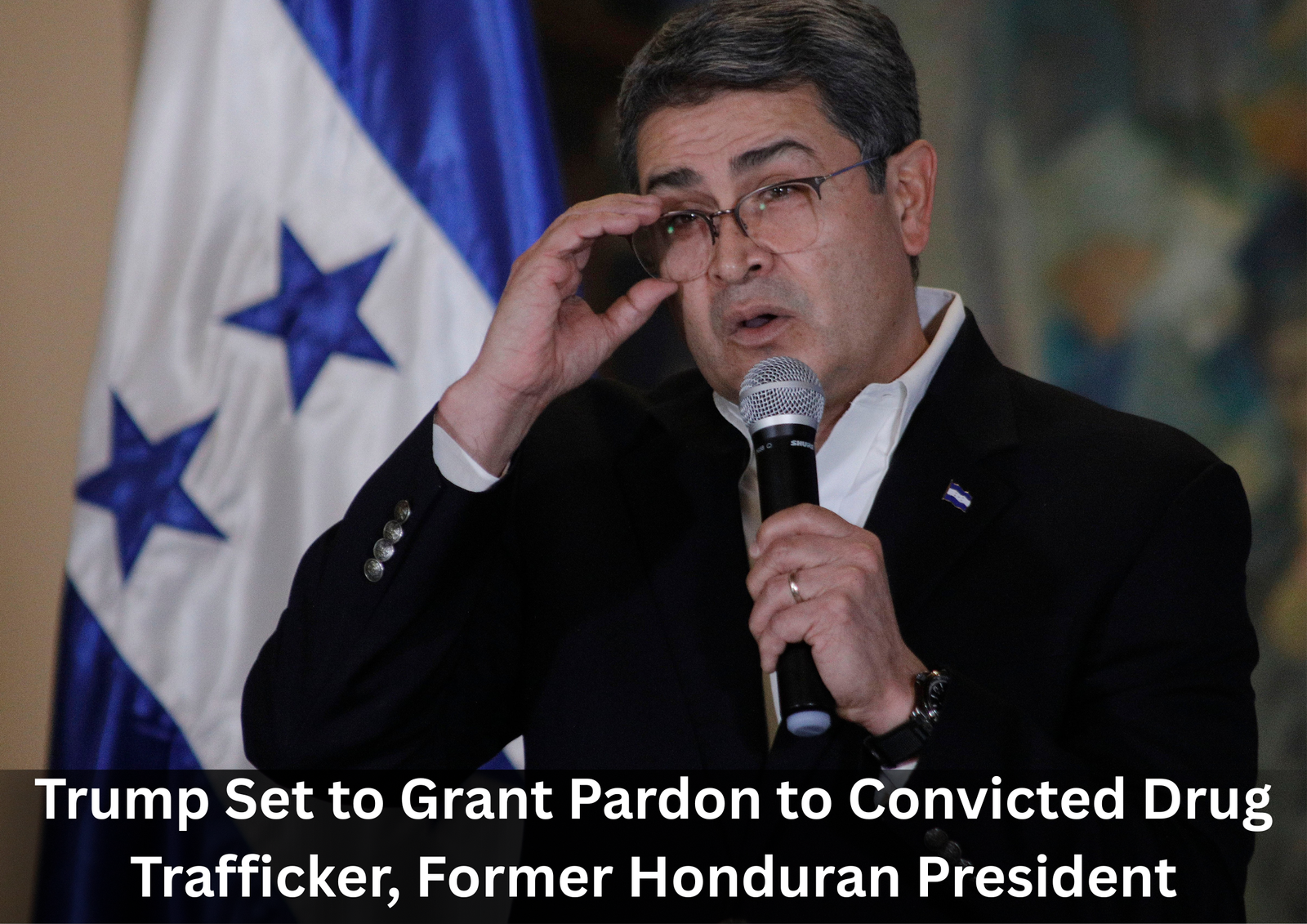
U.S. President Donald Trump has issued a sweeping presidential pardon to Juan Orlando Hernández, the former leader of Honduras who had been serving a life sentence in the United States for narcotics trafficking and weapons offenses. The extraordinary decision, finalized on December 1 and disclosed through a federal court filing, immediately clears the way for Hernández’s release from federal custody.
According to the document submitted by the Justice Department, Trump granted a “full and unconditional pardon” covering all charges for which Hernández had been convicted. The order, bearing Trump’s signature, directs the U.S. Attorney General to carry out the pardon without delay.
Hernández was convicted in March 2024 after a highly publicized trial in the Southern District of New York. Federal prosecutors accused him of collaborating for years with violent drug cartels-including the Sinaloa Cartel-while serving as Honduras’s president from 2014 to 2022. Evidence presented at trial showed Hernández accepted millions in cartel bribes, which prosecutors said he used to entrench his political power and shield drug shipments moving through Central America to the United States. He was additionally found guilty of firearms offenses tied to the trafficking network.
Judge Kevin Castel, who oversaw the case, delivered a life sentence plus 45 years in September 2024, denouncing Hernández’s conduct as fueling “a flood of cocaine” that devastated American communities. Despite the verdict, Hernández maintained that the prosecution was politically motivated and insisted he had been wrongly targeted.
Following the pardon, the Bureau of Prisons is expected to release Hernández from the Metropolitan Detention Center in Brooklyn, where he has been held since his extradition from Honduras in 2022. The pardon nullifies his criminal sentence, although it does not remove the public record of his trial and conviction.
The decision is already reigniting discussions around U.S. foreign policy, drug enforcement, and the reach of presidential pardon powers. Hernández had previously been considered a key ally of the Trump administration, particularly on issues related to migration and regional security.
Officials familiar with the case said reactions from prosecutors and families affected by drug-related violence are expected in the coming days. The Biden administration has not yet issued a formal comment on the pardon, which radically alters one of the most significant U.S. narcotics prosecutions involving a foreign head of state.
The move marks one of the most controversial uses of clemency in recent political history, raising new questions about the intersection of diplomacy, criminal accountability, and presidential authority.