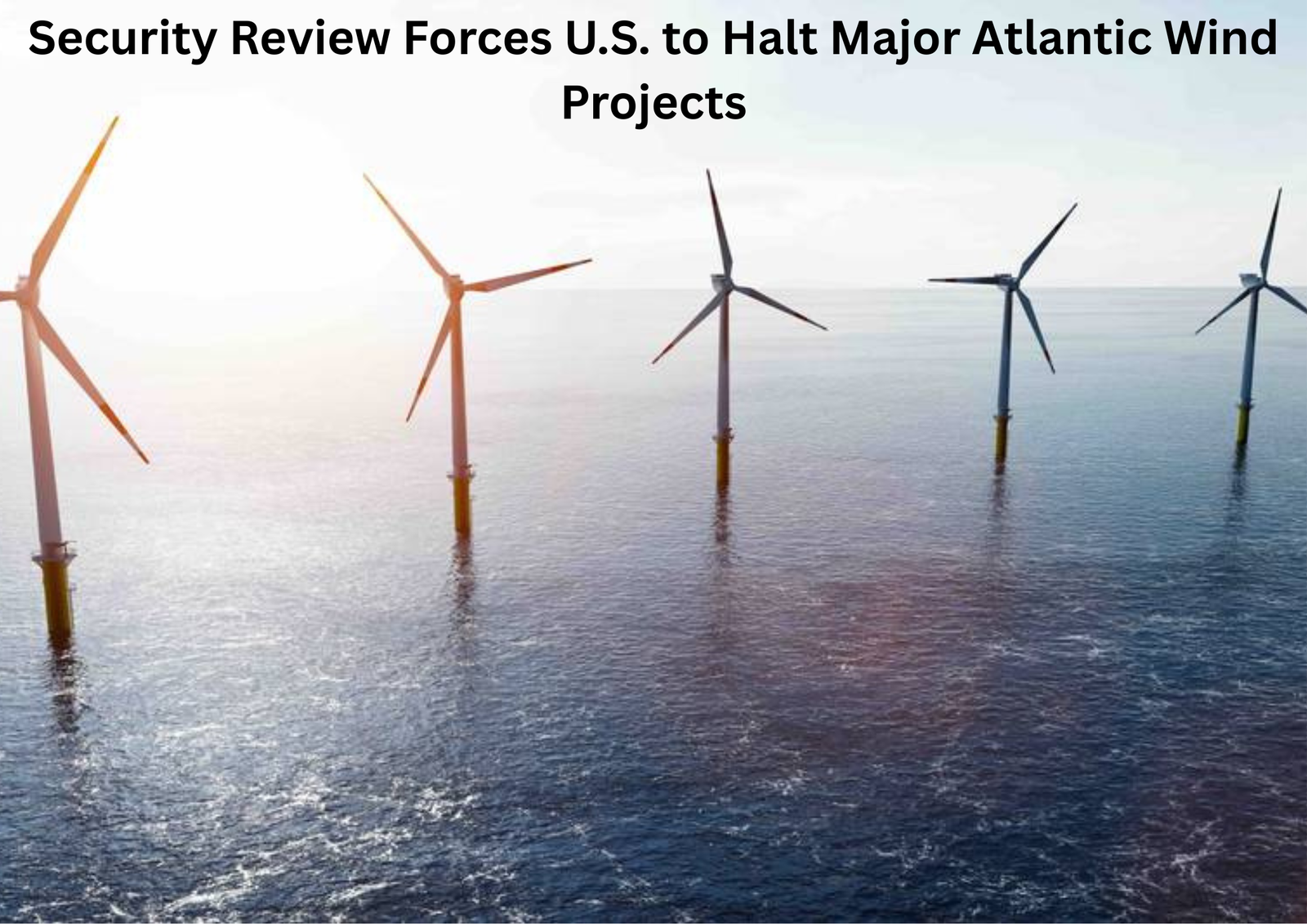
The United States government has ordered a temporary halt to construction activity on several large offshore wind projects along the Atlantic coastline, triggering uncertainty across the renewable energy sector and raising concerns among investors, state officials, and labor groups.
Federal authorities confirmed that leases for five major offshore wind developments are being paused while national security agencies conduct a review of potential risks associated with turbine installations. Officials cited concerns that offshore wind infrastructure could interfere with radar and airspace monitoring systems used for defense and aviation safety.
The affected developments include wind farms planned or under construction off the coasts of Virginia, Massachusetts, Rhode Island, and New York. Together, these projects represent nearly six gigawatts of planned power generation capacity-enough to supply electricity to millions of homes once fully operational.
One of the most advanced projects, located off the Virginia coast, had already completed a significant portion of its construction and was expected to come online within the next two years. Industry analysts warn that prolonged delays could result in major financial losses, increased energy costs, and setbacks to long-term clean energy goals.
Government officials emphasized that the suspension is not a cancellation, but a pause intended to allow time for technical assessments and discussions with developers and state governments. The review will focus on whether turbine structures and rotating blades could disrupt radar signals used to track aircraft and other airborne objects.
The decision has sparked strong reactions on Capitol Hill. Several lawmakers criticized the move, arguing that the projects had already passed extensive environmental and safety reviews. Some warned that halting construction undermines confidence in federal permitting processes and could discourage future infrastructure investment.
Energy companies involved in the projects expressed disappointment, noting that offshore wind has been promoted as a key solution for rising electricity demand, particularly in regions experiencing rapid growth in data centers and advanced computing facilities. Developers also pointed out that pilot turbines have operated for years without documented security incidents.
Financial markets responded quickly, with shares of companies tied to offshore wind development declining following the announcement. Industry groups cautioned that prolonged uncertainty could lead to job losses across manufacturing, construction, and port operations.
The pause comes at a time when electricity demand is climbing sharply across the eastern United States, driven in part by artificial intelligence expansion and population growth. Several state leaders have previously supported offshore wind as a way to stabilize energy prices while reducing reliance on fossil fuels.
Legal challenges are widely expected if the suspension continues without clear technical findings. For now, the future of America’s offshore wind expansion remains uncertain as federal agencies weigh security considerations against energy and economic priorities.