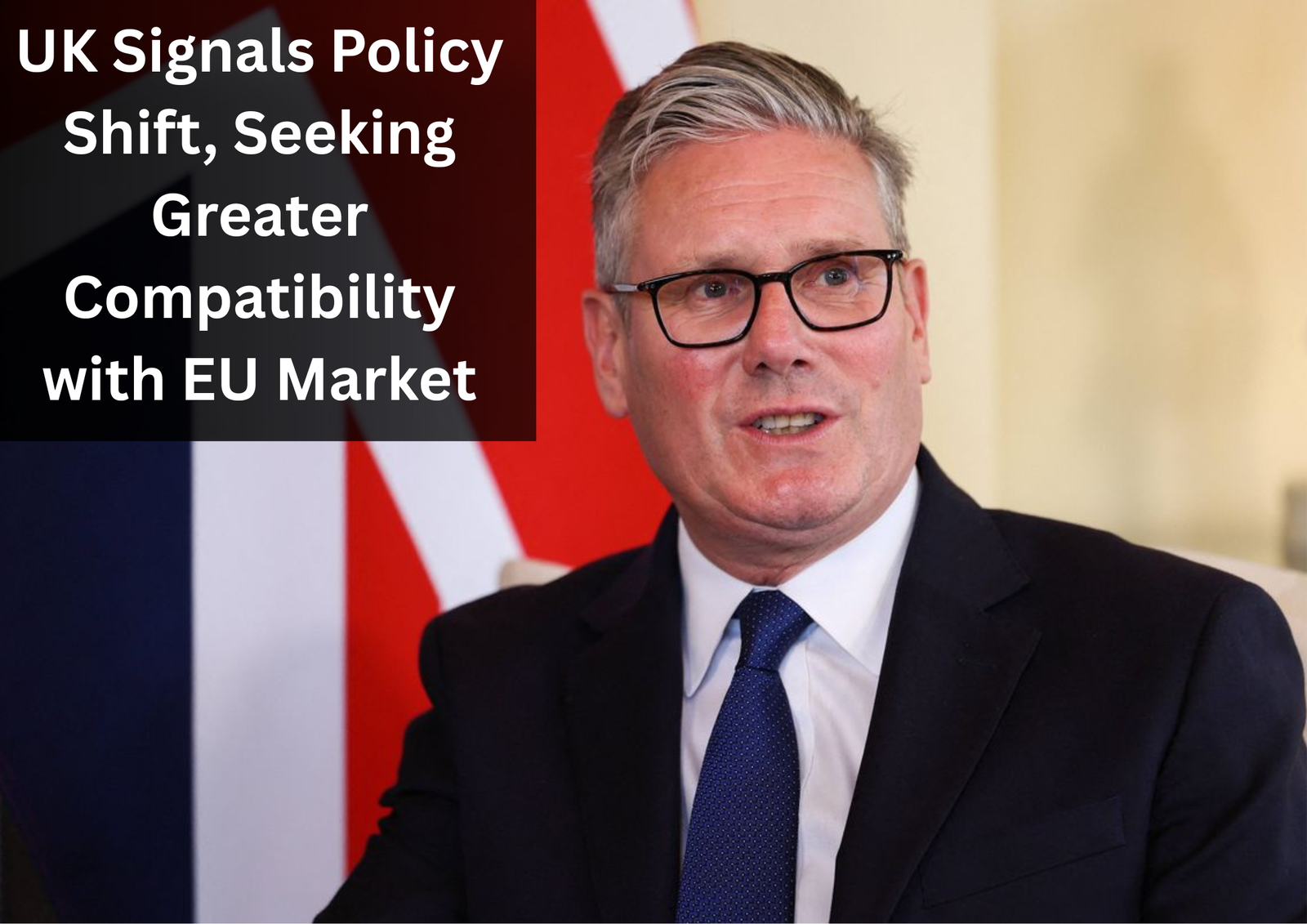
The United Kingdom may be heading toward a recalibrated relationship with the European Union as Prime Minister Keir Starmer signals openness to closer cooperation with the EU’s single market, while firmly rejecting any return to pre-Brexit frameworks such as a customs union or freedom of movement.
In recent media remarks, Starmer emphasized a pragmatic approach to post-Brexit engagement, stating that closer regulatory compatibility with the EU could be considered in areas where it clearly benefits the national economy. Rather than pursuing sweeping institutional changes, the government intends to assess cooperation on a case-by-case basis, aligning specific sectors with EU rules where doing so reduces trade friction and supports growth.
Sector-Based Cooperation Over Structural Reentry
The Prime Minister made clear that the government’s strategy does not involve rejoining the EU’s single market or customs union in full. Instead, officials are exploring selective alignment in industries where regulatory divergence has created operational challenges for businesses. This includes areas such as food standards, energy cooperation, manufacturing supply chains, and professional qualifications.
According to government sources, this targeted model is designed to preserve the UK’s ability to negotiate independent trade agreements globally, while also improving access to its largest trading partner. Starmer pointed to recent trade arrangements with countries like the United States and India as evidence that closer EU alignment does not necessarily undermine broader international trade ambitions.
Firm Red Lines on Immigration and Sovereignty
Despite the shift in tone toward Brussels, the Prime Minister reiterated several non-negotiable positions. There are no plans to restore freedom of movement between the UK and EU, nor to reopen foundational Brexit decisions. Government officials stress that any future alignment would remain a sovereign choice, subject to parliamentary scrutiny and public accountability.
Discussions around youth mobility programs and academic exchanges have been framed as limited, reciprocal arrangements rather than steps toward broader migration policies. The UK has already confirmed its intention to rejoin the Erasmus+ education exchange scheme from 2027, a move welcomed by universities and student groups.
Political Pressures at Home
The evolving stance comes amid a challenging domestic political environment. While Labour secured a decisive victory in the 2024 general election, recent opinion polling suggests growing competition from smaller parties, particularly Reform UK. Internal divisions have also surfaced, with some Labour lawmakers and trade unions advocating for deeper economic integration through a customs union.
Starmer has sought to contain these pressures by warning against internal instability, arguing that leadership turmoil would weaken the government and embolden political opponents. He has positioned his leadership as a stabilizing force, contrasting it with recent years of frequent changes at the top of British politics.
Mixed Reactions Across the Political Spectrum
Opposition parties were quick to respond. Conservative figures accused the government of quietly undermining Brexit’s promise of regulatory independence, while Reform UK leaders described the approach as a departure from voter expectations. On the other hand, Liberal Democrats and pro-European groups cautiously welcomed the warmer rhetoric but argued that meaningful market access would ultimately require broader concessions.
Business organizations have largely reacted positively, noting that regulatory divergence has increased costs and complexity for exporters. Surveys conducted by trade bodies indicate that many firms believe the current UK-EU trade arrangement has constrained growth, particularly for small and medium-sized enterprises.
Economic and Global Context
Beyond domestic politics, broader economic and geopolitical considerations appear to be shaping the government’s thinking. Sluggish growth, supply chain disruptions, and shifting global alliances have increased pressure on the UK to strengthen ties with neighboring economies. Improving relations with the EU is viewed by some analysts as a practical step to enhance resilience without reversing Brexit outright.
While details of future alignment remain under discussion, the government’s message is clear: the UK is seeking a more functional relationship with Europe, grounded in economic realism rather than ideology.
As negotiations and consultations continue, businesses and international partners alike will be watching closely to see how this recalibrated strategy unfolds in practice.
Don’t miss this in-depth blog on “Holocaust Survivor and Educator Eva Schloss Passes Away at 96”, exploring her life, legacy, and enduring message for future generations.