
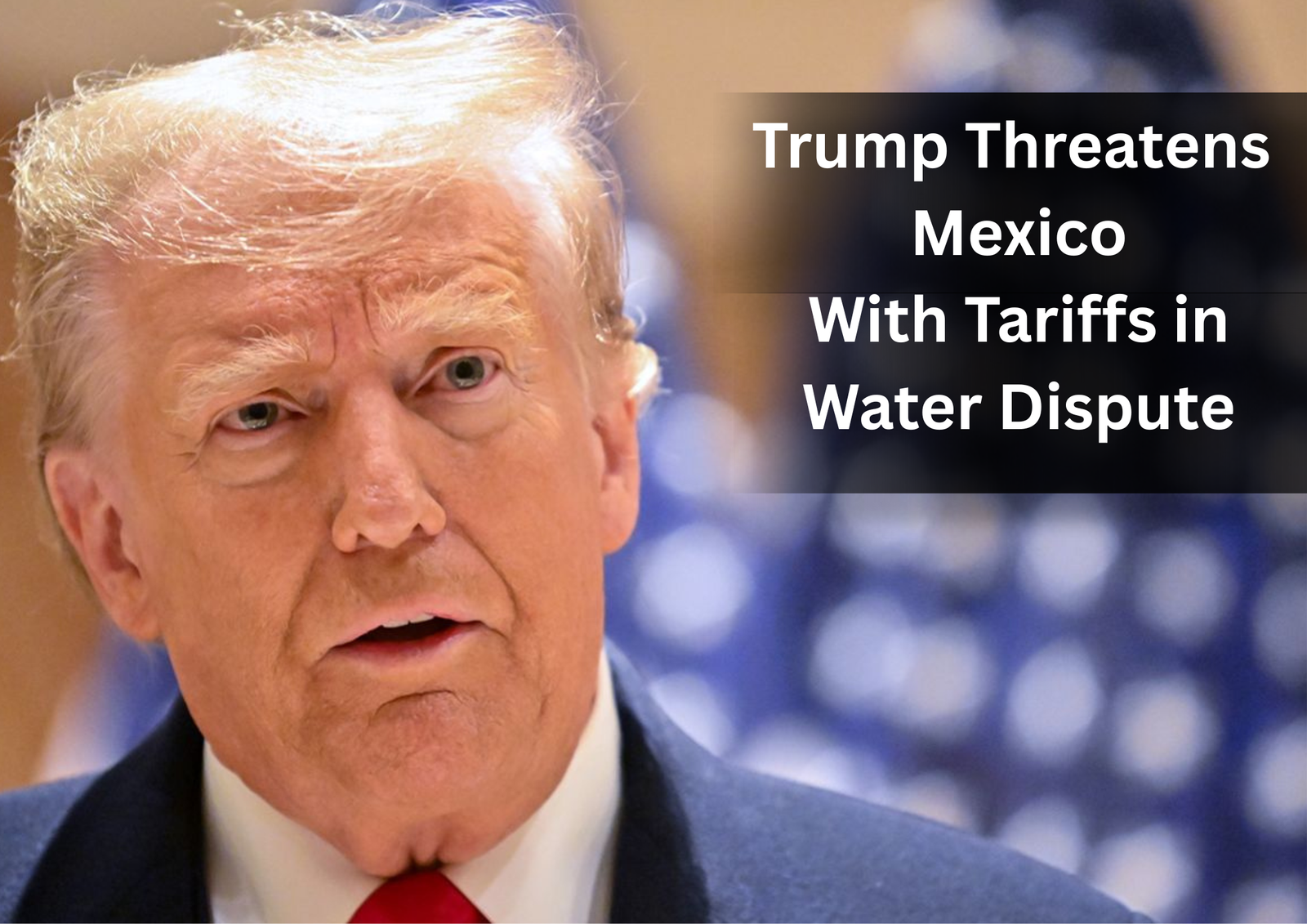
U.S. President Donald Trump has reignited tensions with Mexico by warning of sweeping tariffs if water owed under a decades-old treaty is not released into the drought-hit Rio Grande River. The warning, delivered through a social media post on Monday, links water diplomacy directly with trade pressure at a sensitive moment in North American relations.
Trump said Mexico is significantly behind on its required water deliveries under the 1944 bilateral water-sharing agreement that governs allocations from shared rivers. He warned that unless the water is released immediately from Mexican dams into the Rio Grande, the United States could impose large-scale tariffs on Mexican exports. The statement has drawn swift attention from political leaders, farmers, and business groups on both sides of the border.
The response from Mexico’s incoming leadership was swift. President-elect Claudia Sheinbaum stated that her administration will honor the treaty and move forward with a water release to the United States. She framed the decision as an act of regional cooperation and environmental responsibility. The outgoing President said the issue now falls under the authority of the incoming government.
At the center of the dispute is the Rio Grande, which forms a natural border between the United States and Mexico and provides vital water for agriculture and communities across South Texas and northern Mexico. Under the 1944 treaty, Mexico is required to deliver an average of 350,000 acre-feet of water annually to the United States in five-year cycles. The current cycle ends in October 2025, and U.S. water officials say Mexico is facing a sizable shortfall.
Texas leaders have been particularly vocal about the impact of reduced water flows. Greg Abbott, Governor of Texas, along with agricultural organizations, has urged federal officials to take stronger action, arguing that prolonged shortages are devastating farms, ranches, and local economies already strained by persistent drought.
The renewed tariff threat has unsettled U.S. manufacturers, retailers, and agricultural producers who depend on uninterrupted cross-border trade. Mexico is one of the United States’ largest trading partners, and analysts warn that broad tariffs could ripple quickly through supply chains, raising prices for consumers while undermining regional economic stability.
Legal and trade experts also note that the 1944 water treaty includes technical dispute-resolution mechanisms but offers no direct enforcement tools such as trade penalties. Using tariffs as leverage would represent a unilateral political move rather than a treaty-based remedy, potentially complicating future diplomacy.
While Mexico has pledged to comply with the agreement, no specific timeline or volume for the water release has been publicly confirmed. Until those details emerge, uncertainty remains for farmers awaiting relief and for businesses watching closely for signs of a broader trade confrontation.
As the region faces intensifying drought conditions and growing demand on shared water resources, the dispute highlights how environmental stress, political leadership changes, and economic policy are becoming increasingly intertwined in U.S.–Mexico relations.