
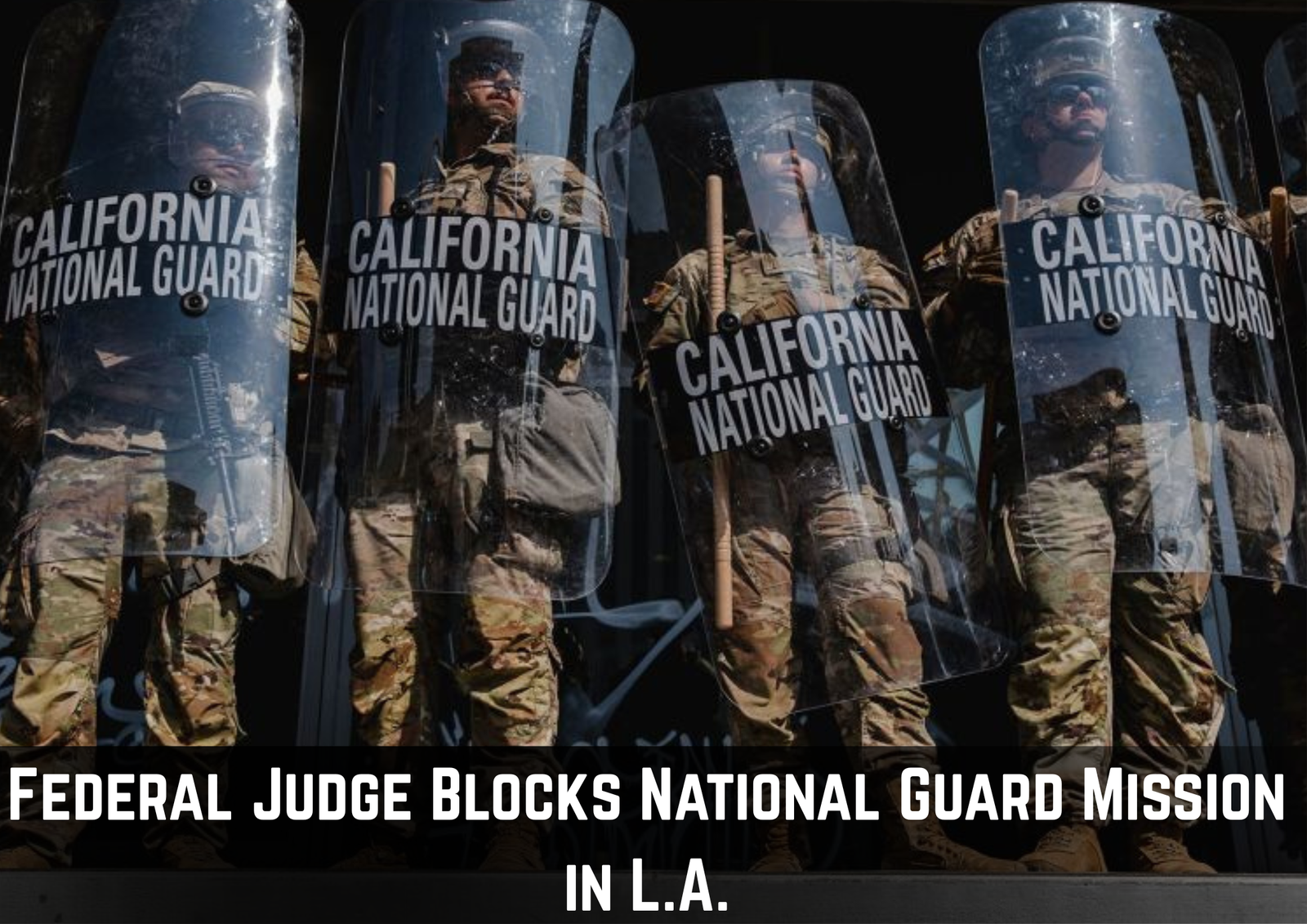
In a significant legal setback for the Trump administration, a federal judge has ordered the immediate wind-down of the National Guard deployment in Los Angeles and directed that authority over the remaining troops be restored to California Governor Gavin Newsom. The ruling, issued Wednesday by Senior U.S. District Judge Charles R. Breyer, challenges the administration’s continued use of the Guard under federal authority and questions the legal boundaries of presidential power.
Court Reverses Course on Federal Control of Troops
The deployment began in June when the administration invoked Title 10 to take command of the California National Guard during protests tied to immigration enforcement actions. More than 4,000 Guard members were initially federalized. Only about 300 remain, and many of those were recently reassigned to Oregon.
Judge Breyer granted a preliminary injunction to halt the mission, though the order will not take effect, giving the White House time to appeal. The Justice Department is expected to move quickly to the 9th U.S. Circuit Court of Appeals.
Sharp Judicial Rebuke of Presidential Authority Claims
In a detailed opinion, Breyer criticized the Justice Department’s argument that extensions of the Guard’s federalization could not be reviewed by the courts. He wrote that accepting such logic would create the possibility of a standing national police force composed of state soldiers indefinitely controlled by the president-an outcome he said would be incompatible with the U.S. constitutional system.
Breyer also pointed out that the administration’s decision to move most remaining California Guard personnel to Oregon in October undercut its claim that their presence in Los Angeles was still essential.
Legal Battle With National Implications
This dispute marks the second major court ruling this year involving the Los Angeles deployment. Breyer previously found the original federalization unlawful in June, though that ruling was temporarily suspended by a 9th Circuit panel. The appellate court has not yet issued a final opinion.
The legal confrontation forms part of a broader clash over domestic uses of military personnel. Throughout 2025, the administration deployed National Guard units to several major cities led by Democratic officials, prompting multiple federal lawsuits. A related challenge from Illinois is currently before the U.S. Supreme Court.
State Leaders Welcome the Decision
Gov. Gavin Newsom praised the ruling, arguing that Guard members had been diverted from essential public-safety responsibilities. State Attorney General Rob Bonta also applauded the injunction, calling it a reaffirmation of constitutional limits on federal authority.
The White House countered that the mission falls well within presidential powers and expressed confidence that higher courts would ultimately back the administration’s position.
Political and Legal Ripples Beyond California
The judge’s order comes as national debate intensifies over the proper scope of federal power in domestic security matters. Some judges have warned that broad presidential discretion risks weakening state autonomy, while others on the federal bench have supported the administration’s interpretation of Title 10.
Congress is also paying close attention. On the same day as Breyer’s ruling, the U.S. House passed a sweeping $900 billion defense bill that would codify several national security initiatives and impose new oversight requirements on future troop deployments.
Additional Legal Moves on December 10
Further highlighting the shifting legal landscape, a federal judge in Oregon temporarily blocked a regulation that criminalized loud or disruptive activity near federal buildings-a measure introduced amid ongoing protests at an immigration facility. The court said the policy likely infringed on free-speech protections.