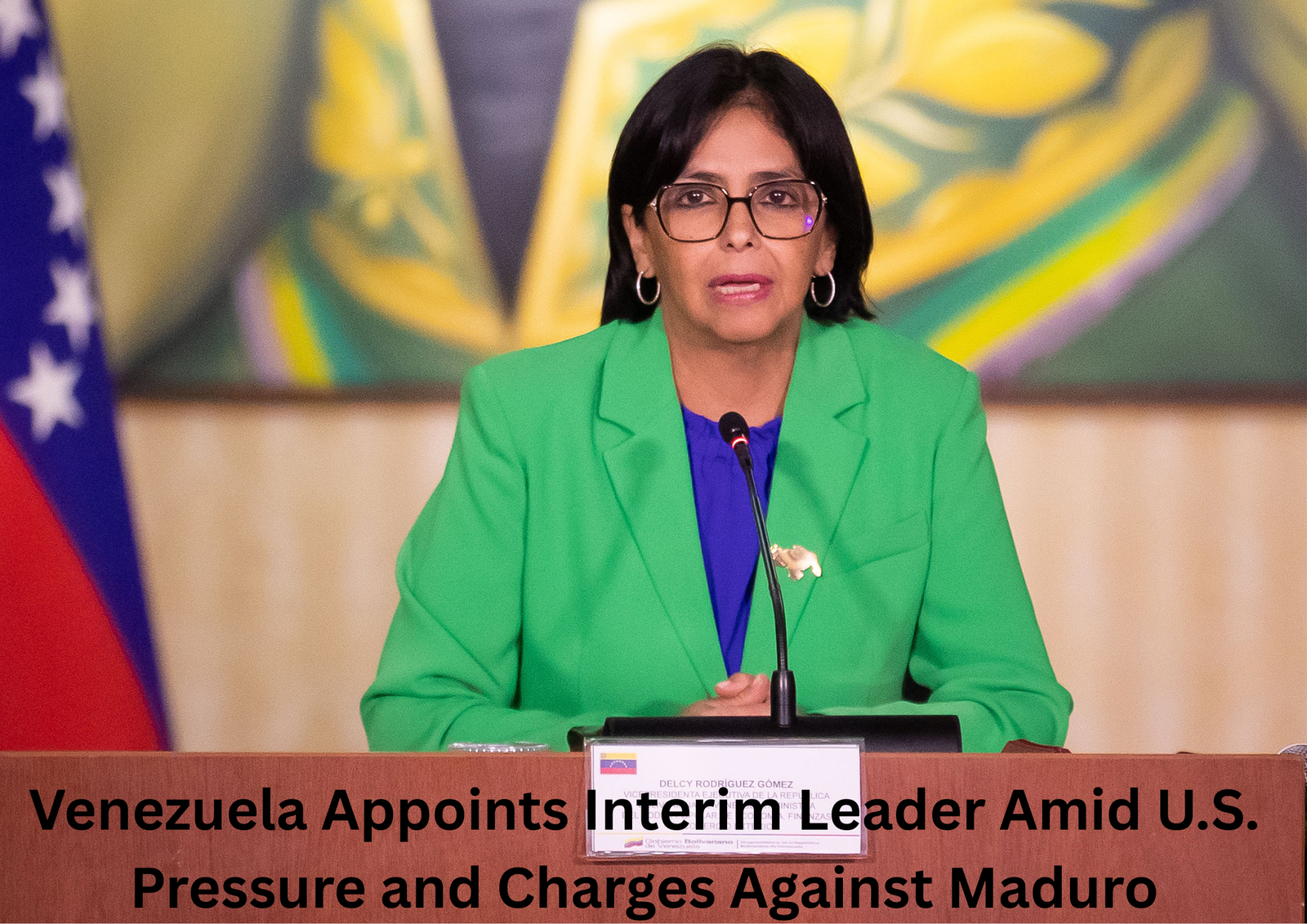
Venezuela entered a new phase of political uncertainty on Monday as Delcy Rodríguez was sworn in as interim president, while deposed leader Nicolás Maduro appeared in a U.S. federal court to deny a slate of serious criminal charges.
Interim Government Takes Power in Caracas
Delcy Rodríguez, a longtime senior figure in Venezuela’s ruling establishment, formally assumed the role of interim president during a special session of the National Assembly in Caracas. The ceremony followed the capture of Nicolás Maduro and his wife, Cilia Flores, by U.S. forces during a weekend military operation.
Rodríguez described her appointment as a painful duty carried out under extraordinary circumstances, accusing the United States of unlawful military intervention. Addressing lawmakers, she pledged to preserve internal stability and maintain calm across the country. Supporters gathered outside the legislative complex, waving flags and chanting slogans in solidarity with the outgoing leadership.
Maduro’s son addressed the assembly during the session, declaring continued loyalty to the political movement and insisting that his parents would eventually return to Venezuela.
Maduro Rejects Charges in U.S. Court
Earlier in the day, Maduro appeared before a federal judge in New York, where he formally pleaded not guilty to multiple charges, including drug trafficking conspiracy and weapons-related offenses. Speaking through an interpreter, he rejected the legitimacy of the proceedings, claiming he remained Venezuela’s lawful president and describing his detention as a kidnapping.
The courtroom appearance drew a tense response from spectators, with at least one individual shouting accusations as Maduro was escorted out under heavy security. The presiding judge scheduled the next hearing for mid-March.
Washington Defends Military Action
U.S. officials have described the operation that led to Maduro’s arrest as a targeted law enforcement action rather than a military invasion. President Donald Trump stated that the move was intended to bring a long-indicted figure to justice and restore order in a country he described as strategically vital to American interests.
Trump also reiterated his administration’s intention to oversee Venezuela’s transition process, warning that further intervention remains possible if cooperation is not forthcoming. He emphasized the importance of rebuilding Venezuela’s damaged oil infrastructure and preventing its resources from benefiting U.S. adversaries.
New Leadership Signals Willingness to Engage
While initially condemning Washington’s actions, Rodríguez later adopted a more measured tone, calling for dialogue and cooperation based on international law. In messages shared through official channels, she expressed openness to working with the United States on shared economic and security goals.
U.S. officials, however, have outlined firm expectations. These reportedly include dismantling drug trafficking networks, removing foreign operatives aligned with hostile governments, and halting energy exports to nations considered rivals of Washington. Although future elections have been discussed, no timetable has been announced.
Pressure Points and Global Reaction
American officials believe they retain considerable leverage over the interim government, citing sanctions, financial assets held abroad, and continued military capability. Despite this, no comprehensive post-Maduro reconstruction or humanitarian strategy has been publicly detailed.
International reaction has been sharply divided. Venezuela’s representatives at the United Nations condemned the operation as a violation of sovereignty, while U.S. diplomats defended the move as necessary to prevent criminal activity tied to state leadership.
At home, Rodríguez has authorized the formation of a special commission tasked with pursuing the release of Maduro and Flores. Meanwhile, the newly seated National Assembly, elected last year amid opposition boycotts, begins its term under intense domestic and international scrutiny.
As Venezuela navigates this volatile transition, uncertainty remains over how long the interim arrangement will last – and whether cooperation or confrontation will define its relationship with Washington in the months ahead.
For deeper insight into “Denmark Issues Sharp Warning as Trump Revives Greenland Takeover Rhetoric,” don’t miss this detailed blog-read the full analysis to understand the global implications and reactions.