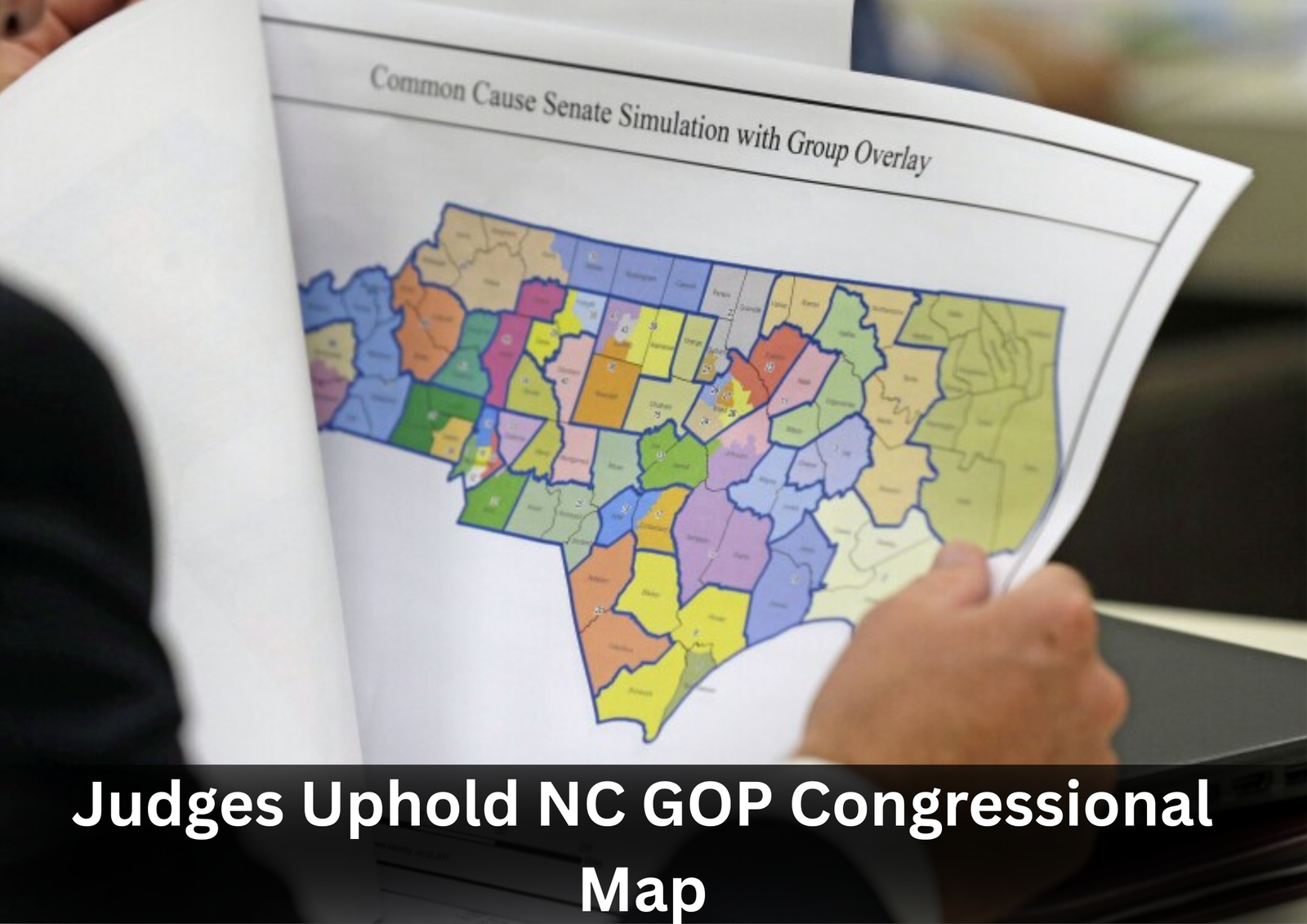
A federal court has cleared North Carolina to use its newly drawn Republican-crafted congressional map for the 2026 midterm elections, a decision that is expected to shape the state’s political landscape for years to come. The unanimous ruling, issued by a three-judge panel in the Eastern District of North Carolina, rejected claims that the new boundaries were an unconstitutional racial gerrymander.
The lawsuit, filed by civil rights groups and Democratic voters, argued that lawmakers illegally concentrated Black voters into two districts to weaken their influence across the rest of the state. But the judges concluded that challengers failed to prove race was the dominant factor behind the map. Instead, the court found that Republican mapmakers relied mainly on political data-a practice that remains legal under current federal law.
The ruling is likely to preserve the GOP’s strong advantage in North Carolina’s congressional delegation. Analysts say the map positions Republicans to secure up to 10 of the state’s 14 House seats in 2026, mirroring the balance achieved after similar lines were used in 2024. While the 1st District in eastern North Carolina remains a Democratic-leaning, Black opportunity district, other seats have shifted significantly. The 6th District has become safely Democratic, while the 13th and 14th Districts are now strongly favorable to Republican candidates.
The decision marks a departure from a 2023 ruling by the same court, which struck down a previous Republican map for improperly using race as a key factor. This time, judges noted that the state’s redistricting leaders avoided racial data and prioritized creating politically advantageous districts-an approach permitted by the Supreme Court’s 2019 Rucho v. Common Cause ruling, which found that partisan gerrymandering claims cannot be addressed in federal courts.
Political reactions were swift and divided. Republican leaders praised the ruling as a validation of their map-drawing approach, arguing that the districts accurately reflect the state’s political geography. Democrats, however, condemned the decision as a setback for fair representation, accusing Republicans of using partisan gerrymandering to entrench their power. Several voting rights organizations involved in the case expressed disappointment, saying the ruling diminishes the electoral influence of Black communities.
The plaintiffs are expected to appeal the case to the U.S. Supreme Court, though it remains unclear whether the justices will intervene. The panel that upheld the map also signaled its concern about altering district lines so close to an election cycle, warning that frequent changes may disrupt voter confidence and candidate planning.
As battles over voting rights and redistricting continue across the country, North Carolina’s case highlights the ongoing struggle between partisan strategy and representation. With the 2026 midterms approaching, the court’s ruling ensures that the newly approved map will play a central role in shaping the political direction of one of the nation’s most competitive states.