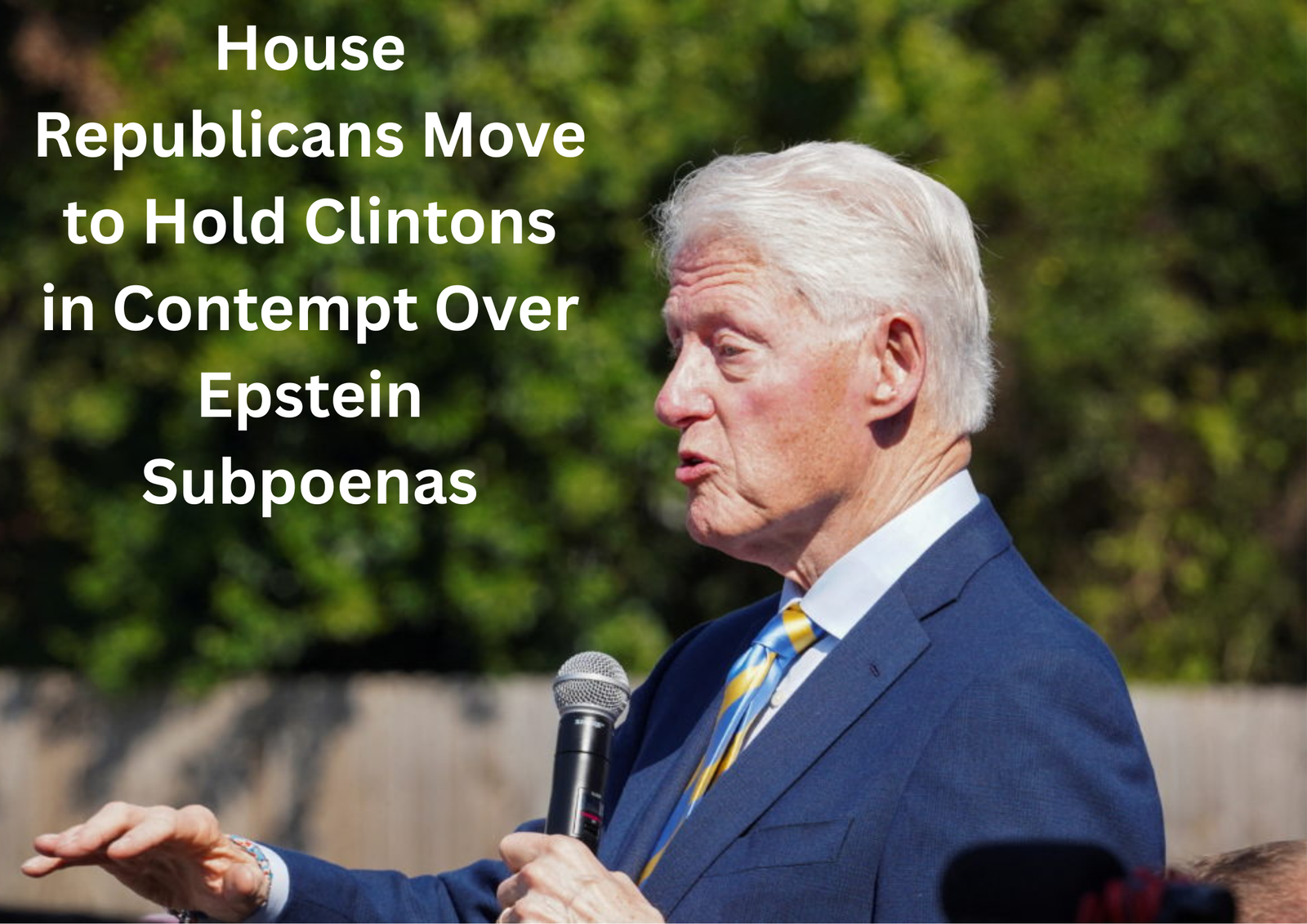
House Republicans are moving toward holding former President Bill Clinton, and potentially former Secretary of State Hillary Clinton, in contempt of Congress after both declined to testify under subpoena in connection with the ongoing investigation into convicted sex offender Jeffrey Epstein.
Oversight Committee Chair James Comer (R-Ky.) said on Tuesday that he intends to pursue contempt proceedings against Bill Clinton as early as next week. Comer also warned that Hillary Clinton could face the same action if she does not appear for a deposition scheduled for Wednesday.
In legal filings, the Clintons’ attorneys argued the subpoenas lack legal basis, calling them “invalid” and “unenforceable,” and lacking any clear legislative purpose. Their team asserted that the pair has already delivered all relevant information they possess in written form and characterized the committee’s efforts as politically motivated.
In a detailed letter to Comer, both Bill and Hillary Clinton framed their refusal as a defense of constitutional limits on congressional power. They accused the committee of conducting a narrow and uneven inquiry, pointing out that most individuals subpoenaed in the probe have not been compelled to testify.
The Clintons’ letter also criticized the committee for not issuing a subpoena to Attorney General Pam Bondi over the Justice Department’s failure to fully disclose Epstein-related materials by a congressionally imposed deadline. They broadened their critique to include grievances with federal enforcement actions, immigration procedures, pardons related to the January 6th attack, and what they described as the politicization of prosecutorial authority.
Some House Democrats, while condemning the subpoenas as excessively partisan, have left open the possibility of backing a contempt vote if it comes before the full House. Representative Maxwell Frost (D-Fla.) said there is a “real possibility” Democrats could support the measure. Others echoed concerns about selective enforcement but stopped short of outright opposition.
Representative Ro Khanna (D-Calif.), who has been active in pushing for fuller public disclosure of Epstein-related records, objected to the idea of holding the Clintons in contempt. Khanna suggested that efforts should instead focus on compelling compliance from the Justice Department regarding document disclosure.
The subpoenas stem from a broader bipartisan investigation into Epstein’s network and associations. Recent government releases include photographs showing Bill Clinton with Epstein in the 1990s and early 2000s, including images from Epstein’s estate and private aircraft. Clinton’s representatives acknowledged several trips on Epstein’s plane in 2002 and 2003, meetings in New York, and a visit to Epstein’s apartment, stating that the former president ceased contact before Epstein’s criminal history became public.
Comer has maintained that the subpoenas were approved with cross-aisle support and that his office has repeatedly contacted the Clintons’ lawyers in hopes of securing cooperation, with little progress.
Under U.S. law, criminal contempt of Congress is classified as a misdemeanor that can carry penalties of up to one year in jail and fines reaching $100,000. Enforcement can involve congressional detention, referral to the Justice Department for prosecution, or judicial orders to enforce compliance. Legal scholars note that contempt actions with limited legislative justification could weaken congressional oversight authority, a concern raised in recent similar cases.
Past enforcement of contempt has resulted in convictions for individuals such as Steve Bannon and Peter Navarro, who defied subpoenas from the January 6 committee and served prison sentences.
Separately, a dispute continues over the Justice Department’s partial compliance with a law requiring the release of all federal files relating to Epstein by December 19. After only a partial disclosure, lawmakers including Representative Thomas Massie (R-Ky.) and Representative Ro Khanna filed a lawsuit seeking appointment of a special master to ensure full compliance. Oversight Committee Ranking Member Robert Garcia (D-Calif.) has publicly demanded further release of the remaining materials.
Supreme Court Signals Support for State Restrictions on Transgender Participation in Women’s Sports, stirring national debate – read this blog for details and important insights you shouldn’t miss.