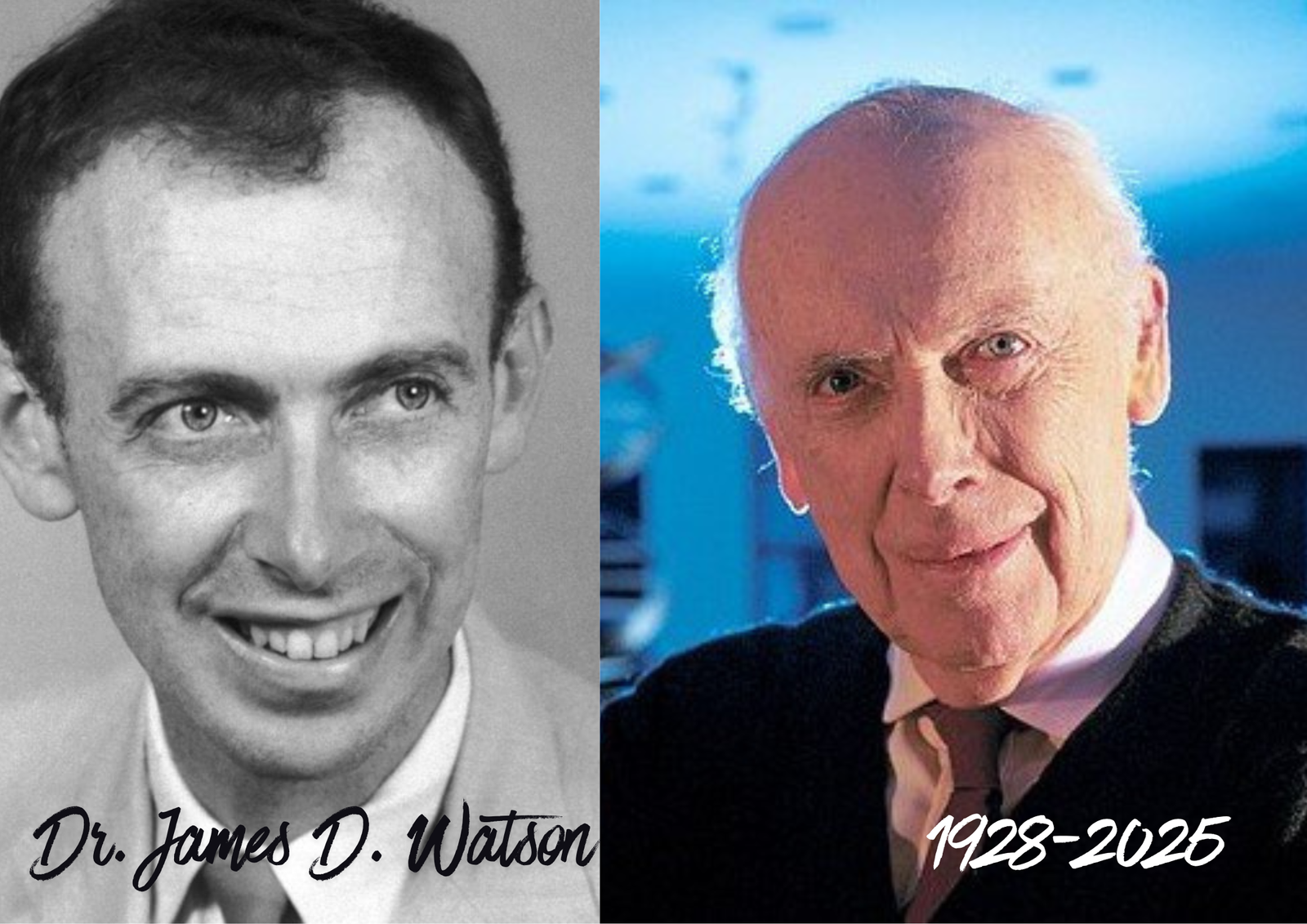
James D. Watson, the groundbreaking American biologist whose work helped unlock the structure of DNA and forever transformed the study of life, has passed away at the age of 97. Cold Spring Harbor Laboratory, where he spent much of his distinguished career, confirmed that Watson died peacefully at his home.
Born in Chicago in 1928, Watson was a child prodigy who entered the University of Chicago at just 15. His scientific journey led him to Cambridge University, where he met Francis Crick in the early 1950s. Together, in 1953, they unveiled one of the greatest discoveries in modern science – the double-helix model of DNA.
Their model, constructed from rods and metal plates, revealed how genetic information is encoded and replicated. It demonstrated that DNA consists of two strands twisting around each other, with base pairs – adenine with thymine, guanine with cytosine – forming the genetic instructions for life. The revelation provided the blueprint for understanding heredity, evolution, and countless genetic disorders.
The discovery earned Watson, Crick, and physicist Maurice Wilkins the 1962 Nobel Prize in Physiology or Medicine. It was a moment that redefined biology and opened the door to fields like genetic engineering, forensic science, and biotechnology.
Beyond his research, Watson played a leading role in shaping modern genetics through his leadership at Cold Spring Harbor Laboratory (CSHL). Serving as director from 1968 and later as chancellor, he guided the institution into becoming a powerhouse for research in genetics, neuroscience, and cancer biology. He was also a driving force in the launch of the Human Genome Project, an ambitious international initiative that mapped the entirety of human DNA.
However, his career was not without controversy. In his later years, Watson faced backlash over remarks about race and intelligence that were widely condemned as unfounded and discriminatory. Following these statements, CSHL suspended and eventually severed ties with him, making clear that while his scientific contributions would always be recognized, his personal opinions did not reflect the institution’s values.
Despite the controversies, Watson’s scientific legacy endures. His work laid the foundation for the biotechnology revolution, the development of genetic testing, and advances in personalized medicine.
In a statement, Cold Spring Harbor Laboratory described Watson as “a visionary scientist whose work reshaped our understanding of life itself.”
Watson is survived by his son, Duncan, and two grandchildren. His wife, Elizabeth, passed away several years earlier. His passing marks the end of an era – that of one of the most influential, and at times divisive, figures in the history of modern science.