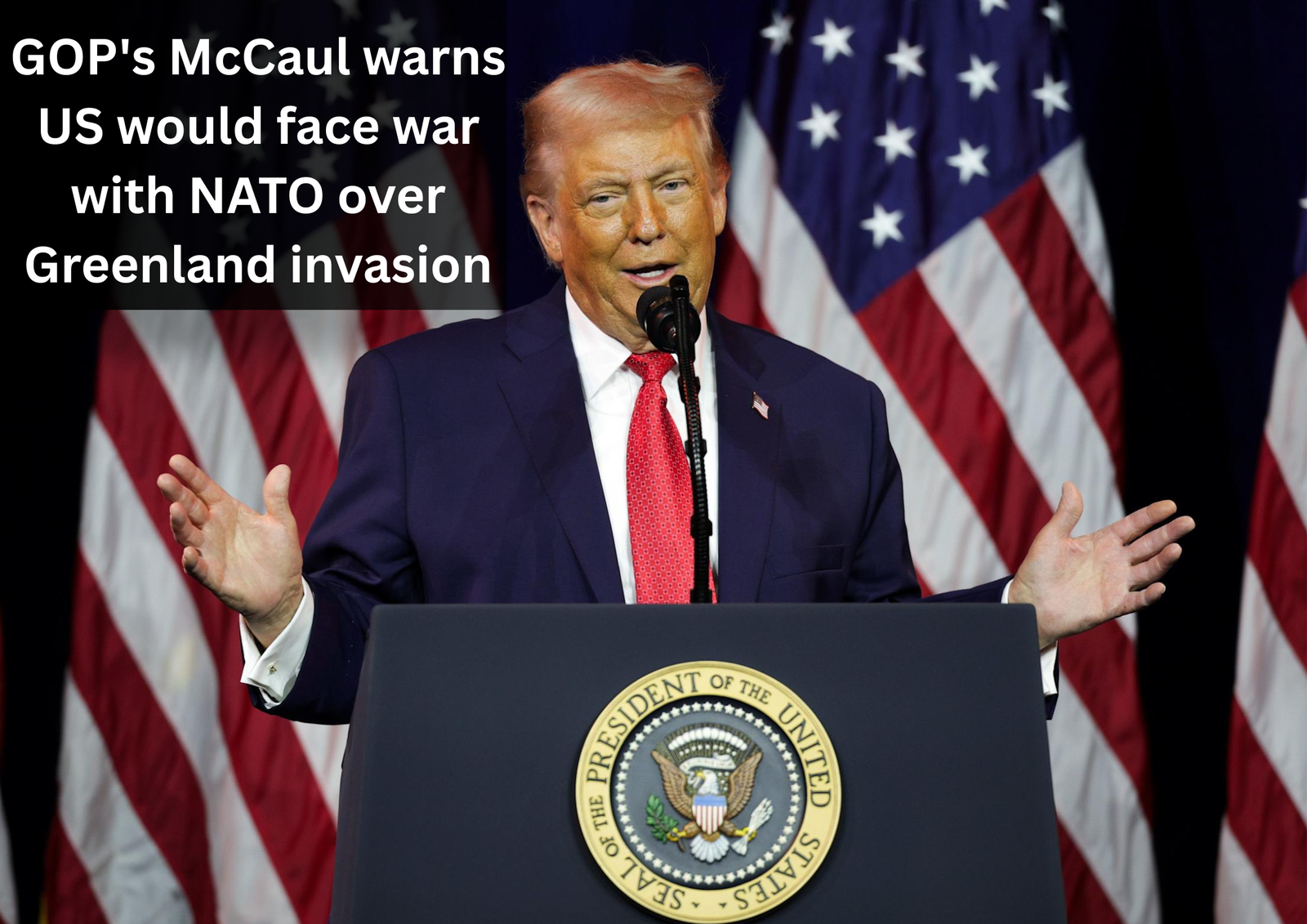
President Donald Trump has reportedly floated the idea of the United States invading Greenland, reviving an unusual geopolitical debate and prompting mixed reactions among Republicans. Multiple media outlets have reported that Trump has mentioned the subject in private conversations several times in recent months, describing the concept as a form of “peacekeeping” that would strengthen U.S. influence in the Arctic.
According to reporting, individuals familiar with the discussions say Trump has portrayed the hypothetical operation as both strategically advantageous and politically feasible. The president has not publicly commented on the matter, and no official policy proposals have been put forward.
A Remark That Sparked Questions
The resurfaced discussion gained wider attention after Representative Michael McCaul (R-Texas), Chairman of the House Foreign Affairs Committee, referenced the idea in a recent television interview. When asked about the Arctic competition between the United States, Russia, and China, McCaul suggested the U.S. could “just invade Greenland,” adding that NATO allies would “complain” but lack the ability to reverse such a decision.
McCaul later clarified the remark, telling that he had spoken sarcastically to highlight the strategic tensions in the region. He did not, however, dispute the underlying national security concerns, noting the ongoing military and research activity conducted by Russia and China in the far north. His clarification did little to quell curiosity about the broader policy conversation taking place among Trump-aligned Republicans.
A Revival of a 2019 Controversy
Trump’s interest in Greenland is not entirely new. During his presidency in 2019, he publicly proposed purchasing the island, an autonomous territory within the Kingdom of Denmark. Danish officials rejected the proposal outright and described the idea as “absurd,” prompting diplomatic tension and causing Trump to cancel a planned state visit to Copenhagen.
That dispute later faded, but political observers noted that Trump and several advisors had discussed Greenland for reasons tied to military positioning, natural resources, and global influence. Former House Speaker Newt Gingrich acknowledged last week that he had discussed the issue with Trump in 2019 and confirmed that the president was “interested” in the notion at the time. Gingrich cautioned that while he did not believe Trump was actively pursuing an invasion, the Arctic’s growing importance continued to make Greenland a topic of interest among foreign policy strategists.
The Arctic Competition
The Arctic has become a focal point for geopolitical competition as melting sea ice unlocks new shipping lanes, fishing rights, and mineral opportunities. Russia has sharply expanded its military infrastructure across the region, while China has declared itself a “near-Arctic state” and invested in research stations, ice-capable shipping, and mineral exploration.
The United States maintains an important foothold in the region through Alaska, yet analysts have argued that Washington’s capabilities lag behind those of Moscow and Beijing. Advocates for stronger U.S. Arctic policy argue that Greenland’s location – adjacent to new northern maritime corridors and near key NATO routes – gives it outsized importance in defense planning.
While Trump’s comments have attracted outsized media attention, foreign policy researchers note that discussions about Greenland’s strategic value predate his presidency and continue within multiple U.S. security circles.
Diplomatic Constraints and Legal Realities
Greenland is officially part of the Kingdom of Denmark and retains extensive autonomy over domestic affairs. Copenhagen controls its foreign policy and defense, and has repeatedly emphasized that Greenland is not for sale and not open to coercion.
Any U.S. military action on Greenland without Danish consent would constitute an attack on Denmark – a founding member of NATO. Such a scenario would trigger severe diplomatic consequences and potentially undermine the alliance’s Article 5 mutual-defense framework.
“The idea of a U.S. invasion of Greenland is not just unconventional – it would be destabilizing for the international system,” said one European security analyst. “It would fracture NATO at a moment when unity is strategically important.” The analyst also emphasized that Danish public opinion remains broadly protective of Greenlandic autonomy and strongly opposed to foreign territorial claims.
White House Reaction
The Biden administration expressed no interest in the discussion and moved quickly to distance itself from the remarks. An official from the National Security Council said that the United States “has no intention to invade Greenland,” adding that Washington values its close partnership with both Greenland and Denmark.
The spokesperson reiterated that Greenland’s political status is respected and that the United States remains committed to cooperation on climate, security, and indigenous affairs – areas that have expanded under the current administration.
Unconventional Foreign Policy Ideas and Political Identity
The episode illustrates how unconventional foreign policy concepts continue to circulate within Trump’s political orbit. Supporters argue that such proposals break from establishment thinking and force strategic conversations that policymakers have overlooked. Critics view the ideas as destabilizing and unserious, particularly when they involve allied territory.
Whether or not Trump is exploring formal policy options remains unknown. Individuals close to him described the remarks as exploratory rather than directive, but noted that Trump has shown long-standing interest in Arctic affairs.
Greenland’s Position in a Changing World
Greenland itself has taken on a more assertive international posture over the past decade, expanding trade relationships and cultural diplomacy. Its government has pursued gradual economic diversification, balancing ties with Denmark while exploring limited foreign investment opportunities in mining and renewable energy.
Greenlandic leaders have consistently maintained that decisions regarding the island’s resources and political future must involve local consent. Discussions about sovereignty occasionally surface in Greenlandic politics, though the government has not endorsed any initiative to alter its status within the Danish realm.
The Broader Strategic Picture
Although the notion of a U.S. invasion has drawn headlines, experts argue that the more consequential takeaway may be the renewed attention on Arctic competition. The region has emerged as one of the fastest changing geostrategic theaters, driven by climate transformation, resource scarcity, and new commercial viability.
For the United States, expanding Arctic policy tools may include investment in icebreakers, satellite surveillance, diplomatic partnerships, and indigenous cooperation. For Europe, the strengthening of NATO’s northern command structures has become a priority.
Republican interest in Greenland underscores the perception that the U.S. may need to rethink its Arctic approach – though how that may manifest in actual policy remains uncertain.
Conclusion
For now, the idea of the United States invading Greenland exists only within the realm of speculation and reported private conversations. No formal plans or policy documents have emerged, and the current administration has dismissed the prospect outright. Yet the fact that the topic persists – and that leading political figures have entertained it even rhetorically – reinforces Greenland’s strategic significance and the evolving geometry of power in the Arctic.
Governor Noem confirmed a federal review of the ICE agent shooting and defended the agent’s conduct in a CBS interview. Read the full details on my blog.