U.S. President Donald Trump has escalated tensions with Canada after warning that all Canadian goods entering the United States could face tariffs of up to 100 percent if Ottawa continues expanding trade relations with China. The remarks mark a sharp shift in tone and have raised concerns among businesses and policymakers on both sides of the border.
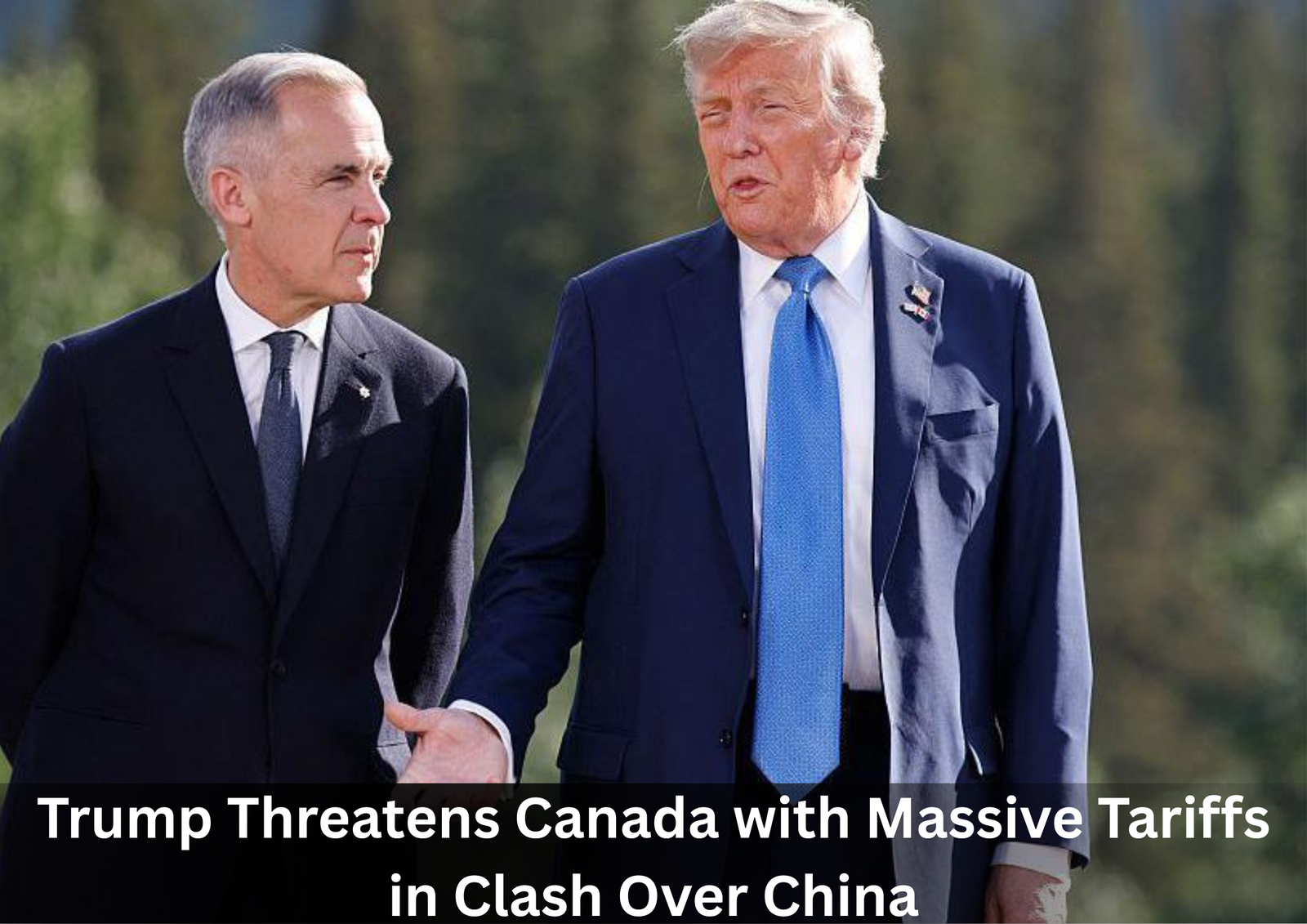
Speaking through social media statements on Saturday, Trump criticized Canadian Prime Minister Mark Carney’s recent engagement with Beijing, accusing Canada of opening the door for China to gain indirect access to U.S. markets. Trump argued that such arrangements would undermine American economic security and pledged swift retaliation if the situation moves forward.
The warning follows Carney’s visit to China earlier this month, where Canada and China agreed to ease select trade barriers. Officials in Ottawa described the agreement as limited in scope, focusing on reducing tariffs on certain agricultural exports and electric vehicles rather than establishing a comprehensive free trade pact. Canadian representatives also emphasized that U.S. officials were briefed in advance of the deal.
Tensions intensified after Carney’s remarks at the World Economic Forum in Davos, where he suggested the long-standing global economic order was undergoing a major shift. Without naming the United States directly, Carney criticized the increasing use of tariffs as political tools and urged mid-sized economies to cooperate more closely in response to global uncertainty. The comments were widely interpreted as a rebuke of Trump’s trade policies.
Trump responded forcefully during his own Davos appearance, asserting that Canada’s prosperity depends heavily on its relationship with the United States. He also claimed that U.S. defense initiatives, including proposed missile defense expansions, would indirectly protect Canada. Carney later rejected that characterization, stating that Canada’s strength comes from its own institutions and independence.
The dispute adds to already strained relations following disagreements over Arctic security and sovereignty. Trump’s renewed interest in Greenland and Arctic shipping routes has prompted Canada to accelerate infrastructure and defense planning in its northern regions, including ports, roads, and military-capable facilities designed to reinforce sovereignty claims.
Canadian officials have attempted to downplay the immediate impact of Trump’s statements. In a public address, Carney encouraged citizens to support domestic businesses and remain focused on economic resilience. Trade Minister Dominic LeBlanc clarified that Canada is not pursuing a broad free trade agreement with China and stressed that recent talks were limited to resolving specific tariff issues.
Business groups, however, have expressed growing concern. Industry leaders warn that a blanket tariff on Canadian exports would severely impact manufacturing, automotive production, agriculture, and supply chains deeply integrated with the U.S. economy. Analysts also note that Trump has previously issued aggressive tariff threats that were later delayed, modified, or dropped during negotiations.
While no formal trade action has been announced, the rhetoric underscores increasing uncertainty in North American economic relations. With the U.S.-Canada-Mexico trade agreement due for review later this year, observers say the coming months could prove critical for the future of cross-border commerce.
For now, markets and businesses are watching closely, as political statements continue to shape an already fragile global trade environment.
For deeper insight into escalating tensions, read “Russian Attacks Hit Multiple Ukrainian Regions as Civilian Casualties Rise Ahead of Global Talks” to understand what’s unfolding and why it matters now.