

The United States on Thursday outlined an expansive proposal to rebuild the Gaza Strip after years of conflict, unveiling a redevelopment vision that would dramatically reshape the territory’s economy, infrastructure, and coastline.
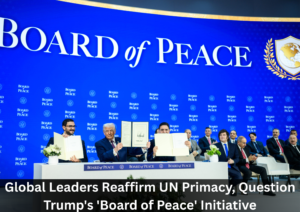
The proposal was introduced at the World Economic Forum in Davos during a ceremony linked to a newly formed international initiative called the “Board of Peace,” spearheaded by the U.S. President Donald Trump. The plan envisions transforming Gaza into a modern urban center featuring high-rise housing, industrial zones, transportation hubs, and tourism districts along the Mediterranean.
The initiative was presented by Jared Kushner, who played a role in facilitating the ceasefire that came into effect last October, ending more than two years of fighting between Israel and Hamas.
A Four-Phase Reconstruction Strategy
According to briefing materials shown at Davos, reconstruction would unfold in four stages, beginning in southern Gaza and gradually expanding northward. The first major project focuses on Rafah, where planners propose constructing more than 100,000 housing units, hundreds of schools, and dozens of medical facilities.
The broader vision includes a coastal development zone with dense commercial towers, new residential districts, green spaces, and industrial parks designed for technology, logistics, and advanced manufacturing. Plans also call for a seaport and airport near the Egyptian border, along with a shared border crossing involving Israel and Egypt.
Speaking at the event, Trump described the territory’s location as central to the project’s economic potential, emphasizing its access to the sea and regional trade routes.
Funding Questions and Security Conditions
While the scale of the proposal is unprecedented, key details remain unresolved-most notably how reconstruction would be financed. Kushner said further announcements on government funding are expected in Washington in the coming weeks, while private investors are being encouraged to participate once security conditions stabilize.
U.S. officials made clear that the plan is tied to the complete demilitarization of Hamas, which is outlined as a non-negotiable condition of the ceasefire framework. Oversight of the process would fall to a newly established Palestinian technocratic body tasked with administering Gaza during reconstruction.
Trump warned that failure to comply with disarmament commitments would derail the initiative entirely, stating that long-term investment depends on lasting security.
Political Sensitivities and Local Skepticism
The proposal largely bypasses existing Palestinian institutions, including the Palestinian Authority, which is mentioned only as a potential future governing body following internal reforms. The United Nations Relief and Works Agency, a key provider of services in Gaza, was not assigned a formal role in the redevelopment framework.
Reaction among Palestinians has been cautious to openly critical. Displaced residents and human rights advocates have questioned whether reconstruction can proceed while large portions of the population remain without stable housing, basic services, or guarantees over land ownership and compensation.
Ceasefire Strains Persist
The announcement came amid continued tensions on the ground. Gaza health officials reported multiple fatalities from Israeli military activity this week, while Israel has accused militant groups of violating ceasefire terms. Both sides maintain they remain committed to the October agreement, though its durability remains uncertain.
According to humanitarian agencies, nearly one million residents still lack adequate shelter, and food insecurity remains widespread across the territory.
A Broader Diplomatic Experiment
The Gaza proposal represents the first major undertaking of Trump’s “Board of Peace,” an international platform intended to mediate and oversee post-conflict transitions. More than 30 countries have signed onto the initiative, while several major European states have declined participation.
Trump said the board would coordinate with the United Nations where possible, framing the initiative as an alternative approach to stalled diplomatic mechanisms.
The conflict began after a Hamas-led attack on southern Israel in October 2023 that killed roughly 1,200 people. Israel’s subsequent military campaign has resulted in tens of thousands of deaths in Gaza, according to local health authorities.
Whether the proposed redevelopment plan can move from concept to reality will depend on security enforcement, international backing, and the trust of a population exhausted by years of war.
Don’t miss “Carney Pushes Back on Trump’s Davos Remarks, Calls for a Self-Directed Canadian Future”-read the full blog for deeper insights, context, and implications shaping Canada’s political direction.