


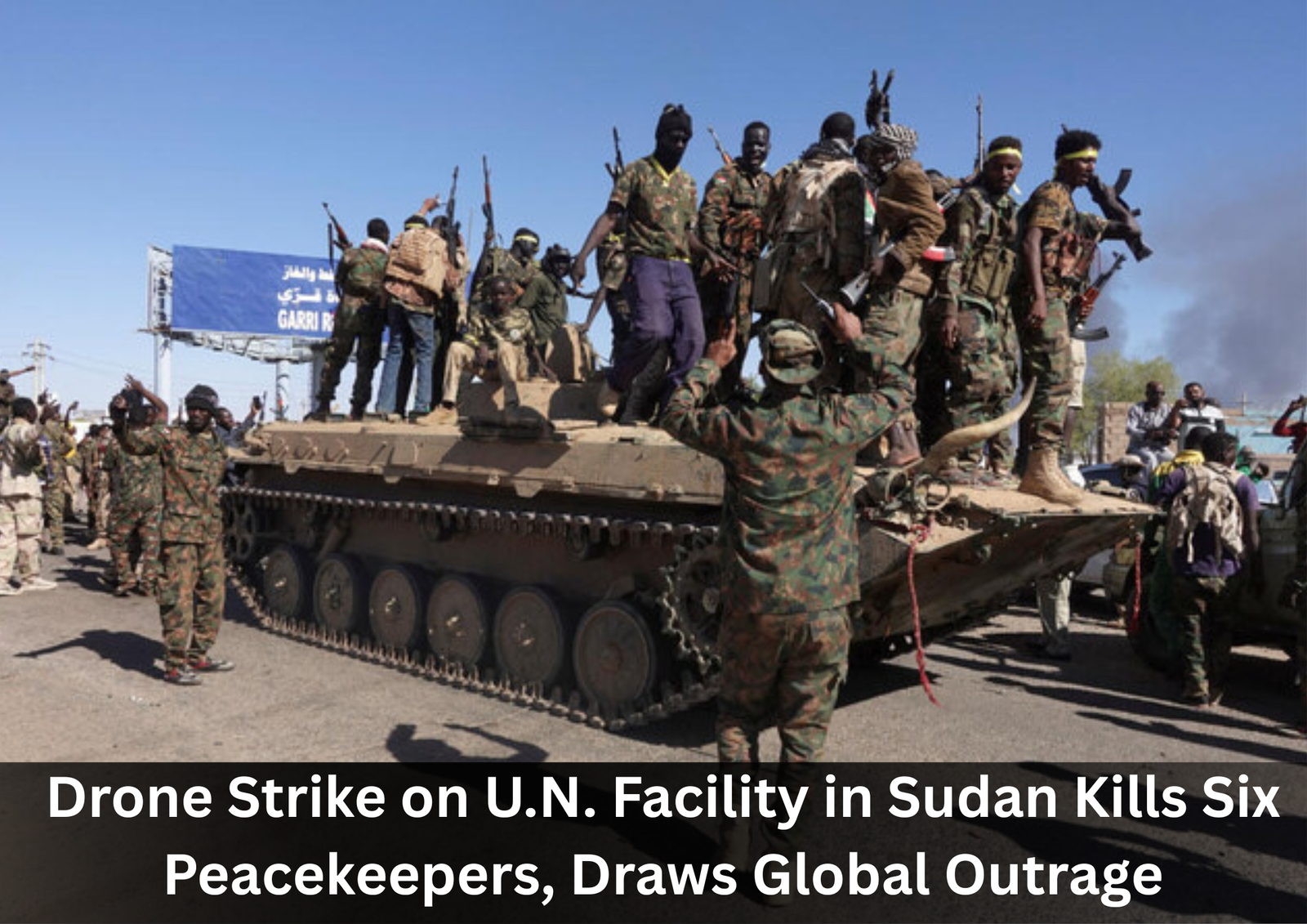
A deadly drone strike hit a United Nations peacekeeping facility in Sudan on Saturday, killing six peacekeepers and injuring eight others, in one of the most serious attacks on U.N. personnel since the country’s civil war began. All those killed were Bangladeshi nationals serving under the United Nations Interim Security Force for Abyei (UNISFA).
The attack occurred at a U.N. logistics base in Kadugli, a city in Sudan’s South Kordofan region that has increasingly become a flashpoint in the ongoing conflict between rival military forces. Witnesses reported thick smoke rising from the area shortly after the strike, underscoring the intensity of the blast.
U.N. Secretary-General António Guterres strongly denounced the incident, calling the targeting of peacekeepers “unacceptable” and warning that such attacks may amount to war crimes under international law. He stressed that U.N. personnel operate under international mandates designed to protect civilians and support stability, not to participate in hostilities.
Sudan’s national army quickly accused the Rapid Support Forces (RSF), a powerful paramilitary group, of carrying out the drone strike. The military described the attack as a deliberate act aimed at undermining international peacekeeping efforts. However, the RSF did not issue an immediate response, and the United Nations has not formally assigned responsibility for the attack.
Bangladesh, one of the world’s largest contributors to U.N. peacekeeping missions, expressed deep sorrow over the loss of its personnel. Interim leader Muhammad Yunus confirmed the casualties and pledged government support for the families of the fallen soldiers. He also urged the international community to ensure adequate protection and emergency assistance for peacekeepers operating in high-risk environments.
UNISFA was established in 2011 following South Sudan’s independence and is tasked with maintaining security in the disputed Abyei region, an oil-rich territory claimed by both Sudan and South Sudan. Although the mission’s primary focus is Abyei, logistical facilities and personnel are also positioned in nearby regions affected by broader instability.
The latest attack comes as Sudan’s civil war continues to devastate the country. Fighting erupted in April 2023 after a power struggle between the national military and the RSF escalated into widespread violence. Since then, tens of thousands of people have been killed, and millions have been displaced. Human rights organizations report that the true death toll may be far higher than official estimates.
The conflict has been marked by severe human rights violations, including mass displacement, sexual violence, and ethnically driven attacks, particularly in western regions such as Darfur. The United Nations has repeatedly warned that some actions by warring parties could constitute war crimes or crimes against humanity.
Beyond the security crisis, Sudan is facing what aid agencies describe as the world’s most severe humanitarian emergency. Large parts of the population are experiencing food shortages, with famine conditions reported in several areas.
The drone strike occurred just weeks after the U.N. Security Council renewed UNISFA’s mandate for another year, reaffirming its role in protecting civilians and preventing cross-border conflict. The mission currently includes around 4,000 military and police personnel.
Secretary-General Guterres renewed his call for an immediate ceasefire, emphasizing that only a Sudanese-led political process can bring lasting peace. As investigations into the attack continue, the incident highlights the growing dangers faced by peacekeepers operating amid modern warfare and unchecked conflict.


