
The European Union is entering a critical final phase in its long-running efforts to seal a sweeping trade agreement with the South American Mercosur bloc, with the European Commission pushing for a formal signing before the end of the year. However, strong resistance from several member states-most notably France-continues to cast uncertainty over the deal’s future, while Italy’s still-undeclared position may ultimately decide its fate.
EU officials argue that the agreement is strategically essential at a moment of shifting global trade alliances. Brussels believes the pact would strengthen Europe’s economic and geopolitical standing, particularly as competition intensifies from the United States and China in Latin America. The proposed agreement would deepen trade ties with Argentina, Brazil, Paraguay, and Uruguay, forming one of the world’s largest free-trade areas, covering nearly 700 million consumers.
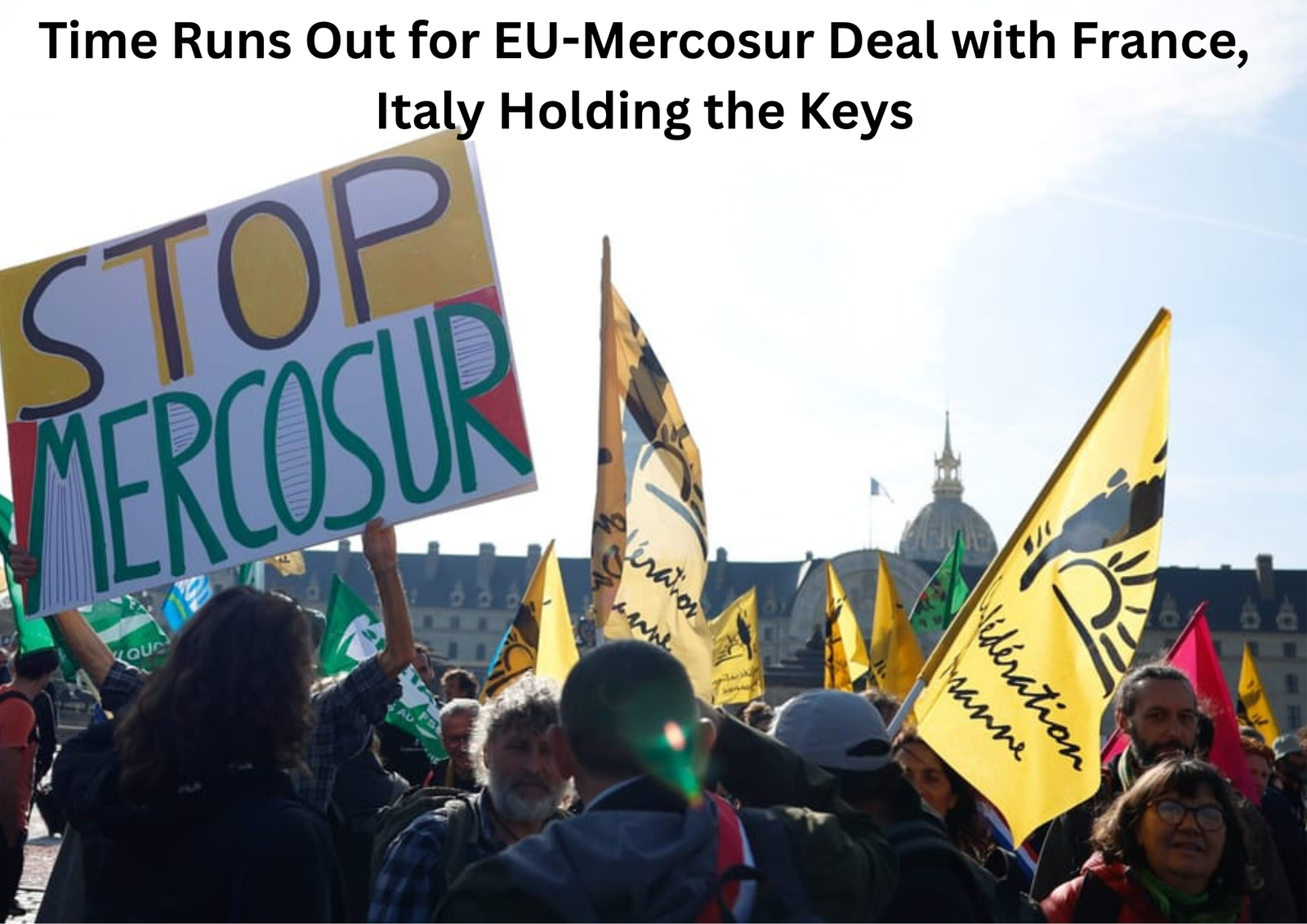
Despite political negotiations concluding in 2024 after more than two decades of talks, ratification remains far from assured. France has taken the lead among critics, citing strong domestic opposition from its agricultural sector. French farmers fear that increased imports of beef, poultry, and other agricultural goods from South America could undercut EU producers who must comply with stricter environmental and food safety standards.
French officials have made it clear that, without stronger guarantees, Paris is unwilling to approve the agreement. Their demands include enforceable safeguards to halt tariff reductions if imports destabilize EU markets, binding commitments to ensure comparable production standards, and tighter sanitary controls on incoming goods. For now, the French government insists the conditions are not right for a formal vote within the EU Council.
In response, the European Commission has advanced a safeguard mechanism designed to monitor imports more closely and allow rapid intervention if market disruption occurs. This proposal has gained backing from member states and is scheduled for a vote in the European Parliament. Some lawmakers are pushing to strengthen the clause by adding stricter reciprocity requirements, though supporters warn that overly rigid conditions could derail the entire agreement.
While France anchors the opposition, the arithmetic of EU voting rules means that Italy’s stance could prove decisive. To block the deal, a coalition of at least four countries representing 35 percent of the EU population is required. France is currently joined by Poland, Hungary, and Austria, while Belgium plans to abstain and several others have yet to commit.
Italy, one of the EU’s largest exporters to Mercosur countries, has so far avoided taking a clear public position. The government in Rome faces competing pressures: industrial exporters and producers of goods such as wine and cheese generally favor the deal, while major farming groups remain firmly opposed. Italy’s largest agricultural association has warned that the proposed safeguards may not activate quickly enough to prevent damage from sudden import surges.
Proponents of the agreement, including Germany and Spain, argue that delay or failure would weaken the EU’s credibility as a global trading power. They contend that access to fast-growing South American markets is increasingly important as Europe’s trade environment becomes more competitive.
As EU leaders weigh economic opportunity against domestic political risk, the coming days are expected to be decisive. With a planned high-level summit in Brazil approaching, Brussels is under mounting pressure to secure enough support to move forward-yet deep divisions within the bloc suggest that the outcome remains far from certain.