
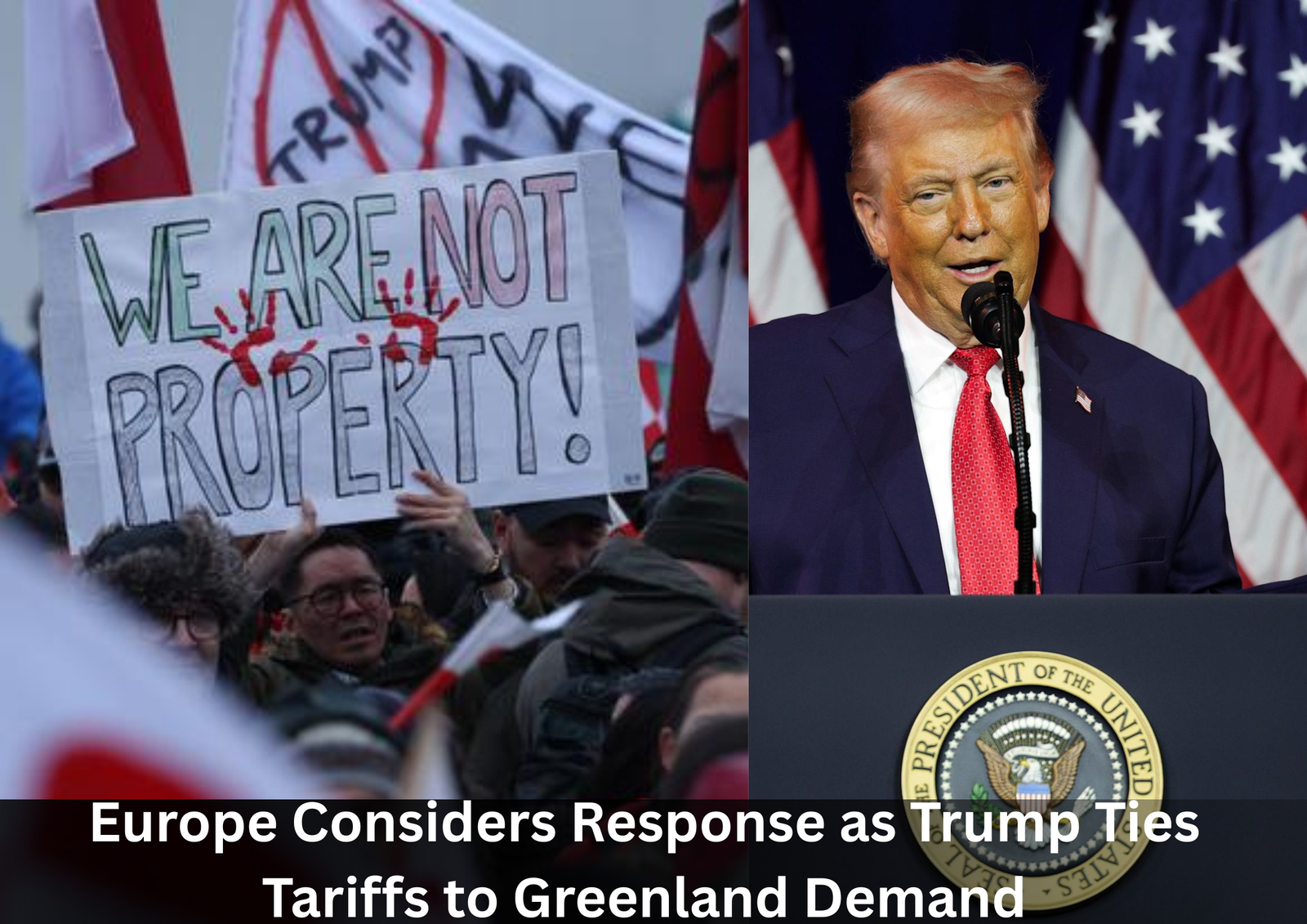
European leaders entered emergency consultations this weekend after the U.S. President Donald Trump signaled he would move forward with new tariffs on several European economies unless a negotiated agreement allowed Washington to acquire Greenland, the autonomous Arctic territory governed by Denmark.
Trump made the proposal in a social media post on Saturday, insisting that Greenland’s strategic value justified U.S. ownership and warning that tariffs would begin at 10% in February before rising to 25% by summer if European nations refused to discuss a sale. The Washington Post reported that the pressure campaign was aimed at eight countries, though U.S. officials did not publicly confirm the list.
EU ambassadors convened in Brussels less than 24 hours later to coordinate their response. Early discussions leaned toward diplomatic engagement, though senior diplomats acknowledged that economic retaliation is on the table if the talks collapse. One option under review involves activating a previously drafted package of retaliatory tariffs worth an estimated €93 billion, prepared during a prior transatlantic trade dispute.
A more aggressive instrument – informally described by EU officials as a “coercion shield” – would allow the bloc to target large U.S. technology and service firms operating within Europe. Although the tool has never been deployed, officials familiar with the negotiations said it remains part of contingency planning should the crisis escalate.
European Council President António Costa confirmed he is preparing to convene heads of government for an extraordinary summit later this week, potentially aligning with preparations for next week’s World Economic Forum in Davos, where European leaders and Trump are expected to attend.
The president’s team appeared unmoved by the backlash. In an interview on NBC, Treasury Secretary Scott Bessent defended the proposal, asserting that U.S. oversight of Greenland would ultimately benefit all parties and predicting European leaders would “reassess” their objections in the coming months.
Major European powers delivered coordinated pushback. A joint statement signed by Britain, France, Germany and Denmark – later endorsed by Iceland, Latvia, and Lithuania – criticized Trump’s approach as destabilizing and pledged collective support for Greenland’s current political status. Leaders also signaled that Greenland’s residents must remain free from external pressure regarding their territorial future.
Several prime ministers spoke directly with Trump on Sunday, expressing disagreement over both the proposal and the tariff strategy. British Prime Minister Keir Starmer warned that penalizing NATO partners risked undermining shared security priorities, while Italian Premier Giorgia Meloni labeled the tariff threat “counterproductive.” NATO Secretary-General Mark Rutte acknowledged discussions took place but did not comment on policy specifics.
The latest dispute reignited a broader debate inside the EU about the future of U.S.-European relations. Critics note that opinion polls throughout the continent show declining public confidence in Washington’s reliability as a strategic ally. Brando Benifei, chair of the European Parliament delegation for relations with the United States, remarked that many Europeans view Trump’s newest ultimatum as crossing “a significant political threshold.”
In the United States, separate domestic controversies added further tensions to the political landscape. Homeland Security Secretary Kristi Noem faced mounting scrutiny following immigration protests in Minneapolis, where demonstrators accused federal agents of violating a court injunction restricting the use of chemical irritants. Although Noem initially denied the agents used such tactics, video evidence prompted her to adjust her explanation, arguing that any actions taken were responses to “violent behavior.”
The injunction in question was issued by Federal District Court Judge Kate M. Menendez, who cited repeated instances of chemical agents being deployed against nonviolent demonstrators during previous protest events. The ruling stemmed from litigation that began before an Immigration and Customs Enforcement agent fatally shot an unarmed U.S. citizen, Renee Good, on January 7. That incident has since triggered protest actions across Minneapolis and new calls for federal transparency.
Amid the unrest, musician Bruce Springsteen criticized the administration’s immigration stance during a surprise concert in New Jersey, telling the audience that national ideals were being put to a profound test. He dedicated a song in memory of Good.
Deputy Attorney General Todd Blanche later defended the Justice Department’s decision not to open a separate investigation into the shooting, contending that doing so due to public pressure would set a problematic precedent.
Don’t miss this powerful post: Katie Bates Faces Miscarriage and Marital Turmoil After Husband Confesses to Affair. Read the full story on my blog.